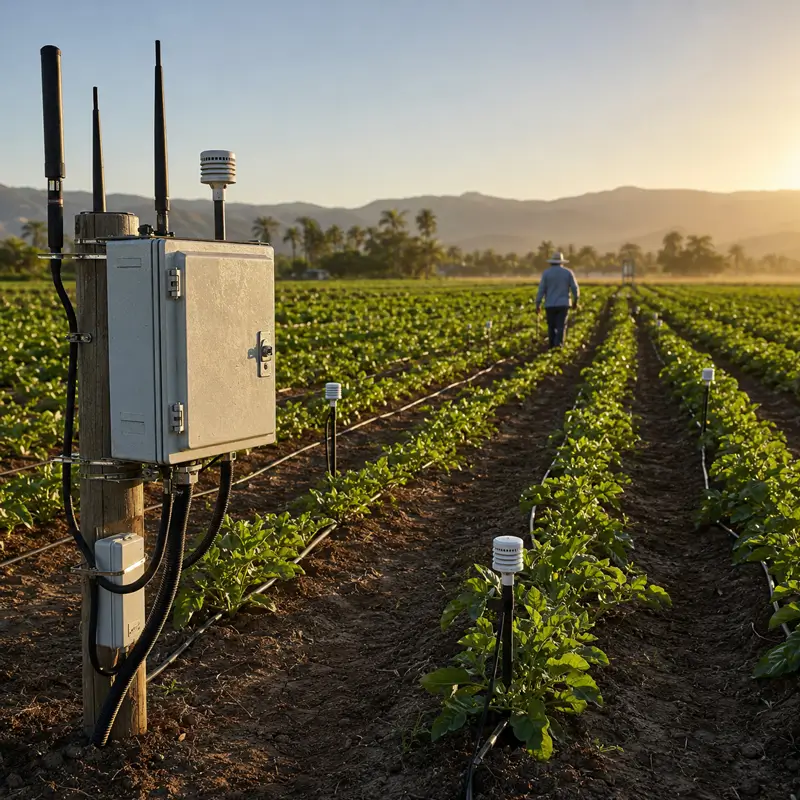
Federated Learning for Farm Sensor Data Security
Federated Learning in Farm Sensor Networks; Training AI Without Transferring Farmers’ Raw Data
A digital farm is not just a collection of soil sensors, weather stations, field cameras, and connected machinery; behind every data point lies a decision about water, inputs, plant disease, crop yield, and the farmer’s economic risk. When raw farm data is transferred to a central location, its analytical value increases, but at the same time, difficult questions arise around data ownership, privacy, security, trust, and the farmer’s economic benefit. Federated learning is a technical response to this tension because it seeks to train a shared model from the data experience of multiple farms without centrally moving farmers’ raw data.
The importance of this architecture becomes clearer when we view the farm as a low-bandwidth, heterogeneous environment where decision errors can be costly. Each farm has different soil, climate, crop varieties, irrigation schedules, and sensor quality, and these differences mean that simple centralized training and transferring all data to one central point is not always the lowest-risk path. Instead of centralizing data, federated learning proposes centralizing the model; in other words, the device, edge gateway, or local organization trains on its own data and sends only the model update for aggregation. In this model, the value of the data remains on the farm, while artificial intelligence learns from distributed agricultural patterns.
– Brendan McMahan and colleagues, researchers at Google Research and authors of the FedAvg paper: “We propose an alternative that keeps training data on devices and learns a shared model from local updates.”
Why Does Federated Learning Matter Economically for Farm Sensor Data?
Farm data, unlike many types of public data, is directly tied to the farmer’s economic assets. Soil moisture, irrigation timing, disease symptoms, input quality, crop yield, and even management mistakes can together create a picture of a farm’s operational condition and financial capacity. If this data is collected without a clear mechanism for ownership and access, the farmer may view the smart system not as a decision-support tool, but as an instrument of external surveillance. For this reason, federated learning architecture is not merely a computational choice; it can become part of the trust contract between technology and the farmer.
The main economic advantage of federated learning begins with reducing the transfer of raw data, but it does not end there. In the FedAvg paper, a 10- to 100-fold reduction in the number of communication rounds compared with synchronized SGD was reported, and this metric has practical importance for farms that do not have access to stable and affordable bandwidth. This figure does not directly represent financial savings, because the real cost of running the network, edge gateway, security, and maintenance depends on project conditions. Still, this reduction in communication rounds shows that algorithm design can be aligned from the outset with the farm’s communication constraints.
In agriculture, data is usually not identically distributed, and this characteristic simultaneously increases both the value and the difficulty of federated learning. A disease-detection model trained in a humid climate, on a specific soil type and crop variety, will not necessarily perform the same way on a dry farm with different soil and another irrigation pattern. A specialized review of federated learning in agriculture identifies data heterogeneity, communication constraints, limited processing capacity in rural areas, data ownership, fairness, and stakeholder trust as key barriers in this path. Therefore, the economics of federated learning on farms does not depend only on reducing data movement; it also depends on designing the right clusters, choosing the right model, and establishing a clear agreement among the actors involved.
– Peter Kairouz, Brendan McMahan, Brendan Avent, and colleagues, authors of the Foundations and Trends in Machine Learning review: “Federated learning implements the principles of focused data collection and data minimization in the training of shared models.”
Federated Learning Architecture on the Farm, from Sensor to Edge Gateway
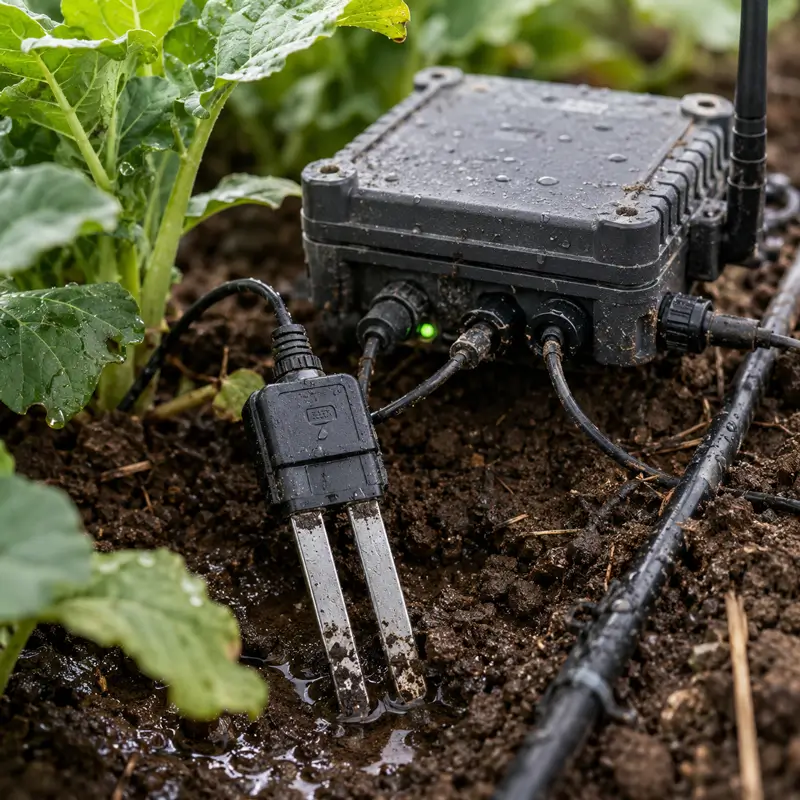
In a farm sensor network, the federated learning client is usually not the low-power sensor itself. A soil moisture, temperature, salinity, water-flow, or field-imaging sensor often lacks the processing capacity needed to locally train complex models, and its role is to generate raw observations. The operational client can be the farm’s edge gateway, local processing box, drone, field station, agronomist’s phone, or cooperative server; the place where sensor data is collected and where local model training becomes possible. This distinction prevents exaggerated claims about the intelligence of the sensor itself and pushes the architecture toward a more realistic system design.
– The Role of the Edge Gateway in Local Training
The operational cycle of federated learning on a farm can be divided into several clear steps. First, the base model is prepared for the clients; then each edge gateway trains on its own local data; next, parameters or gradients are sent for aggregation; and finally, the updated global model is returned to the clients. The Scientific Reports paper on plant disease detection explains the same logic through the stages of initialization, local training, parameter transfer, aggregation, and global model transfer or evaluation. On a real farm, the quality of this cycle depends on communication stability, the consistency of sensor data, local processing capacity, and the security of the model-exchange pathway.
Data standards also play a hidden but decisive role in this architecture. If each sensor, machine, and farm management system produces data in a separate structure, the federated model will stall at the data-compatibility stage before it even reaches the artificial intelligence problem. ISO 11783 covers the data communication network in tractors and machinery for agriculture and forestry, including data transfer among sensors, actuators, controls, storage units, and displays, which makes it important for the connected machinery ecosystem. This standard does not define federated learning, but it shows that without a shared data language, shared model training will also be fragile.
– The Risk of Heterogeneous Data Across Farms
Data heterogeneity in federated learning is highly natural in agriculture and should not be treated as an exceptional error. Farms differ in climate, soil type, seed variety, irrigation schedule, dominant diseases, sensor quality, and data-recording discipline, and these differences make client data non-IID. Based on the literature by Kairouz and colleagues, the research file identifies data heterogeneity as one of the core challenges in federated learning, while the Scientific Reports study also shows that increasing the number of clients does not always improve performance. When the number of clients increases but the local data available to each client decreases, the model may become weaker in terms of local learning, and the final result may decline.
Communication Cost and Model Security in Federated Agricultural Training
Federated learning reduces the transfer of raw data, but it does not automatically solve security. Model updates can carry statistical information or sensitive patterns, which means that a federated architecture without complementary security is not sufficient for agricultural data. The Secure Aggregation protocol introduced by Bonawitz and colleagues is important precisely at this sensitive point because its goal is to securely aggregate large vectors and reduce the risk of exposing individual updates. In a farm network, this issue becomes especially serious when several farmers, cooperatives, or local organizations participate in a shared model.
– Keith Bonawitz, Vladimir Ivanov, Ben Kreuter, Antonio Marcedone, Brendan McMahan, and colleagues, researchers at Google Research and authors of the Secure Aggregation paper: “This protocol designs secure aggregation that keeps training resilient even if one-third of users fail.”
Security has a technical cost here, and that cost must be included in the operating model from the beginning. Bonawitz and colleagues reported that Secure Aggregation can tolerate the failure of up to one-third of users, but it creates a 1.73-fold communication expansion for vectors of dimension 220 with 210 users, and a 1.98-fold expansion for vectors of dimension 224 with 214 users. These figures do not represent direct financial cost, but they matter for bandwidth design, training time, edge-gateway energy consumption, and system maintenance planning. A federated architecture is economically defensible only when the cost of security is considered alongside communication and processing costs.
Security risk is not limited to information leakage; model-poisoning attacks are also important for collaborative networks. If a compromised client injects malicious data or updates into the process, the global model can be pushed toward incorrect decisions, and in agriculture, this kind of error may lead to inaccurate disease detection or faulty management recommendations. The NIST Cybersecurity Framework 2.0, published in 2024, can be used to manage, assess, prioritize, and communicate cybersecurity risks, and it is important for farm gateways and aggregation servers. This framework should be considered alongside model-accuracy metrics because an accurate but insecure model cannot be trusted for agricultural decision-making.
Research Evidence from Plant Disease Detection in the MERIAVINO Project
The strongest agricultural evidence in the research file does not come from large-scale commercial deployment on real farms, but from a peer-reviewed Scientific Reports study on plant disease detection using federated learning. This study was conducted with the participation of INSA Centre Val de Loire, the University of Orleans, PRISME Laboratory, and LIFO Laboratory within the framework of MERIAVINO and ERA-NET Cofund ICT-AGRI-FOOD. Its funding was reported from public and European sources, including national contributions from ANR France, UEFISCDI Romania, and GSRI Greece, as well as Horizon 2020 co-funding under Grant Agreement 862665. Therefore, this case study is useful for demonstrating the research potential of the technology, not for claiming the existence of a mature operational market.
This study worked with the PlantVillage image dataset and examined scenarios with 3, 5, and 7 clients, alongside 10, 30, 50, and 100 communication rounds and 1 and 5 local epochs. In some configurations, the ResNet50 model reached an accuracy and F1 score of 99.76 percent, and in the communication-round analysis, it achieved peak performance of 99.59 percent in both F1 score and accuracy at 30 rounds. These figures are important for showing algorithmic potential, but they should not be interpreted to mean that every farm sensor network will achieve the same performance under real-world conditions. The difference between an image dataset, simulated clients, and an operational farm must be preserved in both technical decisions and investment decisions.
– Denys Mamba Kabala, Adel Hafiane, Laurent Bobelin, and Raphael Canals, researchers at INSA Centre Val de Loire and the University of Orleans: “Agricultural data distributed across multiple devices creates privacy and security challenges.”
The more important message of this case study is not only the high accuracy of ResNet50, but also the system’s behavior in relation to the number of clients and communication rounds. The study showed that increasing the number of clients does not necessarily improve performance in some models, because as the number of clients increases, the local data available to each client decreases, and the model may become poorer in terms of local learning. For Iran, this point means that logical clusters must be designed based on crop, climate, data quality, and model objective, rather than simply increasing the number of participants. A federated model for agriculture is defensible only when the division of clients is compatible with the biological and managerial realities of the farm.
Agricultural Data Governance Between GDPR and the EU Data Act
In Europe, the discussion of federated learning for agriculture cannot be separated from data regulation. Article 5 of the GDPR concerns principles such as data minimization, purpose limitation, and data accuracy, while Article 25 emphasizes data protection by design and by default. Article 32 also addresses the security of processing, which for a federated agricultural system means that communication encryption, gateway access control, secure aggregation, event logging, key management, and hardening against attacks must be part of the initial design. Federated learning can align with minimizing the transfer of raw data, but it is not a substitute for legal assessment, documentation, and model security.
The EU Data Act has applied since September 12, 2025, and creates a clearer framework for access to and use of data from connected products. In connected agriculture, this issue is directly relevant to sensors, tractors, implements, farm management platforms, and data analytics services, because data generated by a connected product can have economic value for both the farmer and the technology provider. If a federated model is trained on such data, the issue is not only that raw data is not transferred; the issue is that access rights, usage rights, maintenance responsibilities, and the boundaries of data exploitation must be clear. Within this framework, federated learning should be seen as a technical architecture alongside data governance.
– European Commission, the official publisher of the EU Data Act: “The European Data Act creates legal clarity around access to and use of data.”
For organizations that intend to develop or deploy federated agricultural systems, NIST frameworks can serve as complementary management tools. The NIST Privacy Framework 1.0, published in 2020, provides a voluntary tool for managing privacy risk in products and services, and it is useful for platforms that process farm data and, in some cases, data that can be linked to the farmer. NIST AI RMF 1.0 also approaches the issue from the perspective of artificial intelligence risk, focusing on validity, security, resilience, transparency, and fairness. These frameworks are not agriculture-specific regulations, but they provide a shared management language for turning a research model into an auditable service.
A Cautious Localization Path for Farm Sensor Networks in Iran
In Iran, the starting point for discussing federated learning should not be a claim of widespread deployment, but real and measurable problems. Water stress, climatic heterogeneity, and major differences among farming systems make applications related to irrigation, plant stress, disease detection, and sensor data quality attractive. For the 2004 data year, FAO reported Iran’s total water withdrawal at about 93.3 cubic kilometers, with agriculture accounting for about 92 percent; in the same dataset, groundwater depletion was reported at about 3.8 cubic kilometers per year. The age of these figures must be preserved in the analysis, but the World Bank’s 2022 report also stated that agriculture accounts for more than 90 percent of Iran’s water withdrawals, compared with a global average of about 70 percent.
In such a context, localizing federated learning is best started with limited, crop-specific, and region-specific pilots. A carefully designed pilot can select a few farms or several same-climate clusters instead of pursuing broad coverage, monitor sensor quality, keep data on the edge gateway, and send only model updates for aggregation. The goal of such a pilot should not be to promote the technology, but to measure model performance, communication cost, gateway stability, model behavior under heterogeneous data, and farmers’ level of trust. If the pilot output is connected to irrigation recommendations or disease detection, the error metric must be evaluated against the real consequences of the farmer’s decision.
Iran’s main risk along this path is the combination of data heterogeneity, weak standardization, and limited communication infrastructure. A sensor network that produces data in incompatible formats, at irregular intervals, or with low accuracy will not create a reliable model even with the best federated algorithm. On the other hand, if responsibility for gateway security, model maintenance, and access management is unclear, the farmer will face a system that asks for data but does not adequately explain its benefits and risks. Therefore, Iran’s implementation path should begin with data design, participation agreements, edge security, and selection of a limited use case, and only then expand to broader networks.
Investment Decisions in Agricultural Federated Learning Without Technological Exaggeration
For an investor or technology holding company, federated learning in agriculture is an attractive opportunity, but only when the boundary between research evidence and practical deployment is respected. Financial decisions should not be built around definitive promises of cost savings, reduced water consumption, or higher crop yields unless the same application has been field-tested. The reliable data in the current file mostly concerns technical metrics such as reduced communication rounds, model accuracy in laboratory settings, secure aggregation overhead, and qualitative implementation barriers. This is enough for decision-making, provided the project is defined in a phased, auditable way and limited to a specific use case.
The investment value in this field emerges when the federated architecture is connected to a specific decision-support service. Plant disease detection, irrigation recommendations, sensor network health monitoring, and farm risk analysis can all be practical pathways, but each one has different data, models, error metrics, and responsibilities. A lighter model may be more practical on a low-bandwidth farm than a more complex model with higher laboratory accuracy, because computation time, energy consumption, and communication stability are also part of real-world performance. Within this framework, security and secure aggregation should be treated as necessary costs of trust, not as optional features added after product development.
The strategic conclusion for Iran is clear: federated learning can support smart agriculture when it is accompanied by a specific problem, reliable data, edge architecture, data governance, and independent evaluation. This technology is not a substitute for improving sensor quality, standardizing data, strengthening cybersecurity, training operators, or creating transparent agreements with farmers. Its main advantage is that it combines collective learning with reduced movement of raw data, creating a balance between AI innovation and the economic sensitivity of farm data. For Vestra and similar players, the logical path begins with a small, measurable, trust-based pilot and then moves toward scalable digital agriculture services.