Offshore Cage Power and Operational Resilience

Subsea Power and Communications Infrastructure in Offshore Marine Cages
An offshore marine cage is not merely a floating structure for holding fish. When the farming site moves away from the natural shelter of the coast, power, data, sensors, cables, feeding systems, mooring, and inspection become a single operational chain. In such an environment, a power outage does not simply mean that a few pieces of equipment shut down; it can simultaneously disrupt feeding, oxygen monitoring, communication with the control room, environmental event logging, and safety response. For this reason, subsea power and communications infrastructure must be treated as part of the production core, not as an add-on beside the cage.
Offshore aquaculture sits at the intersection of the food industry, marine engineering, and the blue economy. The industry can scale only when a farm is able to withstand waves, currents, wind, corrosion, distance from shore, and the difficulty of maintenance. Examples such as Ocean Farm 1 in Norway show that modern cages have moved away from the logic of lightweight coastal cages and toward structures designed for exposed operation. At this scale, subsea cables, data links, and environmental sensors take on the same role that critical systems play on an offshore platform.
The importance of this issue is not only technical; it is also tied to food security, investment, and the scalability of the aquaculture value chain. If a large cage cannot be continuously monitored, the investor faces biological risk, environmental risk, operational downtime risk, and compliance risk. If the power and data architecture is not designed from the outset for redundancy, maintenance, and documentation, scalability becomes a source of cost and vulnerability instead of reducing costs. Therefore, the central question in offshore aquaculture is not how many smart devices have been installed on the cage, but how all of these systems keep production controllable and auditable under real marine conditions.
Why Have Subsea Power and Communications Become the Operational Core of Offshore Cages?
The operational definition of subsea power and communications infrastructure in offshore marine cages includes power transmission from the coastal grid, local generation or generators, power distribution across the structure, subsea cables, data links, biological and environmental sensors, cameras, feeding systems, control, and maintenance in a corrosive marine environment. This definition can be derived from examples such as Ocean Farm 1, Havfarm 1, Guoneng Sharing, and Guoxin 1 2-1, and it shows that the issue is not limited to energy transmission. In practice, power and data must simultaneously support feeding cycles, oxygen monitoring, fault detection, event logging, and environmental impact control. The farther the cage is from shore, the more dependent production becomes on this hidden network.
– Olav Andreas Ervik, then CEO of SalMar Ocean: “Applying offshore and maritime expertise in a new field creates new possibilities for open-ocean aquaculture.”
Ocean Farm 1 is a clear example of this transfer of marine expertise into aquaculture. With a height of 69 meters, a diameter of 110 meters, and a volume of 250,000 cubic meters, the structure was designed at a scale that no longer resembles conventional coastal cages. The project was certified based on DNV rules for offshore fish farming and compliance with NYTEK, and DNV described it as the first salmon farm designed for operation in exposed locations. These dimensions and this certification approach send a clear technical message: in such a project, power infrastructure, cables, sensors, and maintenance must be designed according to offshore logic.
In an offshore environment, distance from shore increases the importance of preventive design. Repairing a connection, replacing a sensor, or resolving a communications fault is no longer a simple routine task near the coast; it depends on an operational plan, sea conditions, a service vessel, and safety coordination. This characteristic means that operational resilience goes beyond simply having backup power. It means the system must be able to continue monitoring, recording data, carrying out controlled feeding, reporting, and enabling inspection. An offshore cage is reliable only when data and power have been stabilized in its design before a disruption occurs.
Cable, Sensor, and Backup Power Architecture in Large-Scale Marine Cages
– Grid Connection and Backup Generator in Havfarm 1
The Jostein Albert project, or Havfarm 1, in Norway explains the engineering scale of offshore cages in numerical terms. DNV reported a capacity of 10,000 tons of salmon, around 2 million fish, a length of 385 meters, and six nets measuring 47 by 47 meters for this structure. Nordlaks’ technical page also mentions a width of 59.5 meters, six farming units each with a volume of 69,000 cubic meters, connection to the main power grid, and the use of a backup generator during power outages. This combination presents one of the few direct examples of operational power architecture in an offshore cage and makes it clear that stable power is a condition for biological scalability.
– Ivar Nygaard, Senior Project Manager at SINTEF Ocean: “The Nordlaks project was the largest aquaculture project SINTEF Ocean had undertaken up to that point.”
The importance of Havfarm 1 lies not only in the size of the structure, but also in the fact that power, mooring, feeding, inspection, and escape prevention are integrated within a single operational architecture. DNV has stated that periodic inspections for Havfarm 1 cover both the condition of marine systems and the specialized functions related to preventing fish escape, fish health, and the environment. This framework shows that cables and sensors should not be treated merely as installed equipment, but as part of the quality assurance, reporting, and compliance cycle. In a cage that holds millions of fish in an offshore environment, any electrical or communications failure can turn into an operational and biological disruption.
– Mooring and Structural Movement in Cable and Data Link Design
Subsea cable design for offshore cages cannot be completed without understanding the mooring system. For Jostein Albert, Nordlaks reports 11 anchors weighing 22 tons each, holding power of 300 to 450 tons per anchor, a distance of approximately 650 meters from the anchors to the center of the site, and a movement radius of 450 meters from the site center. These figures show that cables and data links must be compatible with structural movement, tension, anchor routes, and the possibility of position shifts under marine conditions. When the cage moves within a wide area, cable routing, connection points, mechanical protection, and inspectability become part of safety design.
In China, the Guoneng Sharing project demonstrates another dimension of energy and marine cage architecture. This platform combines a 4-megawatt floating wind turbine with a smart aquaculture cage designed for 50,000 marine fish, and the project owner reported turbine reliability of more than 95 percent and 120 hours of continuous full-capacity generation after commissioning. The value of this example lies in the fact that it co-locates power generation and fish farming on a single platform and highlights the issue of load coupling among energy, structure, net, and mooring. However, its figures should be read as data published by the project owner, not as independent metrics of cost or durability across all components.
Monitoring Oxygen, Current, and Feed in Biological Management of Marine Cages
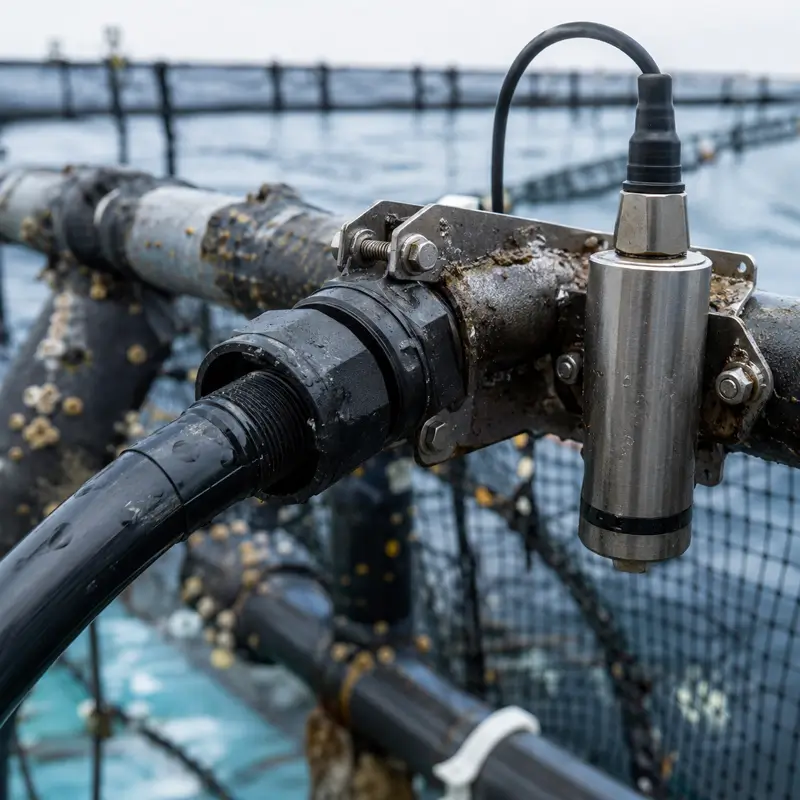
In offshore aquaculture, a sensor is not merely a data collection tool; it is the operational language of the farm. Data on current speed, oxygen level, temperature, and feed volume form the minimum information package needed to understand biological conditions and feeding performance. In China’s smart vessel Guoxin 1 2-1, more than 200 cameras and 2,000 sensors form the production monitoring network, while the monitoring room displays data on current, oxygen, temperature, and feed volume. This is not a fixed offshore cage, but it is important for understanding the level of automation, communications, and data-driven decision-making in industrial aquaculture.
– Dick Jones, CEO of Blue Ocean Mariculture: “Water quality is everything, and it is not limited to fish health and welfare.”
Blue Ocean Mariculture in Hawaii offers a practical example of turning water quality into an operational issue. NOAA reports that this farm monitors dissolved oxygen around the cages and examines upwelling and downwelling currents at different depths in a laboratory setting. According to the company’s report as described by NOAA, no impact was identified on the seafloor beneath cages located about 200 feet, or approximately 61 meters, above the seabed. The distinction between monitoring that has been carried out and the company’s claim is important, because sensor infrastructure must serve both daily management and environmental verification.
– Sun Linlin, Production Manager responsible for Guoxin 1 2-1: “Although the tanks are enclosed, the water circulates continuously and the environmental quality is maintained.”
Market standards also turn monitoring from a management choice into a measurable requirement. In the ASC Tropical Marine Finfish Standard, the weekly average dissolved oxygen saturation at the farm is set at a minimum of 70 percent, and the maximum share of weekly samples below 2 mg/L is listed as 5 percent. This type of metric shows that dissolved oxygen sensors, calibration, data logging, and reviewability are directly linked to certification and market acceptance. When dissolved oxygen becomes a compliance metric, cable quality, communications stability, and data accuracy also acquire economic value.
The data from Guoxin 1 2-1 on more than 90 percent mechanization, a 45 percent increase in automation compared with the previous generation, 30 percent decision-making by the smart system, and a 20 percent reduction in labor costs show that sensors and communications can affect the economics of operations. These figures were reported by state media and should be read with caution regarding the source, but their technical logic is consistent with industrial experience. The more observation, feeding, and monitoring move toward data-driven systems, the less operations depend on continuous human presence at sea. This reduction is sustainable only when the sensor and communications network itself is resilient.
Offshore Aquaculture Standards and the Safety Boundary Between Cage Systems and Electrical Installations
For scalability, an offshore cage needs standards that connect structure, mooring, inspection, biological function, and technical installations. NS 9415, which applies to floating aquaculture farms, covers requirements for design, execution, materials, component interaction, site surveys, load verification, main components, additional equipment, and the user manual, including inspection and maintenance. NYTEK23 was also adopted in Norway to prevent fish escape from aquaculture installations in the sea, lakes, and rivers by ensuring satisfactory technical standards. These two frameworks show that cage safety is the result of design and continuous control.
However, NS 9415 does not include electrical installations within its scope, and this boundary is highly important for the design of smart cages. A farm that relies on subsea cables, oxygen sensors, cameras, data networks, automated feeding, and backup generators cannot derive its safety solely from cage and mooring standards. DNV rules for offshore aquaculture units and installations were cited as the basis for the certification of Ocean Farm 1, and the notation related to offshore fish farming installation and POSMOOR was also included within that framework. The practical conclusion is that design must simultaneously account for aquaculture regulations as well as the logic of electrical systems, marine conditions, and communications.
The FAO guidelines for sustainable aquaculture also clarify the policy-level significance of the issue. These guidelines have been introduced as the first dedicated international instrument for sustainable aquaculture and were developed through consensus and an eight-year global consultation process. Within such a framework, environmental monitoring, fish health, water quality, and operational accountability are not merely internal concerns for the operator; they are connected to food security governance and the blue economy. For offshore cages, this means that every decision about cables, sensors, and communications must be evaluated simultaneously from the perspectives of production, environment, certification, and investor confidence.
The ASC Farm Standard also shows that certified markets are moving toward more detailed operational rules. This standard accepts audit announcements as of August 1, 2025, and becomes mandatory for all audit announcements as of May 1, 2027. Such changes increase the importance of recorded data, audit readiness, and the ability to demonstrate the farm’s actual performance. In practice, the cage’s communications infrastructure must be able to provide a reliable history of environmental conditions, feeding performance, operational events, and inspection results so that the farm is not merely a fish producer, but an auditable system.
The Investment Economics of Cables, Sensors, and Operational Resilience in Marine Cages
The economics of subsea power and communications infrastructure should not be reduced to the purchase price of cables or sensors. The real cost in this area is shaped by the combination of design, installation, mechanical protection, redundancy, maintenance, inspection, potential operational downtime, the need for service vessels, and the risk of data loss. For Jostein Albert, an investment plan of more than NOK 5 billion was reported for the Ocean Farm project and value-chain innovations, and Nordlaks’ employment was reported to have increased from around 500 people to more than 800 between 2017 and 2022. This figure is not limited to the cost of cables and sensors, but it shows that offshore cages require industrial-scale investment across the value chain.
Financing tools for the sustainable ocean economy become important for projects of this kind. In its discussion of financing the sustainable ocean economy, the OECD highlights financial constraints, project-level barriers, and the role of development assistance in unlocking public and private capital. It also refers to instruments such as blended finance, guarantees, concessional loans, first-loss capital, impact investment funds, and blue bonds in this context. This framework is important for offshore cages because technology risk, environmental risk, and operational risk at the early stage can increase the cost of capital. If the government, banks, private investors, and guarantee institutions take on complementary roles, cable and sensor infrastructure can shift from an upfront cost into a risk-reducing asset.
The NOAA Fisheries Finance Program also shows that long-term fixed-rate debt instruments can be used for fisheries and aquaculture industries. In this program, a one-time filing or commitment fee equal to 0.5 percent of the proposed loan amount is listed. The relevance of this example for Iran or any other country is not the direct transfer of a legal model, but the demonstration of infrastructure financing logic. An offshore cage moves closer to bankability when revenue flow, operational risk, maintenance plans, insurance, compliance, and the useful life of assets are placed within a single assessable package.
Sensors and communications can also affect the operating-cost side. The Guoxin 1 2-1 report on a 20 percent reduction in labor costs and a 45 percent increase in automation compared with the previous generation shows that data-driven operations can reduce part of the pressure on human OPEX. However, automation is economically efficient only when data quality, sensor durability, communications stability, and repair methods are aligned with farm design. If a smart system is not properly maintained in a corrosive marine environment, the very equipment installed to reduce costs can become a source of downtime, decision-making errors, and service-team deployment costs.
Iran’s Path Toward Localizing Power and Communications Infrastructure for Offshore Cages
For Iran, the starting point of the discussion should go beyond the farm itself and extend to the decision-making chain. FAO and the Iranian Fisheries Organization signed an agreement on December 18, 2019, to support the sustainable development of marine cage fish farming, and this institutional precedent shows that marine cages have already been raised at the level of food policy and aquaculture development. However, experiences from Norway, China, and Hawaii show that sustainable marine cage development cannot take shape without reliable power and communications architecture. Therefore, the path toward localization must establish an operational link from the outset among site selection, mooring, cables, sensors, feeding, and environmental monitoring.
The key lesson for Iran is that moving farther from shore is not merely a matter of reducing spatial conflict or using marine areas. As distance increases, so does the need for reliable cables, stable communications links, service vessels, maintenance plans, calibrated sensors, and data-logging systems. The Jostein Albert experience shows that structural movement and anchor layout directly affect cable and communications design, while the Ocean Farm 1 experience shows that structural scale shifts the design language toward offshore rules. Therefore, Iranian pilot projects should begin with a complete operational scenario, not with the installation of a few separate pieces of equipment on a cage.
Localization in this field does not mean claiming to produce all equipment domestically. Rather, it means building the capability to design, select, install, maintain, and evaluate performance. In a realistic project, some equipment may be imported, but site engineering knowledge, maintenance procedures, periodic testing plans, sensor calibration protocols, and operational databases must be embedded within the domestic operating chain. If these layers are not developed, dependence merely shifts from equipment purchasing to repair, troubleshooting, and emergency decision-making. For investors, this same operational capability is what turns a project from an experimental trial into a scalable asset.
The right implementation path for Iran is to begin with cages that have clear technical criteria and are designed for learning from the outset. Each pilot should define baseline environmental conditions, oxygen and current metrics, feeding patterns, main and backup power architecture, cable routing, inspection plans, and event-logging methods. In this approach, the purpose of the pilot is not only to produce fish, but also to generate operational knowledge about cable durability, data quality, sensor response, marine service needs, and cage behavior under real conditions. This knowledge can form the basis for national standards, financing models, and maintenance service contracts in later generations of projects.
How Does Operational Resilience Become a Condition for Scaling Marine Aquaculture?
Operational resilience in offshore cages is a combination of stable power, data communications, reliable sensors, periodic inspection, dependable mooring, and the ability to respond to events. Existing experiences show that none of these components is sufficient on its own. Grid connection without a backup generator, sensors without calibration, cables without design suited to structural movement, and data without a decision-making system each create a separate weakness. An offshore cage is scalable only when these components are designed, financed, installed, and maintained as part of a single operational architecture.
From an investment perspective, subsea power and communications infrastructure must be incorporated into the economic model from the feasibility-study stage. The larger the project, the greater the value of continuous data, reduced human deployment, feed control, oxygen monitoring, and environmental documentation. Conversely, any weakness in the initial design can turn into downtime, repair costs, or compliance risk during operation. The professional path for offshore marine cages is to look at technology, biology, standards, and finance simultaneously, because the future of offshore aquaculture will not be built by a single piece of equipment, but by resilient and auditable infrastructure.