Seaweed Economy in Persian Gulf–Gulf of Oman

The Seaweed Economy Ecosystem in the Persian Gulf and the Gulf of Oman
At first glance, seaweed may seem like a simple biomass found along the water’s edge, but in the food economy and biotechnology, it has become a connecting link among aquafeed, hydrocolloids, agricultural biostimulants, biomaterials, and environmental services. The importance of this issue becomes clearer when aquaculture is no longer a marginal activity in global food security. FAO data show that global aquaculture production reached 130.9 million tons in 2022, of which 36.5 million tons came from algae. This volume moves seaweed beyond the level of a specialized coastal product and places it within the new architecture of food and bio-based material production.
– Manuel Barange, FAO Assistant Director-General and Director of the Fisheries and Aquaculture Division: “Aquaculture now accounts for 51 percent of global aquatic animal production.”
For the Persian Gulf and the Gulf of Oman, the seaweed discussion connects to food security and investment through two pathways. The first is feed and aquaculture sustainability, where shrimp, marine fish, and farming chains need inputs that are both nutritionally testable and capable of reducing environmental pressure. The second is the bioeconomy and biomaterials, where seaweed biomass can be converted into agar, carrageenan, biostimulants, functional compounds, and alternatives to fossil-based polymers. These two pathways can generate sustainable economic value only when cultivation, drying, processing, and standardization are designed as part of an integrated chain.
In southern Iran, the appeal of seaweed comes from the fact that its production does not depend on freshwater or agricultural land. However, this feature should not lead to oversimplifying the issue. A seaweed farm requires marine space, a suitable species, reliable seedlings or seedstock, cultivation structures, boats, operational labor, drying equipment, quality laboratories, and a purchasing market. The high salinity and temperature of some areas of the Persian Gulf, competition with fishing and shipping, sedimentation and biofouling on ropes and nets, and the sensitivity of coastal habitats all affect project costs and risks. Therefore, the economics of seaweed in southern Iran can be defended not with slogans about marine development, but with data, pilots, standards, and industrial contracts.
The Place of Seaweed in the Global Aquaculture Economy and Food Security
In its 2022 data, FAO reported marine and coastal aquaculture production at 71.1 million tons, of which 36.4 million tons consisted of algae. This composition shows that within the marine and coastal subgroup, algae accounted for more than half of production by volume. This share is strategically significant because, unlike many food products, seaweed biomass production does not rely on heavy fertilization, freshwater irrigation, or agricultural soil. This feature makes it a notable option for countries facing water and land constraints while having access to coastal areas and local labor.
– Manuel Barange, FAO Assistant Director-General: “These figures show aquaculture’s capacity to feed the world’s growing population.”
Global trends reinforce this importance. UNCTAD has reported that global seaweed production rose from 11.9 million tons in 2002 to 36.3 million tons in 2022, while global exports increased to $3.9 billion. This growth is not merely the result of direct food consumption; it is tied to the expansion of industrial, food, agricultural, and bio-based applications. The World Bank has also estimated that 10 emerging seaweed markets could create up to $11.8 billion in additional growth potential by 2030. For Iran, this figure signals the potential size of future markets, not a guaranteed national share of them.
The geographic concentration of production is the most important economic point in this market. The World Bank has reported that Asian countries produce 98 percent of the global volume of farmed seaweed. This concentration creates both opportunities and constraints for new entrants. The opportunity lies in the fact that the global market has become dependent on Asian experience, technology, standards, and processing, while countries along the Indian Ocean and the Persian Gulf can build complementary positions. The constraint is that competing with high-volume Asian producers in raw dried products, without stable quality, engineered costs, and sales contracts, carries a high level of risk.
From Aquafeed to Biomaterials in the Seaweed Value Chain
The seaweed value chain begins with species selection and extends to industrial processing. Red species such as Gracilaria are important for agar and certain food and industrial applications, while other species occupy positions in the carrageenan, alginate, biostimulant, aquafeed, and bio-based material markets. In operational terms, the seaweed economy ecosystem is not just the farm; it is a system of seedlings, cultivation, monitoring, harvesting, drying, grading, active-compound extraction, safety control, packaging, and industrial sales. Any stage that is poorly designed reduces the value of the stages that follow.
In the aquafeed sector, seaweed is more often discussed as a functional component of the diet rather than as a simple, complete substitute for protein inputs. Scientific reviews have shown that the effect of seaweed in feed depends on the fish species, the seaweed species, the replacement level, and the form in which it is used. A meta-analysis published in 2025 reported that seaweed inclusion generally did not significantly change feed conversion ratio or feed intake, but it did increase the specific growth rate. For southern Iran, this means that introducing seaweed into feed must proceed through precise formulation, species-specific testing, and economic evaluation.
The link between seaweed and integrated aquaculture adds another layer of value to this chain. In IMTA systems, species such as seaweed can absorb part of the nutrients released from aquaculture operations while simultaneously producing usable biomass. In a study on the integrated culture of Pacific white shrimp post-larvae with Gracilaria corticata, the treatment using 1,200 grams of seaweed per square meter showed a survival rate of 95.33±3.05 percent. This metric matters for integrated nursery design because it shows that seaweed can be connected not only to environmental performance, but also to farming outcomes.
– Thierry Chopin and colleagues, researchers in IMTA systems: “IMTA systems produce valuable biomass while also providing waste-reduction services.”
On the other side of the chain are biomaterials and hydrocolloids. Agar, carrageenan, and alginate are examples of products whose value exceeds that of raw dried biomass and which require processing, quality control, and target-market standards. Seaweed-based biomaterials have also been discussed in areas such as packaging, biofilms, textiles, and industrial materials, but entering these markets is not possible through the sale of raw biomass alone. For southern Iran, the logical path is to treat closer applications such as aquafeed, agar, biostimulants, and semi-processed products as entry bridges into more complex biomaterial markets.
Data from Qeshm and Chabahar for Assessing Gracilaria Cultivation Feasibility
– Qeshm and Measuring Seaweed Performance in Open Water
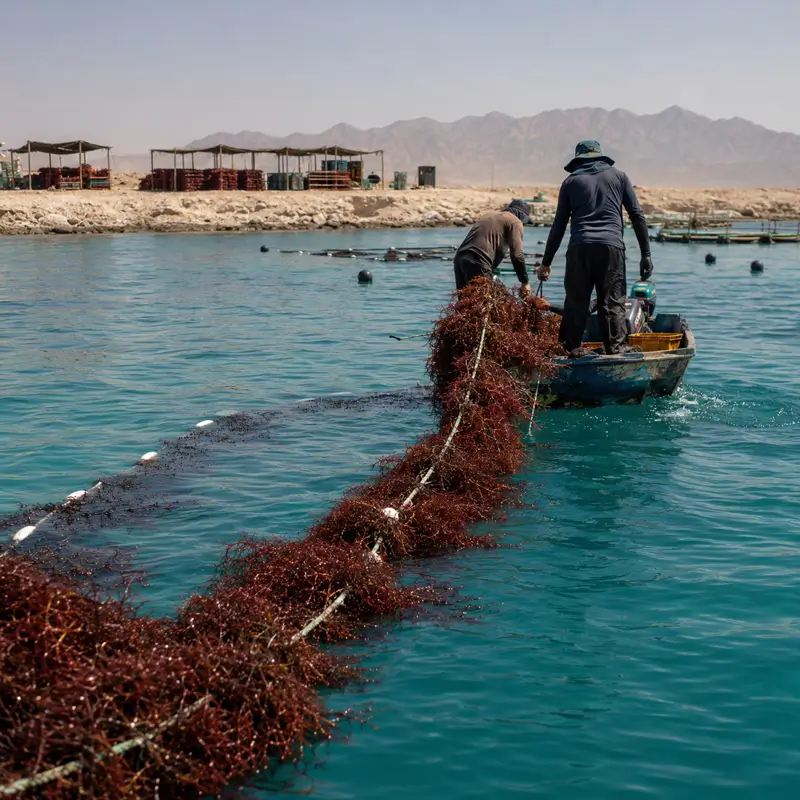
Qeshm is one of the key locations for understanding the technical feasibility of seaweed cultivation in the Persian Gulf. In an open-water Gracilaria cultivation trial, biomass in the monoline method reached 5,890 grams of fresh weight per meter on day 30, while in the net method it reached 5,300 grams of fresh weight per meter on day 36. The relative growth rate of the monoline method was also reported at 4.4 percent per day. These data are important because they come from a real southern marine environment and show that both species and cultivation method directly affect performance.
The same Qeshm trial recorded salinity of 41.2 to 49.75 PSU and temperatures of 25.35 to 30.75 degrees Celsius during the cultivation period. This range is especially important for selecting species resistant to salinity and heat, because parts of the Persian Gulf face more difficult physicochemical conditions than many common seaweed-farming regions. The Qeshm study was not only about biomass growth; it also addressed processing quality. The yield of extracted agar fluctuated from 40.4 to 15 percent during the cultivation period, showing that harvest timing and biomass quality can change the economic value of the product.
– Chabahar and Cultivation Testing in Coastal Earthen Ponds
Chabahar presents a different picture of the cultivation potential of Gracilaria corticata. In a study published in the Iranian Scientific Fisheries Journal, this species was cultivated in two 0.25-hectare earthen ponds from fall 2000 to summer 2001, and after 6 to 7 weeks, biomass increased to 2.3 to 2.7 times its initial amount. The importance of this experience lies in moving seaweed cultivation from open water to the more controllable environment of earthen ponds. For areas where marine space faces spatial competition or wave and wind risks, this model can serve as an intermediate option between laboratory research and marine farming.
A biodiversity study of the eastern coasts of Qeshm also recorded 42 seaweed species, including 10 Chlorophyta species, 9 Phaeophyceae species, and 23 Rhodophyta species. This data does not mean that an industry is already ready, but it does show that local biodiversity is important for species selection, ecological monitoring, and the design of a biological repository. In the same study, the highest annual mean macroalgal biomass was reported in winter at 29.3±9.8 grams of dry weight per square meter, while the lowest was reported in autumn at 17.3±13.5 grams of dry weight per square meter. This seasonal difference matters for investors because seaweed production is tied to biological calendars and harvest seasons.
Dry Seaweed Trade Standards and the Risks of Entering Industrial Markets
The farther the seaweed market moves away from raw consumption, the more dependent it becomes on standards. In 2026, UNCTAD reported that seaweed-specific regulations are limited and that out of 109 trade measures related to plant and animal products, only 18 directly cover seaweed and its derivatives. This regulatory gap sends two messages to exporters and processors. First, the market is still taking shape, and its standards are less established than those of mature agricultural products. Second, any production unit that builds quality, traceability, and safety systems earlier will have a stronger position in negotiations with industrial buyers.
In its 2026 document, the Codex Alimentarius proposed work on a Code of Practice for Raw Dried Seaweeds for Kappaphycus and Eucheuma, with completion planned for 2028. The limitation of this code to specific species is an important point for southern Iran because it does not directly cover Gracilaria or local species. However, its standardization logic for drying, storage, prerequisite programs, good agricultural practices, and post-harvest hygiene is significant. If seaweed products are to enter aquafeed, hydrocolloids, or biomaterials, drying and storage methods become just as important as the farm itself.
The voluntary ASC MSC Seaweed Standard v1.01 is also notable for assessing the environmental and social impacts of seaweed harvesting and cultivation. Risks such as the movement of non-native species, genetic pollution, the release of plastic equipment and ropes, animal entanglement, habitat alteration, and spatial competition with fishing and shipping must be addressed from the farm-design stage. In the Persian Gulf and the Gulf of Oman, these risks become more important because of the density of coastal activities and the sensitivity of some habitats. Seaweed development will be sustainable only when marine-area permits, environmental monitoring, and responsibility for collecting equipment are treated as part of the project’s real cost.
Asian, Omani, and Philippine Case Studies for Designing the Seaweed Market
Asia is the global center of gravity for seaweed production by volume, and this shapes the design of Iran’s strategy. Asian producers have accumulated experience in food, hydrocolloid, feed, and processing chains, and the global market compares price and quality against them. Therefore, southern Iran’s competition in raw dried products, without advantages in standards, proximity to markets, stable quality, or links to domestic aquaculture, is a high-risk path. A more realistic position may lie in products connected to local conditions, native species, co-location with aquaculture, or regional demand for feed and biomaterials.
– David Vivas Eugui, Chief of UNCTAD’s Ocean and Circular Economy Section: “Seaweed can support income diversification, new businesses, and local employment for coastal communities.”
The Philippines is an example of linking production, exports, and standardization. The Codex document shows that the country is among the major exporters of carrageenan and raw dried seaweeds, with carrageenan exports from 2016 to 2024 reported in the range of 22,000 to 35,000 tons and valued at $163 million to $320 million. The importance of this data is not only the size of the market, but also how it demonstrates the relationship among raw dried material, industrial processing, and the need for an international code of practice. For Iran, the main lesson from the Philippines is that seaweed’s economic value becomes more sustainable when the raw-to-processing chain is connected to the language of standards and trade.
Oman is a closer regional case study for Iran. In its 2026 food investment opportunities package, Oman introduced a seaweed cultivation project in A’Suwaiq valued at 2 million Omani rials and a sustainable fish-feed alternative project in Samail valued at 3.8 million Omani rials. These figures are useful for assessing the size of commercial pilot projects and the connection between seaweed and aquafeed in the region. Oman’s geographic proximity to the Gulf of Oman and its use of an investment-opportunity package send a clear message for designing projects in southern Iran: seaweed should be introduced alongside the food, feed, and processing chain, not as a product detached from the marine ecosystem.
Iran’s Implementation Path for the Seaweed Economy in the South
For Iran, a credible starting point in the seaweed economy is the history of experimental research on Gracilaria corticata in Qeshm, Chabahar, Bandar Lengeh, and some tank-based and integrated trials. This background shows that the seaweed discussion in southern Iran is not starting from zero, but the gap between experimental research and commercial industry must be filled with standardized pilots. A suitable pilot should produce several outputs at the same time: fresh and dry weight performance, processing quality, agar or target-compound yield, operating costs, seasonal effects, biofouling risks, water quality, and saleability to an industrial buyer. Such a pilot should be designed from the beginning to support investment decisions, not merely to prove biological growth.
– Thierry Chopin, Seaweed and IMTA Laboratory, University of New Brunswick: “The time has come for seaweeds to be placed around aquaculture cages.”
Connecting seaweed to aquaculture in southern Iran is an important implementation path, but it must be staged. The experience of integrating Gracilaria with Pacific white shrimp post-larvae provides a clearer experimental basis for shrimp nurseries, while directly connecting seaweed to marine cages requires field design, current monitoring, nutrient monitoring, structural planning, and interaction with operators. The IMTA model becomes valuable when seaweed is not merely installed beside a farm, but becomes a harvestable, dryable, and marketable product. In this model, revenue is formed through two channels: biomass sales and partial reduction of nutrient pressure in the farming environment.
From an investment perspective, a seaweed project must be defined as a chain. A farm without drying facilities and a quality laboratory produces an unstable product, while a processing unit without a biomass supply contract faces input-feedstock risk. Private investors need purchase agreements, product standards, operational insurance, marine-area permits, and cost estimates for maintaining cultivation structures. Government and development institutions can also reduce investment-entry risk by providing suitable marine areas, coastal infrastructure, environmental assessment frameworks, and support for connecting producers to aquafeed and biomaterials industries.
To turn seaweed into biomaterials, Iran must first gain control over biomass quality and production repeatability. The biomaterials market needs raw material whose composition, moisture, contamination, uniformity, color, odor, extractability, and stability can be measured. If the product is collected from multiple sites with different quality levels, industrial processing will face cost volatility and quality decline. Therefore, the pathway to biomaterials begins with precise, data-driven farming, not with the laboratory development of the final product. Qeshm and Chabahar can serve as climate and operational testing bases, provided their outputs are interpreted in relation to processing needs and market demand.
Practical Summary for Investing in Seaweed in Southern Iran
The seaweed economy ecosystem for the Persian Gulf and the Gulf of Oman is not a single-product opportunity, but a chain of interrelated decisions. Global data show that seaweed has a real position in aquaculture and emerging markets, but the 98 percent concentration of production in Asia warns that new entrants must enter with differentiation and standards. Data from Qeshm and Chabahar also show that experimental growth of Gracilaria is possible in southern Iran, but the same data highlight the importance of salinity, temperature, season, cultivation method, processing quality, and environmental monitoring. The practical conclusion is that any seaweed program must be connected from the outset to the target market, product standards, and an industrial partner.
The decision-making path for Vestra and similar players should begin with the market question: Is the biomass being produced for aquafeed, agar and hydrocolloids, biostimulants, or biomaterials? The answer to this question determines the species, cultivation site, harvesting method, drying standard, quality tests, and industrial partner. If the target is aquafeed, formulation and diet-performance testing matter most; if the target is biomaterials, uniformity and processing become more important. The seaweed economy in southern Iran becomes investable when existing research is converted into measurable pilots, purchase contracts, quality standards, and a chain-based financial model.