Root Microbiome for Stable Hydroponic Nutrients

Managing the Root Microbiome in Hydroponics: Biofilters, SynCom, and Nutrient Solution Stability
For many greenhouse managers, hydroponics evokes an image of water, dissolved fertilizer, white roots, and precise control of EC and pH. That image is accurate, but incomplete, because even in soilless systems, the root exists in a living environment, and over time the nutrient solution becomes a carrier of microbes, organic matter, ions, and biological consequences. When the nutrient solution is recirculated, the advantage of saving water and fertilizer comes with an operational risk: any microbial disturbance can move through that same solution across the entire system. Therefore, managing the root microbiome is not merely a laboratory concern; it is directly tied to production quality, food safety, and the economics of greenhouse investment.
The central question is not whether microbes exist in the nutrient solution; the question is what kind of microbial community forms around the root, how it changes, and when it shifts from a tolerable microflora into a disease risk or a source of nutritional instability. In open systems, part of the risk enters through the environment, growing medium, water, seedlings, equipment, and operational practices. In closed systems, that same risk can repeat more rapidly within the recirculation loop. This is where biofilters, slow sand filtration, microbial inoculation, and SynCom become tools for steering the system. The ultimate goal is not to blindly eliminate biological life, but to reduce pathogens, preserve beneficial microbial functions, and keep the nutrient solution within a stable and manageable range.
For holdings and investors in knowledge-based agriculture, this issue also has a strategic layer. A system that relies only on intensive disinfection may reduce pathogens, but at the same time it can weaken the biological services of the solution and create a need for repeated interventions. A system that recirculates without microbial control and sufficient monitoring can shift from the advantage of lower water and fertilizer use toward the risks of disease, salinity, pH instability, and food safety challenges. The defensible path is to design a managed system in which the root, nutrient solution, biological monitoring, biofilter, and biosafety regulations are treated as one integrated chain.
The Root Microbiome in Hydroponics and the End of the Sterile Solution Assumption
In the traditional view, hydroponics is often described as a cleaner environment than soil, and this perception sometimes leads to the assumption that it is completely sterile. The research evidence in this dossier shows that this assumption needs to be corrected, because the root microbiome in hydroponics forms shortly after planting and develops alongside the crop. This means that even in the absence of soil, the root remains an active surface for the establishment and transformation of a microbial community. If greenhouse management focuses only on fertilizer solution and chemical indicators, it overlooks part of the system’s biological reality and reacts late to root-driven changes.
– Phil Thomas and colleagues, University of New England and Western Sydney University: “The hydroponic root microbiome forms shortly after cultivation and flourishes alongside the crop.”
The importance of this statement is that it transforms hydroponics from a purely chemical system into a biological-chemical system. The root, nutrient solution, and growing medium together form a network in which plant growth, nutrient uptake, microbial competition, and disease potential are interdependent. If this network is monitored properly, it can help reduce pathogen pressure and improve nutritional stability; if neglected, the same network can become a pathway for disease spread. From this perspective, root microbiome management is neither a substitute for nutrition management nor a side issue; it is a complementary layer for understanding the real behavior of a hydroponic system.
In recirculating systems, the issue becomes even more sensitive. A review in Agronomie has shown that the risk of rapid spread of root diseases through the nutrient solution has been one of the barriers to adopting recirculation in greenhouses. This point is highly important for modern greenhouses, because recirculation is attractive in terms of water and fertilizer consumption, but the same closed loop can also facilitate pathogen transmission. Therefore, decisions about recirculation should not be made only through the logic of reducing input use; they must be accompanied by risk-control design for the nutrient solution, microbial monitoring, and the selection of appropriate treatment technology.
Recirculating Nutrient Solution and the Trade-Off Between Disease Control and Microflora Preservation
For disease control in recirculating nutrient solutions, five categories of methods are distinguished in the scientific literature: heat, filtration, chemical treatment, irradiation, and biological control. This classification shows that disease management does not rely on a single tool, and each method introduces its own biological and operational costs into the system. Sterilizing methods such as heat, oxidizing agents, UV, and membrane filtration can be effective in reducing pathogens, but at the same time they can damage beneficial microorganisms in the recirculating solution. This trade-off is critical for designing knowledge-based greenhouses, because the ideal system must both reduce disease risk and avoid destroying beneficial biological capacity.
Heat disinfection is a clear example of this logic. In the Agronomie review, commercial heat disinfection in some systems is discussed on the basis of 95 °C for 30 seconds, and the treatable solution volume in commercial systems is reported at about 1,800 m³/ha/year. This figure can be important for calculating energy demand and treatment capacity, but it does not by itself indicate operating cost. Therefore, economic analysis must be cautious and avoid directly turning technical data into claims about cost or return on investment.
– David L. Ehret and colleagues, Agriculture and Agri-Food Canada, Swedish University of Agricultural Sciences, and State Research Institute Geisenheim: “Slow filtration and microbial inoculation cause less damage to the microflora, but their effectiveness depends on the pathogen.”
This quote clarifies the boundary between classic disinfection and biological management. Instead of removing all biological components, slow filtration and microbial inoculation seek to reduce disease pressure while preserving part of the functional capacity of the microflora. However, this approach is not simple, because its effectiveness depends on the type of pathogen, contamination load, filter medium, retention time, water quality, and operating conditions. For this reason, the term “biological” should not be interpreted as “low-maintenance”; biological management is reliable only when it is accompanied by metrics, testing, and protocols.
Biofilters in Root Pathogen Control and the Stability of Soilless Cultivation Systems
– Dynamic Tomato Biofilters and a Goal Beyond Sterilization
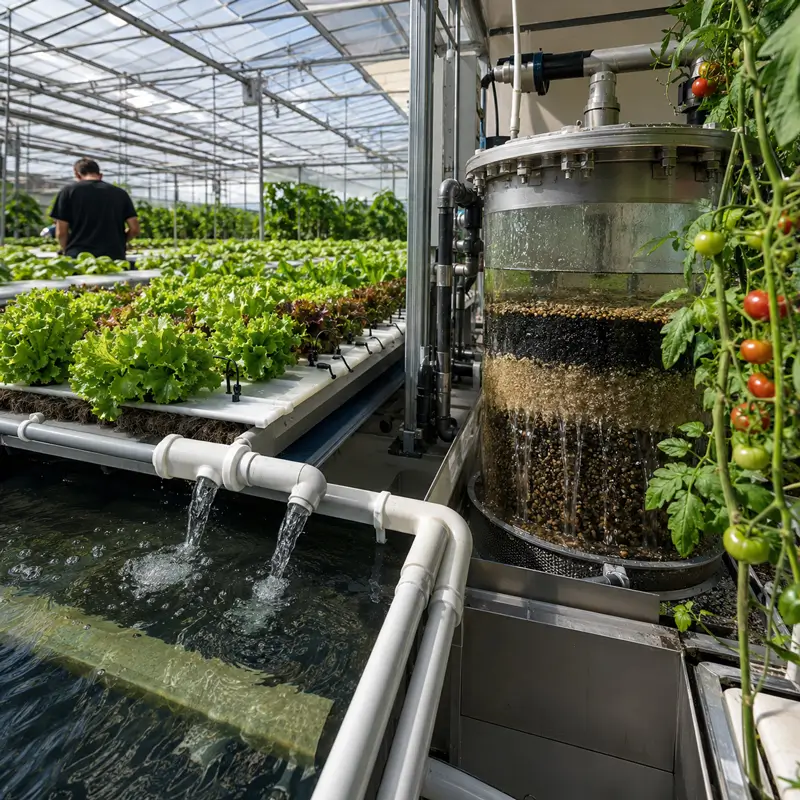
In this field, a biofilter refers to a unit that relies on a microbial community established on the filter medium to biologically remove or transform contaminants, pathogens, or nitrogen compounds. In a three-year study of a dynamic biofilter for soilless tomato production, removal of Pythium spp. was reported at more than 99%, while removal of Fusarium oxysporum ranged from 92.7% to 99.3%. Removal of total culturable bacteria ranged from 91.2% to 98.9%, yet the effluent still contained 6.6×10² to 1.4×10⁴ CFU/mL of bacteria. This result shows that the goal of a biofilter is not absolute sterilization, but rather reducing dangerous microbial pressure and keeping the system in a manageable state.
The CFU/mL metric here is not merely a laboratory number; it is a shared language among the farm, laboratory, and system designer. When the biofilter effluent still contains culturable bacteria, the greenhouse manager must distinguish between dangerous contamination and the remaining microflora. In addition, pathogen removal percentages must be reported separately for each disease agent, because a filter’s performance against Pythium is not necessarily the same as its performance against Fusarium. This species-specific view is more precise than a general claim of “water disinfection” and provides a more measurable criterion for investment decisions.
– Slow Sand Filtration and the Importance of Microbial Positioning
A 2024 soilless cucumber case study highlights the importance of combining filter technology with a biological agent. In this experiment, slow sand filtration enriched with Trichoderma atroviride was used to control Rhizoctonia solani, and disease severity was measured on a scale from 1 to 5. Disease control in some experiments was reported at 75% to 100%, showing a 49% improvement compared with a filter without an antagonist and an 86% improvement compared with no control method. The key point is that direct application of T. atroviride into the water provided only 9% disease control, whereas its establishment in the filter showed better performance.
– Pedro Matias, Luísa Coelho, Mário Reis, and colleagues, Crop Protection: “Slow sand filtration with Trichoderma increased disease control by 49% compared with filtration without the antagonist.”
The practical message of this data is clear: in microbiome management, strain selection alone is not enough; the location where the microbe is established, the formulation, and the filter architecture are also decisive. When an antagonist is established in the filter medium, it has greater opportunity for contact with the water flow, biological competition, and sustained effect. This distinction matters for designing biological products for greenhouses, because a beneficial strain or consortium may fail to deliver the expected performance if it is introduced into the wrong part of the system. Therefore, the future of microbial biofilters depends not only on selecting microbes, but also on engineering their location and biological stability.
SynCom and the Design of Microbial Consortia for Hydroponic Roots
SynCom, or synthetic microbial community, is a research-based response to microbiome complexity. Instead of relying on a single strain, multiple microbial taxa are co-cultured under defined conditions to mimic part of the structure and function of the natural microbiome. This concept is attractive for hydroponic roots because the soilless environment provides greater control over inputs, substrate, and nutrient solution. However, the research dossier emphasizes that many SynCom experiments are still conducted under controlled conditions, and the gap between laboratory success and stable performance in commercial greenhouses must be approached carefully.
– A. S. Ambihai Shayanthan, Patricia Ann C. Ordoñez, and Ivan John Oresnik, University of Manitoba and University of Jaffna: “SynCom is the co-culture of several microbial groups under defined conditions to mimic the structure and function of the microbiome.”
The advantage of SynCom is that it can move beyond a single-factor perspective and bring the collective performance of microbes into product design. In the rhizosphere, microbes do not act in isolation; competition, symbiosis, carbon use, metabolite production, and interaction with the root create a network of effects. For this reason, a designed consortium can, in theory, be more stable and multifunctional than inoculation with a single strain. Yet the same complexity makes quality control, regulatory registration, production reproducibility, and efficacy validation more difficult.
In the European Union, Regulation (EU) 2019/1009 provides the CE framework for EU fertilizing products, and for plant microbial biostimulants under PFC 6(A), the reference to CMC 7 is important. Within this framework, CMC 7 includes a limited list: Azotobacter spp., mycorrhizal fungi, Rhizobium spp., and Azospirillum spp. This limitation matters for complex SynComs, because not every multi-taxon consortium necessarily fits into a simple product registration framework. Therefore, commercializing SynCom in hydroponics is not only a biotechnology issue; it is simultaneously a scientific, regulatory, industrial, and quality-control challenge.
Bioponics and Aquaponics in Assessing Nutrient Solution Stability
The stability of the nutrient solution in biological systems cannot be explained by EC and pH alone. In bioponics, microorganisms metabolize organic matter and release nutrients required for plant growth, so nutrient release depends on biological activity, organic matter quality, and biofilter capacity. The research dossier explicitly states that in bioponics, pH and EC alone are not sufficient for monitoring and managing systems based on organic materials. This point is important for greenhouses considering organic or recycled sources, because solution management shifts from simple chemical control to multivariable biological management.
The Swiss case study in closed bioponics shows that using biogas digestate concentrate, biochar, and a biofilter can bring nutrient release into system design, but it also creates new risks. The nutrient source in that study included digestate concentrate from green waste, catering waste, animal manure, and slaughterhouse waste, while treatment at 55 °C and ultrafiltration were used to reduce mesophilic pathogens and bacterial load. Along the same line, salinity and the accumulation of ions such as Na+, Ca2+, Mg2+, Cl−, SO4²−, and Mn were reported, which can limit nutrient uptake. Therefore, bioponics is not merely a replacement of fertilizer source; safety design, salinity control, and monitoring capacity are decisive in its performance.
Aquaponics is a clear example of a system’s dependence on microbial function. In this system, fish retain only 20% to 30% of feed nitrogen, while 70% to 80% is excreted into the water. Microbial nitrification converts ammonium into nitrate and helps maintain water quality. From this perspective, the water microbiome and biofilter are not peripheral factors, but core infrastructure for system performance.
– Nasser Kasozi and colleagues, Annals of Microbiology and Springer Nature: “Nitrification converts harmful ammonium at high pH into nitrate and maintains water quality.”
Operational metrics in aquaponics show that microbiome management requires a multivariable perspective. An operating pH of 6.5 to 7.0 has been reported as a compromise among the needs of fish, plants, and nitrifying bacteria, while a lower pH of 5.2 to 6.0 can weaken AOB and NOB, reduce nitrification, and increase N2O. Dissolved oxygen above 5 mg/L has been reported as important for microorganisms, fish, and plant growth, and the optimal growth temperature for many nitrifiers has been cited as 25 to 30 °C. In addition, increasing the input C/N ratio from 2 to 5 in a bioreactor with nitrification and denitrification reduced the nitrification rate by 50%. This body of data shows that nutrient solution stability is built through the connection between water chemistry, oxygen, temperature, carbon, and the microbial community.
Food Safety and Biological Regulations on the Path to Hydroponic Commercialization
Because hydroponics eliminates soil, it moves away from many soilborne risks, but this does not mean microbial risk disappears. Codex emphasizes that hydroponic water should be replaced regularly or, if recirculated, treated to reduce microbial and chemical contamination. The same logic applies to aquaponics, where effluent from the fish tank must be controlled to reduce microbial contamination. Therefore, any microbiome management plan must be compatible with food safety from the beginning, rather than having food safety added after biological design is complete.
– Codex Alimentarius Commission and FAO WHO: “The nutrient solution in hydroponics can support the survival or growth of pathogens and create a safety risk.”
At the regulatory level, the distinction among biostimulants, biofertilizers, biological control agents, and biopesticides matters. If a SynCom or biofilter is marketed with claims of improving nutrition, stimulating growth, or controlling disease, its evaluation pathway becomes tied to the product’s technical claim. In Iran, the executive regulation on the import, production, formulation, and use of chemical, biological, and organic fertilizers and plant protection pesticides prohibits the production, mixing, import, purchase, sale, distribution, and use of unauthorized fertilizers and unregistered pesticides. In addition, under Iran’s Plant Protection Law, the import, production, processing, distribution, and export of substances used to control pests and diseases, plant hormones, and herbicides require authorization from the Ministry of Agriculture.
This framework sends a clear message for the commercialization of root microbiome management. Any product or system introduced as a biological greenhouse input must have a precise definition in terms of claims, composition, quality control, safety, and licensing pathway. Otherwise, even if it is scientifically attractive, it will face operational ambiguity at the market-entry stage. For technology holdings, the proper starting point is to clearly distinguish among a research project, a greenhouse pilot, a registrable product, and an operational monitoring service.
The Economics of Root Microbiome Management and the Logic of Cautious Investment
The economics of root microbiome management should not be oversimplified through speculative return-on-investment figures. Potential benefits can be imagined through reduced disease, lower water and fertilizer losses, reduced pesticide pressure, and greater production stability, but these benefits must be managed as an economic data gap, not as fixed numbers. On the other hand, sterilizing methods may be effective in pathogen control, but the removal of beneficial microorganisms can create a need for reinoculation or complementary biological design. Therefore, economic comparison should consider equipment cost, energy use, treatment capacity, impact on the microflora, monitoring requirements, and reduction of disease risk.
For investors, a biofilter becomes attractive when it answers a specific operational problem. If the problem is the spread of Pythium or Fusarium in a recirculating solution, the metric should be the removal percentage of that specific pathogen. If the problem is bioponic stability, the metric should combine pH, EC, dissolved oxygen, salinity, nutrient release, and microbial load. If the problem is Rhizoctonia control in soilless cucumber, the data on Trichoderma-enriched SSF shows that engineering the antagonist’s location can be more effective than direct injection into the water. This type of problem definition shifts investment away from purchasing generic technology and toward designing a greenhouse-specific solution.
– Phil Thomas and colleagues, University of New England and Western Sydney University: “Growers have limited ability to assess the status of the microbiome and monitor its changes over time.”
This monitoring limitation is one of the main points of value creation. Many greenhouses track EC and pH effectively, but they lack sufficient visibility into microbiome status, gradual changes, pathogen pressure, or biofilter function. For this reason, the business model for microbiome management is not merely the sale of a microbe or a filter; it can include monitoring, data interpretation, protocol design, quality control, and periodic system optimization. In such a model, investment in laboratory capacity, sensors, regular sampling, and operational analysis is as important as the biological technology itself.
Localization Pathways in Iran for Recirculating Greenhouses and Food Security
For Iran, the logical entry point does not begin with claims about a large market or immediate return on investment, but with controlled, problem-driven pilots. A greenhouse that recirculates its nutrient solution must first understand its own risk map: water source, substrate quality, history of root disease, treatment capacity, sampling capability, salinity status, and equipment maintenance capacity. Only then can it be decided whether a dynamic biofilter, slow sand filtration, microbial inoculation, or SynCom design creates the greatest value at a given point. Successful localization occurs when the technology aligns with water quality, operator skill, regulations governing biological inputs, and laboratory capacity.
Salinity risk must be taken seriously in Iranian system design, not based on numerical claims about specific regions, but based on technical evidence from bioponic systems. When organic sources or digestate enter the nutrient solution, ion accumulation can disrupt nutrient uptake, and EC alone does not explain the full risk. Under such conditions, monitoring Na+, Ca2+, Mg2+, Cl−, SO4²−, and Mn alongside pH, EC, and dissolved oxygen becomes important. If this monitoring layer is not included in the design, the biological project may increase nutritional instability and make solution correction more difficult instead of improving stability.
The proposed implementation pathway for Iranian greenhouses should be staged. The first stage is baseline monitoring, including pH, EC, dissolved oxygen, temperature, CFU/mL, root symptoms, and identification of dominant pathogens. The second stage is selecting the intervention technology based on the real problem; for example, a biological filter to reduce pathogen pressure, enriched SSF to establish an antagonist, or a nitrification protocol for aquaponic systems. The third stage is repeatable evaluation at pilot scale so that efficacy, safety, maintenance requirements, and the licensing pathway are clarified before commercialization.
The practical conclusion is that root microbiome management in hydroponics is neither a return to nature nor the complete removal of nature from the greenhouse. It is an effort to carefully engineer the microbial community in an environment where water, fertilizer, roots, and technology are interdependent. Biofilters show that disease pressure can be reduced without absolute sterilization; SynCom shows that designing microbial consortia is possible, but entry into commercial greenhouses requires quality control and a regulatory framework. For Iran, real value will be created by linking monitoring, piloting, licensing, product safety, and data-driven investment decision-making.