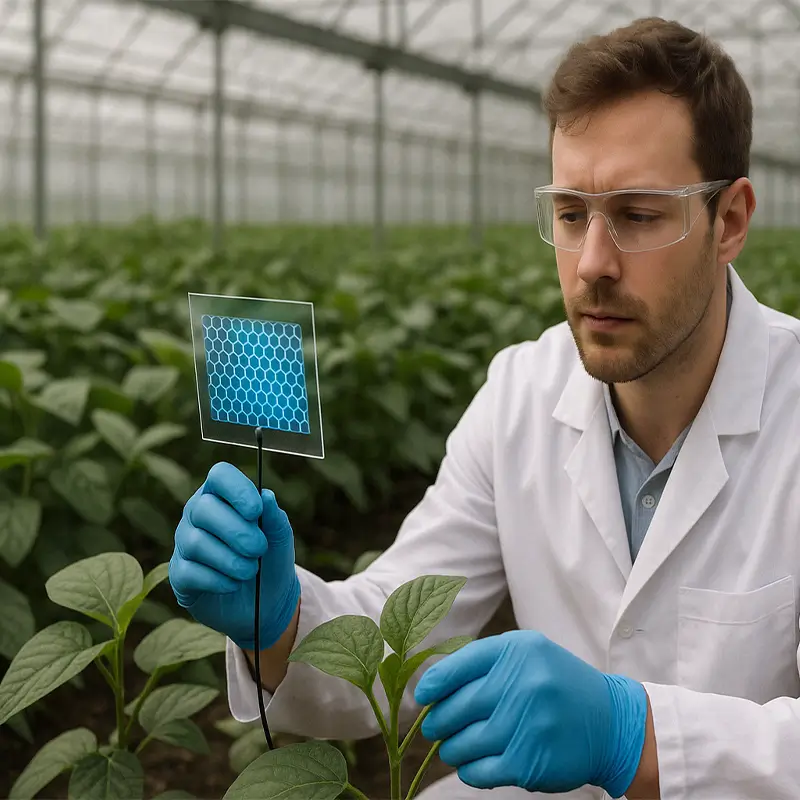
Enhanced Semi-Artificial Photosynthesis Efficiency in Low-Light Crops

Semi-Artificial Photosynthesis with Nanomaterials to Enhance Crop Efficiency in Low-Light Conditions
Semi-artificial photosynthesis is an innovative fusion of biological systems and synthetic materials, developed to improve the conversion efficiency of light into chemical energy in plants. This approach utilizes isolated chloroplasts or microorganisms as biological components, while nanomaterials are employed to modify light spectra and accelerate electron transfer. A recent study by Chen and colleagues demonstrated that biomass-derived carbon dots (CDs) can convert sunlight into red wavelengths usable by chloroplasts, boosting CO₂ fixation in cyanobacteria by up to 2.4 times and increasing the fresh weight growth of *Arabidopsis thaliana* by 1.8 times.
Despite the potential of natural photosynthesis, in practice, most crop plants store less than 1% of solar energy in biomass. Even in exceptional cases like sugarcane, the rate rarely exceeds 3.5%. The primary limitation lies in the narrow range of usable light and the loss of a significant portion of energy as heat and fluorescence.
In low-light environments such as enclosed greenhouses, vertical farms, or space missions, this limitation becomes even more pronounced. The cost of artificial lighting not only increases energy consumption but also imposes a substantial financial burden on producers. Luminescent nanomaterials, such as nitrogen-doped carbon dots (N-CDs), can absorb UV wavelengths and convert them into far-red light, thereby enhancing the electron transport chain efficiency in photosynthesis.
Understanding the theoretical and practical foundations of this technology shows that incorporating nanomaterial-based nanofertilizers can improve plant resilience to environmental stress and enhance overall productivity. A brief review of current research highlights the broad potential for developing hybrid bio-synthetic systems to support sustainable agriculture.
– Peidong Yang: “Our system represents the emerging union between materials science and biology, where opportunities arise to build new functional devices by integrating components from both domains.”
This compelling perspective emphasizes the need for a deeper integration of materials science and biology in advancing semi-artificial photosynthesis. It also serves as a source of inspiration for a new wave of research aimed at addressing the challenges of food production under adverse environmental conditions.
The Role of Nanomaterials in Enhancing Photosynthetic Efficiency
Nanomaterials, thanks to their unique optical and electronic properties, open up promising avenues for improving photosynthetic performance. These materials can absorb light wavelengths that are normally ineffective for chloroplasts and convert them into spectra usable for light-dependent reactions. Additionally, some nanomaterials are capable of directly injecting excited electrons into the photosynthetic electron transport chain, thereby reducing energy loss and enhancing CO₂ fixation rates.
Another advantage of nanomaterials lies in their high biocompatibility and tunable surface properties, allowing them to respond effectively to various environmental conditions. From an economic perspective, the production of certain nanomaterials—such as carbon dots derived from biomass—is both cost-effective and sustainable. This makes them particularly attractive for use in smart agriculture. Critical review studies have shown that using luminescent and photocatalytic nanomaterials can boost the effective energy utilization of solar radiation by more than 30%.
– Carbon Dots
Due to their nanoparticle structure with a high active surface area and strong light-scattering ability, carbon dots are considered highly effective optical converters. These particles can absorb UV radiation and convert it into far-red light, which is optimally absorbed by chloroplast photopigments. A study published in *Nature* revealed that biomass-based carbon dots not only improve optical efficiency but also significantly enhance CO₂ fixation in cyanobacteria by delivering additional excited electrons—up to 2.4 times more than the control.
In research by Cheng and colleagues, published in *Science of the Total Environment*, integrating carbon dots into hybrid systems with cyanobacteria and *Arabidopsis thaliana* led to a 1.8-fold increase in shoot biomass and improvements in light-limited photosynthetic efficiency. These findings underscore the potential of nanotechnology to enhance solar energy conversion in plant systems.
– Nitrogen-Doped Carbon Dots (N-CDs)
Nitrogen-doped carbon dots (N‑CDs), through their tailored electronic properties, can achieve light conversion quantum yields exceeding 50%. N‑CDs are capable of absorbing ultraviolet and blue light and transforming it into wavelengths suitable for photosynthesis. In a study published by *ACS*, foliar spraying of N‑CDs at a concentration of 5 mg/L on maize resulted in a 21.51% increase in net photosynthesis rate and a 66.43% increase in root carbohydrate accumulation.
The electrons generated by N‑CDs can enter the electron transport chain directly, without the need for complex catalysts, boosting the production efficiency of ATP and NADPH. This simple and low-cost mechanism presents a powerful solution for reducing reliance on artificial lighting and optimizing energy efficiency in vertical farming and greenhouse agriculture.
Practical Applications of This Technology in Agriculture
In recent years, the use of nanomaterials in agriculture has grown significantly, aiming to boost productivity and reduce environmental impacts. These technologies—implemented in the form of nanofertilizers, nanosensors, and hybrid bio-synthetic systems—enable more precise nutrient management, real-time crop health monitoring, and conservation of water and soil resources. One of the most prominent applications is the enhancement of photosynthesis under challenging conditions such as low-light environments, which can directly contribute to increased crop yields.
Particularly in enclosed greenhouses and vertical farming, where artificial lighting accounts for a large share of production costs, integrating nanomaterials with isolated chloroplasts, microorganisms, and compact electronic devices can help reduce energy consumption and improve light-use efficiency. For instance, nanomaterial-based luminescent coatings can adjust the solar spectrum and convert less efficient light into useful wavelengths—without relying heavily on energy-intensive LED systems.
– Nanofertilizers
Nanofertilizers are among the most advanced tools in smart agriculture, playing a transformative role in optimizing nutrient utilization. These materials are typically made from mineral or polymeric carriers with extremely high surface area, allowing for controlled release and targeted delivery of macro (N, P, K) and micro (Fe, Zn, Mn) nutrients. Studies have shown that nutrient uptake efficiency using nanofertilizers can exceed 90%, while conventional fertilizers often remain below 50%.
– S. Munné-Bosch: “Nanofertilizers, with their precise nutrient delivery capabilities, can dramatically improve nutrient use efficiency and prevent the leaching of elements into soil and groundwater.”
Beyond improving photosynthetic efficiency, nanofertilizers also help plants cope with environmental stresses by reducing oxidative damage caused by nutrient deficiencies. Nanotechnology enables the development of composite formulations—such as bio-based nanofertilizers—and co-application with beneficial microorganisms, laying the groundwork for sustainable bio-agriculture.
– Plant Growth in Darkness
One of the most innovative outcomes of semi-artificial photosynthesis is the production of acetate via electrocatalysis to serve as a carbon and energy source for plants. In this approach, solar-powered electrolyzers convert CO₂ and water into acetate, enabling plants and microorganisms to shift to a heterotrophic metabolism—growing without light. Experiments published in *Nature Food* showed that this method can support biomass production in a range of species, including *Arabidopsis thaliana*, tuber crops, tomatoes, and lentils, even in complete darkness.
– Robert Jinkerson: “If we can decouple plant growth from sunlight, we’ll be able to produce crops in fully controlled environments without depending on traditional farmland.”
The practical implications of this technology are striking for vertical farming and space missions, as it dramatically reduces the need for artificial lighting and arable land, enabling food production in compact and controlled environments. Researchers estimate that “electro-agriculture” could reduce land requirements by up to 94% compared to conventional farming, while achieving a higher yield-to-energy ratio than traditional methods.

Researchers’ Vision for Advancing Semi-Artificial Photosynthesis
Research into semi-artificial photosynthesis has bridged the gap between biology and materials science, fueling hopes for dramatically improving crop productivity. Leading scientists from prestigious universities and research centers around the world are working toward a shared goal: using smart nanomaterials and biological mechanisms to overcome limitations of ambient light and boost photosynthetic efficiency beyond what nature currently allows.
This diverse community of experts—ranging from bold ideas for solar fuel production to metabolic pathway redesign—believes that the future of global food security lies in the intelligent fusion of technology and biology. They emphasize that only through interdisciplinary synergy can we tackle the looming crises of food scarcity and climate change.
One prominent example of such collaboration is the “Realizing Increased Photosynthetic Efficiency” (RIPE) project, led by Stephen Long. This initiative brings together biologists and materials engineers, with support from the Gates Foundation, to develop practical solutions for improving photosynthesis through electronic leaf simulations and mathematical modeling.
Alongside these interdisciplinary efforts, many researchers stress the need for scaling up and expanding field trials. From controlled greenhouse environments to smart simulation systems, their next step is testing the resilience and viability of these technologies under real-world agricultural conditions.
Nocera, the pioneer behind the “artificial leaf,” argues that mimicking the natural leaf’s mechanism for converting light into fuel could provide clean, low-cost energy sources to under-resourced communities. He believes that a deep understanding of photochemical reactions in leaves could pave the way for converting CO₂ into hydrogen and oxygen.
– Stephen P. Long: “If we can find a way to improve photosynthesis, we can increase crop yields.”
Stephen Long, the director of the RIPE project at the University of Illinois, highlights the critical role of electronic leaf modeling. He believes that enhancing any component of the photosynthetic electron transport chain could lead to significant gains in plant productivity. He also speaks of collaborating with computational scientists to simulate and test hundreds of genetic modifications simultaneously within virtual leaves.
– Donald Ort: “The calories lost each year to photorespiration in the U.S. Midwest alone could feed an additional 200 million people.”
Donald Ort, a plant scientist at the University of Illinois, points to the detrimental effects of photorespiration on plant productivity. He explains that even partial recovery of this carbon loss could help feed hundreds of millions of people. His field trials in warmed agricultural plots have shown over a 26% increase in biomass among genetically engineered plants.
– Amanda Cavanagh: “Climate change will increasingly impact crop productivity—and one day, I realized that in 2050, I’ll be 64. I want to use my research time to help solve this crisis.”
Amanda Cavanagh from the University of Essex brings a future-oriented perspective, emphasizing the need to optimize photosynthetic pathways to withstand heat stress. She views remote-sensing systems and thermal modeling in SoyFACE fields as essential tools for anticipating and mitigating the effects of climate change on agriculture.
Conclusion and Future Outlook of Semi-Artificial Photosynthesis
Semi-artificial photosynthesis, by integrating nanomaterials with biological components, offers remarkable potential for boosting solar energy utilization in crops. Recent studies show that these systems can significantly increase CO₂ fixation rates by modifying light spectra and enhancing electron transfer. A critical review of research published in journals like *ACS* and *RSC* highlights impressive progress, yet it also underscores the need for deeper investigation into the underlying mechanisms and the long-term stability of hybrid systems.
Despite early successes, several technical and practical barriers remain before commercial adoption is feasible. One major concern is the interaction of nanostructured materials with the environment and their potential impacts on soil health and microbial ecosystems. Moreover, many systems remain confined to laboratory-scale experiments, emphasizing the need for expanded field trials in real-world conditions such as greenhouses and open farms. According to *AltEnergyMag*, semi-artificial systems are still far from outperforming fully natural or fully artificial approaches, and researchers stress the importance of advancing sustainability and material recycling strategies.
On the other hand, practical innovations like “electro-agriculture” or growing crops in complete darkness have opened new horizons for food production in urban settings and space missions. The method of producing acetate from solar energy and supplying carbon to plants without direct light can reduce land and artificial lighting requirements by up to 94%. This breakthrough—featured in *Food & Wine*—signals a move toward operational semi-artificial photosynthesis and a significant reduction in resource consumption.
– Donald R. Ort: “The calories lost each year to photorespiration in the U.S. Midwest alone could feed an additional 200 million people.”
Undoubtedly, the future of sustainable agriculture is closely tied to the advancement of semi-artificial photosynthesis systems. Universities, research institutes, and industry must collaborate—alongside governments and international organizations—to expand interdisciplinary research networks. Vesta Holding can play an accelerator role by investing in field-scale projects and supporting the development of functional prototypes. Connecting the value chain from farm to table through this technology could offer a powerful solution to the growing challenges of water scarcity, climate change, and global food demand.