
Smart irrigation scheduling using dynamic, time-of-use (TOU) electricity pricing

Smart Pumping and Irrigation Scheduling Based on Real-Time Electricity Pricing
Pumping and irrigation are the backbone of food security, and even small reductions in energy cost or slight improvements in scheduling show up in product quality, water use, and grid resilience. Time-of-use and dynamic electricity pricing provide policy and technology tools to shift irrigation from peak hours to off-peak periods, or to curtail it contractually within demand-response programs. In the European Union, customers with smart meters have a legal right to enter “dynamic price” contracts.
The convergence of these price signals with agronomic metrics such as reference evapotranspiration (ETo) and the crop coefficient (Kc) enables scheduling that both meets crop water demand and reduces energy costs and grid stress. In countries like Spain, public access to day-ahead hourly prices improves farmers’ decision-making.
In the United States and New Zealand, irrigation-specific tariff classes or pump load-reduction programs with defined time windows provide a practical execution framework. In Iran, the agricultural-well load-management program operates on the rule of “five hours of cooperation at peak in exchange for nineteen hours of free electricity.” Technically, pump variable-speed drives smooth pressure/flow control and cut energy use at part load; on the communications side, standards such as OpenADR and IEEE 2030.5 link irrigation systems to price messages and demand-response events. This article provides a roadmap policy, operational/technical, and economic for implementing smart pumping and irrigation scheduling based on TOU/DM pricing, grounded in reputable international sources and real-world examples.
– Ralf Heine, CTO, OpenADR Alliance: “Anchoring OpenADR at the IEC level enables more confident adoption of demand-response programs.”
– Hideo Ishii, Professor, Waseda University: “IEC-level standardization expands the transfer of OpenADR-based resource-control methods to other countries.”
Across EU member states, regulators and technical associations have clarified access to dynamic tariffs and consumer education. Germany has required suppliers to offer at least one dynamic tariff from 2024, and public guides explain selection and the risks of price exposure. Spain publishes hour-by-hour PVPC prices daily, allowing farmers to identify low-price windows and coordinate night or early-morning irrigation.
In New Zealand, Orion defines an irrigation price category with time-based components and capacity requirements. In the U.S., Idaho Power’s “Irrigation Peak Rewards” program contractually turns off pumps at peak times and sets daily/weekly/seasonal caps to protect farm operations. This policy architecture enables economic modeling and the design of scheduling algorithms algorithms that must simultaneously account for crop water needs, hydraulic capacity, grid constraints, and price signals.
At the farm level, FAO-standard metrics such as ETo and Kc provide the basis for calculating water demand and setting irrigation turns. Linking these metrics to hourly prices or peak/shoulder/off-peak windows lets growers shift irrigation to cooler, cheaper periods; with a variable-speed drive, they can fine-tune pressure and flow to avoid water hammer and throttling losses.
Electrical safety in agricultural environments per IEC 60364-7-705, and accurate measurement/billing with IEC 62052/62053-compliant meters, build deployment trust. Upstream, OpenADR 2.0b / IEC 62746-10-1 and IEEE 2030.5 ensure interoperability between price/event platforms and pump control gateways, enabling automated execution of demand-response events.
Within this framework, a localization path for Iran is clear: leverage the current well load-management mechanism and add public, online publication of price windows or translate them into “allowed and low-cost hours”; connect VSD-equipped pump panels to standards-based gateways; and combine ETo/Kc-based irrigation planning with grid constraints. Success requires open data, user training, electrical safety assurance, and financial support for installing drives and sensors.
Conceptual Framework and History
A time-of-use (TOU) or time-based tariff is a structure in which the energy price rises or falls across predefined windows typically off-peak, shoulder, and peak. The policy aim is to shift load from peak to off-peak so that generation and network capacity are freed up and the end-user’s marginal cost falls. More advanced variants are dynamic pricing schemes that link prices over short time steps directly to day-ahead and intraday market movements (the formal definition of a “dynamic price contract” appears in Directive 2019/944). This distinction is embedded not only in theory but also in Europe’s electricity-market governance: governments are tasked with ensuring access to dynamic contracts for customers with smart meters and with informing them about the opportunities and risks of price exposure.
The history of using these two mechanisms in agriculture can be traced along two paths: a cost-driven, TOU-based scheduling path that, for decades, enabled cheaper night irrigation in parts of Australia and the United States; and a “demand response” path that has grown with competitive markets and digitalized infrastructure. In the United States, Idaho Power began an irrigation pump load-reduction program with financial incentives in the early 2000s and today sets predictable caps on the frequency and duration of events. In Spain, the PVPC scheme’s publication of hourly prices effectively gives small customers daily, data-driven planning capability. In Germany, with new smart-metering requirements and metering-technology laws, suppliers are obliged starting January 1, 2025 to offer at least one dynamic tariff, ensuring broad access to flexible price signals.
The linkage between these price mechanisms and irrigation science was strengthened by the release of FAO-56 in 1998. That guide standardized the framework for estimating reference evapotranspiration (ETo) and converting it to crop water need (ETc = Kc × ETo), showing that scheduling should follow actual crop demand and meteorological conditions. When this framework is combined with hourly prices or TOU windows, an optimization algorithm can set irrigation turns so that soil-moisture deficit does not reach a critical threshold while taking advantage of off-peak periods and lower prices. In pump-system engineering, the shift from “throttling with a valve” to “speed control” via a variable-speed drive is recommended in U.S. Department of Energy guidance and energy-efficiency programs as a systematic approach to cutting consumption and improving controllability at part-load flow.
– Richard G. Allen, lead author of FAO-56: “This guide provides the up-to-date procedure for calculating reference evapotranspiration.”
In Iran, there is clear potential to align energy and agriculture policy. On one hand, the well load-management policy—“five hours of cooperation during peak in exchange for nineteen hours of free electricity” creates a strong incentive to avoid peak. On the other, as smart meters and timer functions spread, operational rules can evolve from “fixed shut-off” to “variable, announced windows,” enabling alignment with weather and market changes. In such a setup, event-notification platforms using open protocols send high-price or curtailment messages to pump panels; the controller, considering irrigation constraints and soil-moisture status, decides whether to irrigate or defer. The result is lower energy cost, reduced summer peak stress on the grid, and maintained farm performance.
– An agriculture-and-energy researcher: “The key to success is fusing the price signal with real water need based on ETo/Kc.”
A key theme in the regulatory history is transparency and customer education for dynamic contracts, because price exposure entails understanding volatility risk. The European directive requires clear information on whether prices are fixed, variable, or dynamic, full cost details, and the right to participate in demand response. This model can inform national documents for Iran’s agricultural sector: public announcement of time windows, technical guides for connecting VSD-equipped pumps, and predictable caps for curtailment events so the farm water-supply chain remains secure.
– An electrical-standards expert: “Compliance with IEC 60364-7-705 in agricultural environments is a prerequisite for any irrigation automation.”
Technical Design, Operations, and Case Studies
– Metrics and the Scheduling Algorithm
The scientific core of irrigation scheduling is the combination of ET0 (millimeters per day) and the crop coefficient Kc. Crop water need is obtained via ETc = Kc × ET0, and each millimeter of water over one hectare is roughly equivalent to 10 cubic meters. ET0 inputs include radiation, temperature, relative humidity, and wind; for higher accuracy, local calibration is recommended. On the energy side, the algorithm must account for the farm’s hydraulic layout, pressure constraints, the pump curve, and friction losses. With a variable-speed drive (VSD), target pressure can be maintained by changing speed, avoiding losses from throttling with a valve. A common operating rule is to define a “minimum irrigation depth” and a “maximum allowed delay relative to the soil-moisture threshold,” so that irrigation is not missed and water stress is avoided when electricity prices are high or a curtailment event is announced.
– Metering, Communications, and Safety Infrastructure
For billing and signal delivery, smart meters compliant with IEC 62052/62053 and secure communications are required. IEC 60364-7-705 sets installation and protection requirements for agricultural environments. For exchanging demand-response events and prices, OpenADR 2.0b approved as IEC 62746-10-1 on 1397-10-19 together with IEEE 2030.5, provides end-to-end architecture: an event “publisher” on the market/operator side, and a farm-side VEN gateway connected to the pump panel. This model enables automatic event notifications and execution of curtailment policies while preserving irrigation constraints.
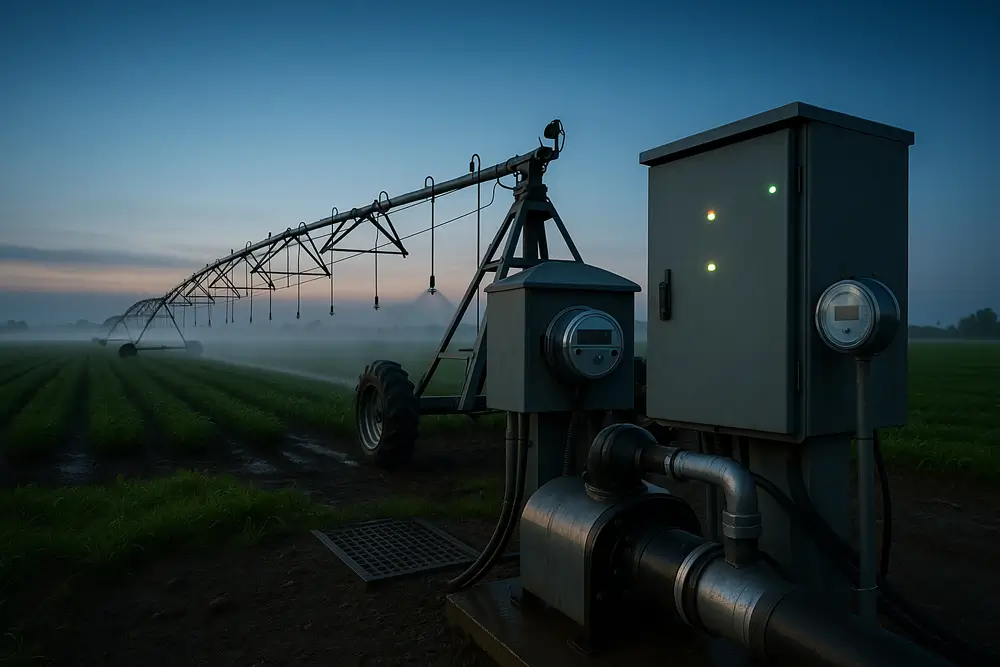
In practice, a smart pump panel includes a variable-speed drive, pressure/flow/level sensors, motor temperature monitoring, a local controller with safe logic, and a communications unit using an open protocol. Under curtailment, the controller reduces flow, lowers the target pressure to the minimum allowable level, or shuts the pump down; when the event ends, it manages a soft return to normal to avoid water hammer and inrush-current peaks. In multi-pump arrangements, the on/off sequence and load sharing should be set to maximize overall efficiency.
– A pump-systems engineer: “Speed control is the inherent solution for cutting power at part flow, not an after-the-fact fix.”
From an environmental perspective, shifting load to off-peak can reduce the grid’s marginal emissions during fossil-fueled peak hours. On-farm, cooler nighttime irrigation lowers evaporation; however, this benefit persists only when the tariff design gives enough incentive to shift. Experience in Queensland showed that removing night incentives and moving to a flat tariff pushed some operators toward daytime irrigation and higher evaporation though some reported staffing conveniences.
– A farmers’ union representative: “Without night incentives, some growers must irrigate by day and evaporation losses climb.”
In pump energy engineering, the U.S. Department of Energy has reported that pumping systems account for nearly 20% of global electric motor energy use and consume 25–50% of electricity in some industries. In agriculture, this means even small optimizations in pump selection, speed control, and network design can deliver rapid payback. In addition, USDA NRCS guidance on “pump performance testing and VFD installation assessment” lays out specific steps to test flow, pressure, and power and to calculate pre/post savings.
– An energy-efficiency specialist: “Double-digit savings potential in pumping is achievable with speed control and a systems view.”
Real-world examples make the picture clearer. In Spain, farmers consult REE’s hourly price curves to shift irrigation to cheaper windows and use a simple controller to schedule pump starts at target hours. In New Zealand, Orion’s irrigation tariff category with time-based components and capacity requirements pushes the price signal from the distribution grid down to the farm, even providing rules for power-factor correction on VSD-equipped pumps. In the United States, Idaho Power’s irrigation curtailment caps “maximum 4 hours per day, 16 hours per week, and 60 hours per season”—frame scheduling boundaries. In Iran, according to official Tavanir notices, peak windows (e.g., 11–16 or 12–17) are announced by province, and smart-meter settings support execution. Together, these experiences form a template for a localized pilot that connects weather data with an ET0/Kc computation module.
– A demand-response program manager: “Clear time caps are essential to preserve irrigation plans and farmer trust.”
Economics, Finance, and Governance
The economics of TOU/DM-based irrigation scheduling depend on the price spread between time windows and the farm’s degree of operational flexibility. In the Spanish model, access to hourly prices and the 1402-10-11 reforms to dampen volatility enable farmers to plan day by day. In Idaho’s demand-response model, growers earn financial credits for curtailing at peak times and, thanks to explicit time caps, can manage the risk of yield loss. In New Zealand, a time-based network component and capacity requirements transmit the network cost signal directly to the irrigation consumption point, while in Germany the obligation to offer at least one dynamic tariff has spurred retailer competition around price-exposure bundles.
On the investment side, a variable-speed drive, pressure/flow/soil-moisture sensors, and a controller that supports open communications standards comprise the core CAPEX for the transition. Economic returns arise along three channels: lowering energy costs by shifting to cheaper hours; earning peak-time curtailment incentives; and reducing instantaneous power via speed control (which can sometimes allow smaller transformers/lines or lower demand charges). DOE documentation and industrial experience show that part-load savings from speed control are significant in many applications, and with a systems view, double-digit average savings are attainable. Financing models such as performance-based contracts, drive/sensor leasing, and co-investment with specialized agriculture and energy funds can reduce upfront risk for growers. In behind-the-meter solar cases, aligning with off-peak windows further lowers the effective cost of energy.
– An energy economist: “For a farm, time-varying price spreads plus operational flexibility equal the energy margin.”
In Iran, the agricultural-well load-management program “five hours of cooperation at peak in exchange for nineteen hours free” in practice creates a strong economic signal to avoid peak-time irrigation. Official Tavanir reports state that smart meters can be configured to enforce these limits and that peak windows (e.g., 11–16 or 12–17) can be set by province. If this framework is coupled with public announcements of low-price windows (or their equivalent as allowed off-peak hours) and with voluntary participation in curtailment programs, a TOU/DR blend lowers irrigation electricity OPEX and eases grid peaks. In parallel, a basket of incentives for installing drives, soil-moisture sensors, and controllers supporting open standards should be offered to overcome initial investment barriers.
– A distribution utility manager: “Smart meters and timely notifications are the pillars of fair load management for wells.”
From a governance perspective, European experience shows that codifying consumer rights for dynamic contracts (clear explanation of risks/opportunities, ability to participate in demand response, and annual impact reporting) is essential. Technical standardization must advance in step: agricultural-environment safety (IEC 60364-7-705), metering and measurement (IEC 62052/62053), drives (IEC 61800), and DR communications (OpenADR/IEC 62746-10-1 and IEEE 2030.5). Germany’s obligation to offer at least one dynamic tariff, alongside smart metering systems, illustrates a blend of market governance and technology. Spain’s daily publication of hourly prices and impact monitoring is an example of full, data-driven transparency. These lessons can inform national documents in Iran, including publishing a prices/allowed-window API, drafting interconnection rules for agricultural equipment to event-notification platforms, and defining clear caps for curtailment events.
– An electricity-market policymaker: “Price transparency and open standards are the winning combination for digital agriculture.”
Risk assessment centers on three axes: first, price-exposure and volatility risk (under dynamic models), which should be managed through training and simple hedging tools; second, operational risk from deferring irrigation, which should be bounded by minimum ETc constraints and curtailment time caps; and third, safety/cyber risk, which calls for electrical-safety audits and strict implementation of secure protocols. With this approach, smart pumping and irrigation scheduling not only cut costs but also reduce peak demand, enabling greater renewable integration and improving grid resilience.
– A power-systems researcher: “Cutting agricultural peaks, put simply, frees capacity for a cleaner future.”