
Vertical Farming and Land Scarcity
How Can Vertical Farming Address the Challenge of Land Scarcity in Food Production?
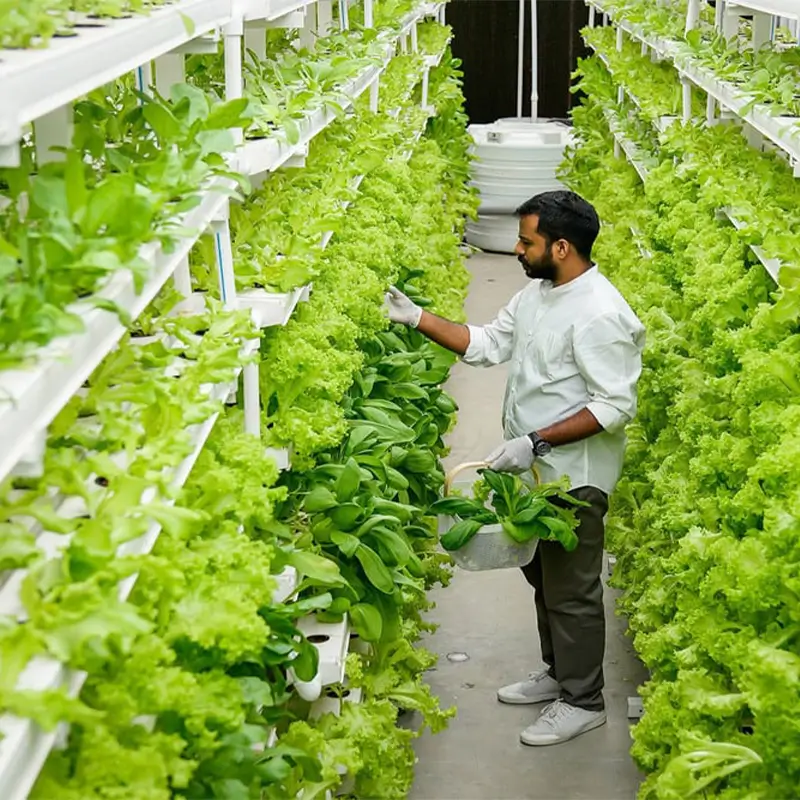
Vertical farming, with its advanced technology and multi-layered structure, significantly enhances food production in urban spaces. By conserving water and reducing the need for agricultural land, it ensures food security. As the global population grows rapidly and demand for food increases, land scarcity has become a critical challenge for modern societies. Traditional farming methods, due to land limitations and high costs, can no longer meet the escalating demand. In this context, innovative technologies such as vertical farming present an unparalleled opportunity to maximize the use of limited spaces efficiently.
This cutting-edge approach utilizes multi-tiered structures and advanced technologies, enabling agricultural production in urban environments and small spaces. This transformation in farming methods not only boosts land productivity but also contributes to water conservation, reduced pesticide use, and improved crop quality.
International studies have shown that vertical farming can increase land productivity by up to tenfold. Given the rapid population growth and the rising demand for food resources, this innovation has become increasingly significant. Investing in modern agricultural technologies paves the way for a structural transformation in food production systems.
Moreover, the environmental pressures caused by converting natural lands into traditional farms have heightened the need for more sustainable approaches. As a result, utilizing vertical spaces—often integrated into existing urban buildings—can help preserve natural resources and reduce greenhouse gas emissions.
Vertical Farming Technology
Vertical farming is based on the use of multi-layered structures and controlled environmental systems. This technology, utilizing closed-loop irrigation systems, LED lighting, and precise sensors, enables meticulous monitoring and management of plant growth conditions. By implementing these advanced systems, each square meter of available space achieves significantly higher productivity compared to traditional agriculture.
In vertical farming systems, multi-tiered structures allow for multiple harvest cycles per year. This not only increases land productivity but also minimizes idle periods. The integration of advanced technologies in vertical farming system design—including sophisticated software for environmental management and plant growth monitoring—ensures optimal growing conditions are maintained at all times.
Some modern vertical farming systems are equipped with temperature, humidity, and light sensors that continuously collect and analyze environmental data in real time. This data enables system managers to adjust environmental parameters as needed, ensuring optimal growth conditions. As a result, the consumption of resources such as water and fertilizers is intelligently managed, preventing waste and maximizing efficiency.
Economic and Environmental Benefits
Vertical farming is recognized as a highly efficient economic solution due to its numerous advantages, including increased land productivity, reduced water consumption, and lower production costs. By utilizing existing spaces in urban areas, this technology minimizes the need for purchasing new land and significantly reduces operational expenses through resource optimization.
These systems enable food production within urban environments, decreasing dependence on food imports. As a result, national food security is strengthened, making the country less vulnerable to fluctuations in international markets.
Water and Energy Conservation
One of the most significant advantages of vertical farming is its substantial reduction in water consumption. By utilizing closed-loop irrigation systems and water recycling, it enables up to 95% water savings. This approach is not only economically beneficial but also has a positive environmental impact. Additionally, by precisely controlling environmental conditions and using high-efficiency LED lighting, energy consumption in these systems is optimized, ultimately reducing greenhouse gas emissions associated with food production and transportation.
Another key environmental benefit of vertical farming is the reduced use of pesticides and chemical treatments. In controlled environments, the need for chemical-based pest and disease management is minimized, which helps decrease environmental pollution and preserve biodiversity. Furthermore, local food production through vertical farming in urban areas shortens transportation distances, leading to lower fuel consumption and reduced harmful emissions into the atmosphere.
Expert Opinions and International Statistics
Global studies indicate that by 2050, the world’s population is projected to reach approximately 9.7 billion, necessitating a 70% increase in food production. This enormous challenge underscores the urgency of adopting innovative agricultural technologies more than ever.
According to reports from the Food and Agriculture Organization (FAO), vertical farming systems can increase productivity by up to 390 times per square meter compared to traditional agriculture. This statistic highlights how utilizing vertical spaces can serve as an effective solution to land scarcity.
A study conducted by leading universities found that vertical farming systems not only enhance productivity but also reduce water consumption and minimize reliance on chemical inputs. These achievements create a solid foundation for the sustainable development of urban agriculture.
– Dr. Dickson Despommier, Professor at Columbia University, stated: «Vertical farming can significantly reduce pressure on agricultural lands and enhance food security in urban areas.»
– Erika Hernandez, Senior Researcher at the Massachusetts Institute of Technology (MIT), remarked: «y integrating advanced technologies with vertical farming, we can maximize food production within limited urban spaces.»
Challenges and Existing Barriers
Despite the numerous advantages of vertical farming, several challenges hinder its widespread adoption, requiring targeted research and strategic investments to overcome them. The most significant obstacles include high initial costs, the need for technical expertise, and substantial energy consumption.
Establishing a vertical farm requires advanced equipment, intelligent environmental control systems, and substantial infrastructure investments. The high upfront costs may limit the widespread adoption of this technology, particularly in developing countries.
Additionally, managing complex vertical farming systems demands multidisciplinary expertise in agricultural engineering, information technology, and resource management. A shortage of skilled professionals in these fields can be a major barrier to the successful implementation of vertical farming projects. Energy consumption is another critical challenge, as artificial lighting and climate control systems significantly increase energy usage. If non-renewable energy sources are used, this could lead to negative environmental consequences.
Development Potential and Future Prospects
Despite these challenges, the development potential of vertical farming remains significant. Recent research has shown that advancements in environmental control technologies, reductions in initial costs through engineering innovations, and the adoption of renewable energy sources can facilitate the global expansion of this farming method. Government and private sector investments in agricultural technology research and development can enhance productivity and lower operational costs in vertical farms. This, in turn, could establish vertical farming as a sustainable solution for food production in cities and space-constrained areas.
Furthermore, the establishment of international standards for vertical farming systems and the creation of collaborative networks between universities, research centers, and industries play a crucial role in accelerating the adoption and expansion of this technology. The exchange of expertise and technical knowledge on a global scale can help overcome existing challenges and improve the efficiency of vertical farming systems.
It is predicted that in the coming decades, vertical farming will become a cornerstone of food security in major cities. By reducing dependence on traditional agricultural land, this innovation is expected to have a profound impact on the economic and environmental sustainability of urban communities. The integration of cutting-edge technologies such as artificial intelligence and the Internet of Things (IoT) in monitoring systems can further accelerate the growth of this sector.
Case Studies and Practical Experiences
In several advanced countries, vertical farming projects have been successfully implemented in major cities. For example, in some American and European urban centers, vertical farms have been integrated into buildings, significantly increasing food production by optimizing space utilization.
A case study revealed that a 100-square-meter vertical farm could produce several times more food than traditional agriculture. This achievement, coupled with a 95% reduction in water consumption and improved crop quality, highlights the remarkable potential of this technology in urban settings with limited space.
Successful global experiences demonstrate that the incorporation of advanced technologies in vertical farming—such as artificial intelligence-driven monitoring systems and big data analytics—has enhanced performance and reduced production costs. These achievements have attracted the attention of investors and policymakers, motivating the expansion of similar projects worldwide.
Moreover, collaboration between the private sector and government institutions in establishing research centers and providing specialized training has played a vital role in transferring knowledge and innovative technologies to vertical farming systems. These partnerships have significantly contributed to the development of new technologies and the enhancement of infrastructure required for large-scale vertical farming projects.
Conclusion
Vertical farming, as an innovative and sustainable method of food production, has successfully addressed the challenge of land scarcity in the face of rapid population growth. By utilizing multi-layered structures and advanced technologies, this approach enables agricultural production in limited urban spaces while optimizing the use of natural resources.
The economic and environmental benefits of vertical farming include increased land productivity, water conservation, reduced reliance on pesticides and herbicides, and lower greenhouse gas emissions. International statistics and practical experiences indicate that this technology can enhance food production several times over compared to traditional agriculture.
Despite challenges such as high initial costs, the need for technical expertise, and high energy consumption, extensive investments in research and development, along with collaborative networks between various institutions, can facilitate the expansion of this technology. The formulation of supportive policies and international standards for vertical farming is a key factor in realizing its full potential.
Ultimately, optimizing urban spaces for agricultural use and leveraging advanced farming technologies can provide a sustainable solution for food security while creating a modern and efficient food system. The proposed strategies in this field not only address land scarcity but also contribute to economic and environmental transformation within societies.
Vastra Holding’s Role in Advancing Vertical Farming
Given the increasing challenge of land scarcity and the need for innovative food production solutions, Vastra Holding, as a specialized knowledge-based investment company in smart agriculture, plays a pivotal role in supporting and advancing modern farming technologies. With Vastra’s strategic investments and backing of innovative projects, vertical farming solutions can effectively address land scarcity challenges and enhance food production, paving the way for a transformative shift in the nation’s food system.