Waste Heat for Greenhouse and RAS Savings

Waste Heat and Shallow Geothermal Energy in Greenhouses and RAS
In controlled food production, energy is not merely a secondary cost; it is part of the production architecture. A greenhouse becomes more economically viable when its nighttime temperature, humidity, ventilation, and heating can be managed, and an RAS remains sustainable when water temperature, water quality, and water circulation are controlled simultaneously. This is precisely where waste heat and shallow geothermal energy shift from an environmental idea to an investment issue. If the heat source is stable, nearby, contractually accessible, and thermally suitable, energy cost can move from being a source of pressure to becoming an economic design tool.
In this discussion, waste heat refers to heat released from an industrial process, data center, boiler room, condenser, warm wastewater, cold storage facility, or cooling system that would normally have no useful application. Shallow geothermal energy refers to the thermal use of shallow ground layers, groundwater, or borehole heat exchangers, and it usually requires a heat pump to reach a suitable delivery temperature. The key difference between these two sources lies in project risk. Waste heat often depends on contracts, source ownership, and the continuity of industrial operations, whereas shallow geothermal energy is tied to subsurface design quality, drilling execution, and groundwater protection. In both cases, energy price is not the only decision variable; source reliability, heat-transfer quality, and the cost of production downtime are decisive factors.
The importance of this issue for food security comes from the fact that controlled production is usually developed to reduce climate risk, improve product quality, and bring production closer to consumer markets. Yet this same advantage, without energy management, can turn into a heavy operating cost. In greenhouses, energy affects temperature, humidity, disease pressure, and product quality; in RAS, energy is linked to water temperature, dissolved oxygen, carbon dioxide, ammonia, suspended solids, and nitrate. Therefore, reducing energy cost in these two areas is not simply a matter of replacing fuel; it is a redesign of the relationship between biology, thermal engineering, and project cash flow.
Why Does a Stable Heat Load Determine the Economics of Greenhouses and RAS?
The economic logic of a heat pump begins with the fact that this technology takes heat from a low-temperature source and transfers it to a more useful temperature level. The IEA report emphasizes that heat pumps are a proven technology for low- and medium-temperature heating and are used in industry for processes below 100 degrees Celsius, while commercial technologies up to 150 degrees Celsius are also available. This range matters for controlled production because the heat demand of greenhouses and aquaculture is usually not at very high temperatures. The smaller the difference between the source temperature and the delivery temperature, the less electricity the heat pump needs to transfer heat, and the stronger the project economics become.
– International Energy Agency: “Because most of the heat is transferred rather than generated, heat pumps are far more efficient than conventional heating technologies.”
In a greenhouse, the heat load is not determined only by outdoor and indoor temperatures; the greenhouse covering, air infiltration, dehumidification, ventilation, and nighttime load also matter in the calculation. IRENA explains that the purpose of greenhouse heating is to regulate temperature and humidity in order to increase production rates, improve quality, and reduce disease. For this reason, a low-temperature heat source may deliver more value than a cheap fuel if it aligns with the greenhouse’s consumption schedule. A source that cannot cover cold nights or shuts down during peak demand makes the project economics fragile, even if its price is low.
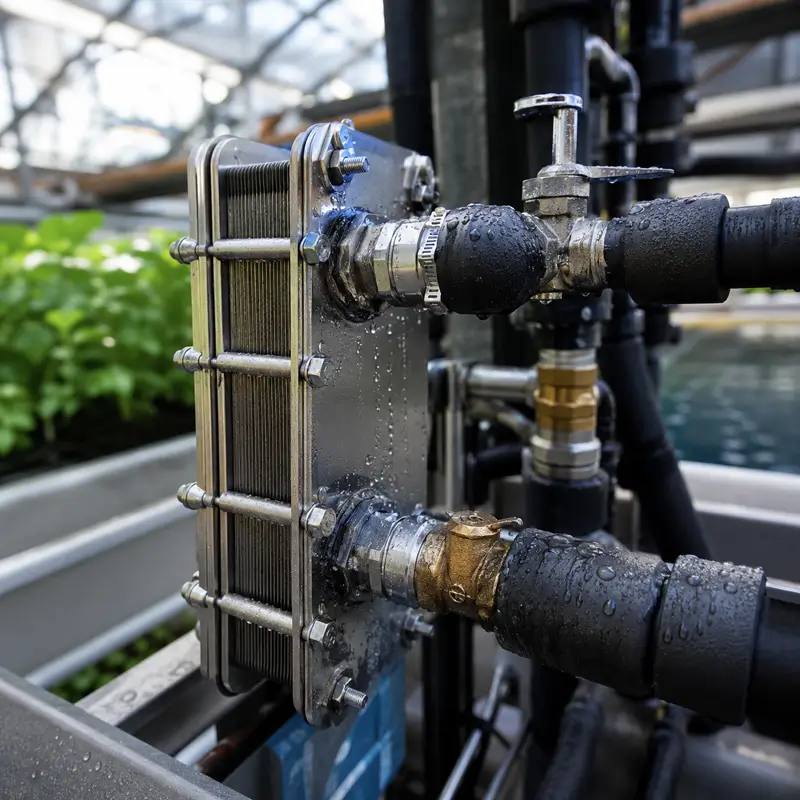
In RAS, the concept of heat load is more complex because water temperature is directly connected to species biology and water quality. IRENA reports a typical temperature range of 15 to 30 degrees Celsius for aquaculture water and states that heat can be transferred from geothermal water through a heat exchanger or direct mixing. In a recirculating system, an indirect heat exchanger is the more cautious option, because direct mixing can introduce chemical, microbial, and mineral risks into the culture water. Therefore, in RAS, the main question is not whether the heat is cheap; the more precise question is whether the heat is stable and manageable without compromising biological control.
Technical Design of Waste Heat and Shallow Geothermal Energy for Controlled Production
In technical design, waste heat must be evaluated in terms of temperature, flow rate, continuity, cleanliness, and distance from the user. A source such as a cold-storage condenser or warm wastewater may be attractive from a temperature perspective, but if annual availability, industrial shutdowns, or connection rights are unclear, it becomes an operational risk. For shallow geothermal energy, the issue is not merely drilling; borehole execution quality, groundwater protection, sealing, compatible materials, and compliance with water and environmental regulations are all part of the design. The VDI 4640 standards are based on this same logic and frame shallow geothermal energy as an engineering system, not simply as a heat source.
– German Engineering Guideline Body: “VDI 4640-2 focuses on the design and installation of ground-source heat pumps.”
For greenhouses, low-temperature geothermal resources below 90 degrees Celsius generally fall within a range that can provide heating. This type of resource is not the same as shallow geothermal energy, because in German references, shallow geothermal energy can be defined up to roughly 400 meters and around 25 degrees Celsius, and it often requires a heat pump to deliver useful heat. By contrast, low-temperature geothermal energy may enter the system as warm water or a hot well for direct or semi-direct use. Distinguishing between these two concepts is critical from an investment perspective, because CAPEX, permitting, source risk, and heat-exchanger architecture differ in each case.
– International Renewable Energy Agency: “Geothermal resources below 90 degrees Celsius usually provide the heat required for greenhouses.”
Thermal storage is also important in greenhouses because heat production and heat demand are not always simultaneous. In the HEATSTORE example in the Netherlands, IRENA refers to aquifer thermal energy storage at a depth of about 500 meters with an expected recovery efficiency of 80 percent. This data shows that in large greenhouses, the issue is not only finding a heat source; temporal management of heat is also part of the energy architecture. If excess heat from summer or low-demand hours is stored and returned during the cold season, the project becomes less dependent on the exact moment when heat is produced.
In RAS, the thermal system must be designed alongside filtration, aeration, and water circulation. Energy modeling in this field becomes meaningful when it is combined with mass balance, water quality, makeup water, evaporation, tank losses, and the biological requirements of the species. Adjusting the recirculation flow in one RAS modeling study for Atlantic salmon reduced energy consumption by 8 percent, but this figure should not be interpreted as the direct effect of a heat pump or geothermal energy. Its technical message is clearer: operational optimization in RAS can sometimes be as important as the choice of energy source in reducing OPEX pressure.
Global Evidence on Geothermal Greenhouses and the Lesson of Source-Risk Reduction
The Netherlands is an example showing that greenhouse geothermal energy does not advance through technology alone; it also requires policy and financial tools. IRENA reported that by the end of 2017, 18 of the 19 active geothermal projects in the Netherlands were used for heating commercial greenhouses. This concentration is not accidental. Greenhouses have a more stable and predictable heat load than many dispersed uses, and this feature makes them more suitable for geothermal investment. The key lesson from the Dutch experience is the link between subsurface data, operational support, and well-risk reduction.
The Dutch risk-reduction mechanism for geothermal projects included coverage of 85 percent of well costs if the thermal capacity was lower than expected, a 7 percent insurance premium, and a coverage cap of 7.2 million euros. This model shows that source risk in a geothermal project is a matter of bankability before it is a matter of operation. A bank or private investor enters the project only when a potential well failure does not destroy the entire financial balance of the plan. For countries that do not have broad commercial experience in this field, direct technology transfer without transferring a risk-reduction mechanism is not enough.
The Chena case in Alaska shows another operational angle of the issue. This greenhouse has been active since 2004 and, according to IRENA’s reference to NREL, has used geothermal heat for hydroponic production of lettuce, vegetables, tomatoes, and small fruits. Fuel savings of up to 80 percent compared with energy production using diesel or gas have been reported, and these savings have been estimated at about 5 to 8 percent of total operating costs. These two figures are important together because they show that a significant reduction in fuel consumption does not always reduce total OPEX by the same proportion; the share of energy in each project’s cost structure must be calculated separately.
The Çaldıran example in Turkey is also valuable from a climate perspective. IRENA reports that temperatures in the region can fall to minus 40 degrees Celsius, while geothermal wells keep the temperature inside the greenhouse above 15 degrees Celsius. This example sends a clear message for cold regions: a stable heat source can make greenhouse production possible in a climate where production would carry high risk without reliable heating. However, the value of such an example in an investment article becomes complete only when financial data, return rates, and cost of capital are also available. Therefore, the correct use of this case is as technical climate evidence, not as a guaranteed promise of profitability.
RAS and the Trade-Off Between Lower Water Pollution and Higher Electricity Risk
RAS is environmentally attractive because it recirculates water and increases the ability to control nutrients and outlet water quality. A Luke Finland report on the Baltic region estimates that phosphorus and nitrogen discharge can be reduced by about 80 to 90 percent compared with cage farming. This advantage matters to fisheries and environmental policymakers, but it does not mean production is automatically cheaper. The same report warns that the carbon footprint of RAS can be larger because of high electricity consumption, and that the economic performance of some companies has been weaker than feasibility-study estimates.
– Researchers at the Natural Resources Institute Finland: “Depending on the technology, phosphorus and nitrogen discharge in RAS can be reduced by about 80 to 90 percent.”
The study by Ayuso-Virgili and colleagues on Atlantic salmon makes RAS energy figures more tangible. In this modeling study, a 15-week growth period from 42.5 to 322 grams was examined, and a specific energy demand of 9.59 kilowatt-hours per kilogram was reported. Total energy use over the period was 664 megawatt-hours, and daily demand ranged from 4.93 to 6.96 megawatt-hours per day. These figures show that without energy design, RAS may be advanced in terms of biological control but remain vulnerable in terms of OPEX.
– Gerard Ayuso-Virgili and colleagues, researchers at Western Norway University of Applied Sciences and NTNU: “The study calculated the specific energy demand of RAS at 9.59 kilowatt-hours per kilogram.”
In RAS, heat recovery and the use of a low-temperature source must be combined with biological caution. Using an indirect heat exchanger allows energy from geothermal or waste heat sources to be transferred to culture water without allowing the source water itself to enter the biological system. This separation is important to prevent the entry of minerals, microbial contamination, or unwanted chemical compounds. Therefore, proper RAS design is not only about selecting a pump and heat exchanger; it is about defining a safe boundary between the energy loop and the biological loop.
The Baltic and Danish experience also carries an economic warning. Luke has reported that Denmark accounts for about half of EU RAS production, while the actual economic performance of some RAS companies has been weaker than feasibility studies suggested, and several companies have become loss-making, shut down, or gone bankrupt. This report shows that larger scale alone does not guarantee profitability, even if the project is environmentally attractive. For investment in RAS, electricity cost, access to stable heat, disease risk, sales markets, and operational efficiency must be assessed together.
The Heat-Contract Financial Model for Controlling Project CAPEX and OPEX
Financial analysis of a waste heat or geothermal project must begin by separating CAPEX and OPEX. CAPEX includes feasibility studies, engineering, heat exchangers, pumps, electricity and control systems, design and construction of the hot-water supply and return loop, and, in standalone geothermal projects, exploration and drilling. OPEX includes electricity for pumps and compressors, heat-pump maintenance, descaling, heat-exchanger corrosion control, water-quality monitoring, insurance, repairs, and the cost of heat-source downtime. This distinction allows the project to be evaluated not merely through the slogan of energy reduction, but through the clear cash-flow impact of each decision.
For investment decisions, IRENA introduces indicators such as NPV, IRR, BCR, and PBT. The payback time, or PBT, is calculated by dividing the investment by annual cash flow and shows when the project approaches breakeven. But for projects that involve source risk or long-term contracts, PBT alone is not sufficient because it does not fully capture the time value of money, downtime risk, discount rate, and revenue stability. For this reason, NPV and IRR are essential for comparing a heat project with other investment options.
The cost-plus model in heat sales states that the heat tariff should cover capital costs, operating costs, and a reasonable return for the developer. This logic can be used for heat-purchase agreements, greenhouse heat supply, RAS heat supply, and heat-as-a-service models. If the source owner and consumer are not the same entity, the contract must define heat quality, delivery temperature, availability hours, tariff formula, downtime responsibility, and maintenance standards. Otherwise, cheap heat can turn into a contractual dispute or a production-downtime risk.
In projects connected to existing infrastructure, the logic of cost allocation is especially important. IRENA explains that in geothermal projects connected to a power plant, exploration and drilling costs have already been paid by the plant owner, and only the CAPEX and OPEX of thermal use should be reflected in the heat tariff. The same logic applies to power-plant or industrial waste heat: the consumer should not pay the full infrastructure cost for assets that were created for another purpose. This point can make the difference between an attractive project and one that cannot be financed.
Financial instruments in this field must match the project’s risk stage. For early exploration and drilling, grants or development loans can reduce upfront capital pressure; after the source test is approved, project finance and credit or source guarantees can enter. Heat-purchase agreements, public-private partnerships for local heat networks, and BOOT models are useful when the source owner, energy operator, and final consumer are not the same entity. For Iran, such a structure is defensible only when the heat-source map, consumption baseline, and contractual framework are prepared at the same time.
Energy Standards and Public Policy for Connecting Waste Heat
In Europe, energy policy has moved toward prioritizing efficiency, heat recovery, and connecting heating and cooling to cleaner sources. The European Union Energy Efficiency Directive in 2023 gave the “energy efficiency first” principle a legal position. For greenhouses and RAS, the practical translation of this principle is clear: before purchasing new energy, the heat load must be reduced, recoverable heat must be identified, and only then should the supplementary source be selected. This sequence also makes economic sense, because reducing the load can reduce the size of the pump, heat exchanger, storage tank, and heat network.
– European Commission: “The energy efficiency first principle was given legal status in EU energy policy for the first time.”
Article 26 of the same directive strengthens the transition of district heating and cooling toward renewable energy and waste heat or waste cooling. This approach is relevant for greenhouse clusters, industrial parks, and food-production complexes because the value of waste heat usually increases when the distance between the source and the consumer is short. Article 11 also expands the requirement for energy management systems and energy audits for large consumers. Such a framework reminds industrial greenhouses and energy-intensive RAS facilities that without a consumption baseline, monitoring, and continuous improvement, claims of energy reduction are not reliable.
– International Organization for Standardization: “ISO 50001 provides a framework for establishing, implementing, maintaining, and improving an energy management system.”
RED III also identifies the physical integration of renewable energy or waste heat and cooling into heating and cooling supply as one of its policy measures. This statement matters for controlled food-production projects because it turns waste heat from an unused output into part of the energy plan. At the implementation level, this change means a need for waste-heat mapping, heat-purchase agreements, connection standards, and metering rules. As long as waste heat is seen only as a scattered opportunity, turning it into an investable asset remains difficult.
– Official Text of the European Union: “Countries should pursue the physical integration of renewable energy or waste heat into heating and cooling supply.”
Iran’s Implementation Path for a Low-Risk Greenhouse and RAS Pilot
For Iran, a cautious path does not begin with claims about a mature market; it begins with site-specific feasibility studies and pilots. A defensible opportunity emerges when a greenhouse or RAS is located beside a stable heat source, such as a cold storage facility, food industry plant, small power plant, industrial park, large condenser, warm wastewater stream, or a geothermal source suitable for study. In such a scenario, physical proximity is as important as source temperature, because long-distance heat transfer increases CAPEX and thermal losses. Iran’s priority should be to identify locations that have both a stable consumer and a nearby heat source.
A greenhouse pilot can be lower-risk than moving directly into RAS because a greenhouse is generally less biologically sensitive to the chemical quality of source water, and its delivery temperature is more compatible with low-temperature hot water. In this pathway, the hot-water loop, thermal storage tank, heat exchanger, water-to-water heat pump, and temperature and humidity control system must be designed together with an energy-consumption baseline. The goal of the pilot should not be to announce a return-on-investment figure from the start, but to record real data on heat load, source availability hours, maintenance costs, and crop behavior. Such data can later become the basis for NPV, IRR, and a heat-purchase agreement.
An RAS pilot must be designed more narrowly and more precisely. A warm-water species located near a stable heat source, an indirect heat exchanger, water-quality monitoring, backup electricity, and a heat-source interruption protocol are essential elements of such a pilot. In RAS, even a short-term temperature drop or disruption in water circulation can create biological consequences, so electricity stability and heat stability must be assessed simultaneously. The use of waste heat in RAS is defensible only when the energy loop remains separate from the biological loop and water-temperature control is managed alongside oxygen, ammonia, and nitrate.
For shallow geothermal energy, Iran’s path should rely on drilling standards, groundwater protection, and a source-risk reduction model. The Dutch experience shows that well-performance guarantees can prevent capital from being locked into geological risk. However, projects close to industrial waste heat are lower-risk at the beginning than exploratory geothermal projects, because the heat source already exists and the initial capital is focused more on connection, heat exchangers, controls, and contracts. This same trade-off should be considered when selecting the first pilots.
The Investment Decision for Turning Low-Grade Heat into a Productive Asset
Low-grade heat becomes a productive asset when three conditions exist at the same time: the source is stable, the consumer has a predictable heat load, and the economic contract can allocate risks among the parties. Greenhouses and RAS are both controlled consumers, but their risk profiles are not identical. A greenhouse is more exposed to nighttime load, humidity, seasonality, and product quality; RAS, in addition to energy, depends on water quality, disease, oxygen, and equipment reliability. Therefore, applying one single formula to both areas dangerously oversimplifies the investment decision.
A reliable implementation path begins with thermal mapping. Waste-heat sources, their temperatures, flow rates, operating hours, possible shutdowns, ownership, and distance from the consumer must be recorded. Then the heat load of the greenhouse or RAS must be measured using an energy-consumption baseline and operational scenarios. After that, the financial model must assess CAPEX, OPEX, heat tariff, discount rate, NPV, IRR, BCR, and PBT under several scenarios, and only the options that remain resilient against source shutdowns and electricity-cost changes should move to the contracting stage.
For Vestra and similar investors, the value of this field lies in combining energy technology with the food value chain. Waste heat and shallow geothermal energy, if properly designed, can reduce energy costs in controlled production. More importantly, however, they introduce a new data and contractual discipline into the project. A successful project is not built by purchasing a single piece of equipment, but by synchronizing the heat source, consumer, control system, energy standard, and financial model. This perspective turns energy-cost reduction from a general promise into a measurable engineering and investment pathway.