
Autonomous Sea Cage Feeding Economics

Autonomous Feeding in Offshore Sea Cages by Combining USVs, Underwater Vision, and Fish Behavior Modeling
When fish farming moves from controlled ponds to open offshore cages, feed is no longer just a production input; it becomes the point where economics, fish welfare, and seabed health intersect. Every feed pellet distributed at the wrong time, in excess of actual need, or at the wrong location can increase production costs while entering the water column and seabed as uneaten feed or fecal waste. This issue is more sensitive in offshore cages because the farming environment exchanges directly with the surrounding ecosystem, and operational errors do not simply remain inside the farm. Autonomous feeding becomes important at precisely this point, because its purpose is to turn feeding from an experience-based and schedule-driven decision into a data-driven loop.
The FAO global report published on June 7, 2024, makes the scale of this shift clearer. In the 2022 statistical year, total global fisheries and aquaculture production reached 223.2 million tons, total aquaculture production stood at 130.9 million tons, and farmed aquatic animal production reached 94.4 million tons, accounting for 51 percent of global aquatic animal production for the first time. The first-sale value of total fisheries and aquaculture production was also reported at about $472 billion, while the first-sale value of aquaculture was $313 billion. This scale shows that even small improvements in feed management can translate, at the industry level, into lower costs, reduced waste, and greater capacity for sustainable production.
– Manuel Barange, Assistant Director-General and Director of the FAO Fisheries and Aquaculture Division: “Today, 750 million people suffer from hunger, and that number has not declined.”
The connection between precision feeding and food security begins with this reality. If aquaculture is expected to play a larger role in supplying healthy protein, its development cannot be defined only by increasing the number of cages or expanding production volume. A system that observes fish behavior, detects uneaten feed, analyzes density conditions and group response, and then adjusts the feeding command is closer to efficiency than an approach that relies only on manual experience or fixed scheduling. From this perspective, autonomous technology is not a simple replacement for human labor, but a tool for more precise decision-making in a complex and living environment.
From Feed Delivery Boat to Feeding Decision-Support System
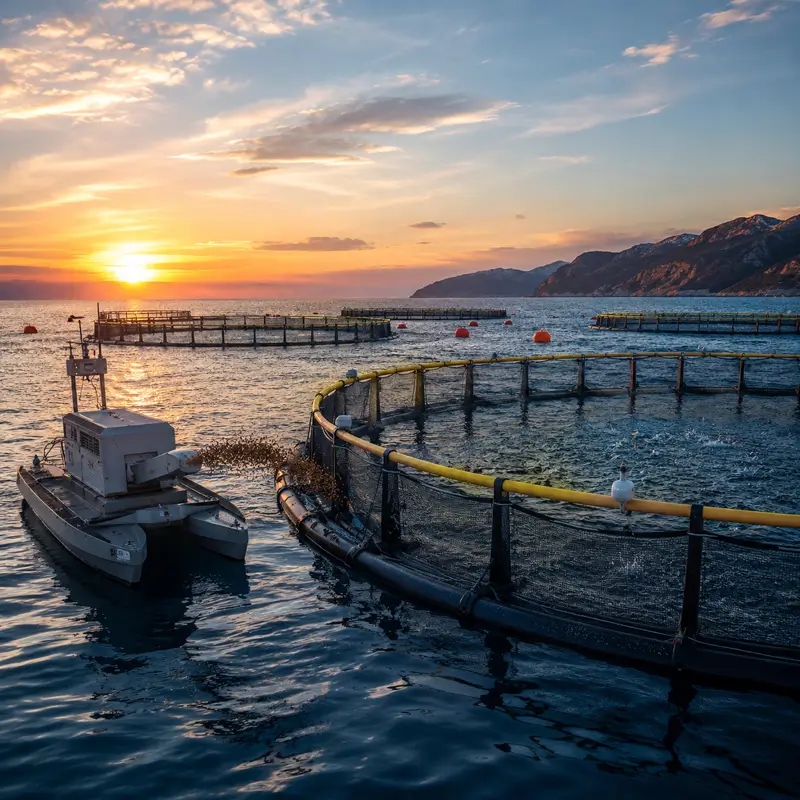
Autonomous feeding in offshore cages should be understood as a closed-loop system, not merely as a vessel that spreads feed across the water surface. In an operational definition aligned with the framework of precision fish farming, data from underwater cameras, environmental sensors, collective fish behavior, and growth programs are fed into a decision model, whose output adjusts the timing, rate, quantity, and location of feeding. In a version equipped with an unmanned surface vessel, the USV serves as the surface-level operational layer and can participate in transport, distribution, or sensing support. However, the intelligence center of the system is not the boat; it is the monitoring, analysis, decision, and action loop.
The Precision Fish Farming framework introduced by Føre and colleagues in Biosystems Engineering provides a suitable scientific basis for such a system. This framework brings together sensors, cameras, biological models, and automated systems to improve aquaculture production and move aquaculture from reactive operations toward more precise and data-driven management. The key difference between automatic feeding and autonomous feeding lies exactly here. Automatic feeding can be the execution of a predefined program, but autonomous feeding must use real fish behavior and environmental feedback to revise its decisions.
This distinction has direct importance for investment and farm design. If technology only means replacing human labor with a mechanical actuator, its value is limited to reducing part of the daily workload. If technology becomes a feeding decision-support or automated feeding system, its output affects FCR, growth uniformity, fish welfare, and the reduction of organic pressure on the seabed. In offshore cages, these four outcomes are interdependent; overfeeding not only worsens the feed conversion ratio, but also increases the likelihood of pellets passing beyond the reach of fish and raises the organic load in the environment.
– Manuel Barange, FAO Assistant Director-General: “These figures demonstrate aquaculture’s capacity to feed the world’s growing population.”
Underwater Vision and Fish Behavior Models at the Core of the Control Loop
An underwater camera in autonomous feeding is not merely an imaging tool. Underwater imagery can turn signs of appetite, local density, swimming depth, movement speed, group dispersion, fish orientation toward feed, and response intensity to feed distribution into analyzable data. When fish move toward the distribution point during feeding, changes in movement and density patterns can justify continuing the feeding process. When the group response weakens or uneaten pellets appear in the image, that same image warns the system that the feeding rate should be reduced or the distribution point should be corrected.
A direct scientific example of this pathway is the use of a modified YOLO-v4 version for real-time detection of uneaten feed pellets in underwater aquaculture images. The value of this example is that it turns the issue of wasted feed from a subjective judgment into an object-detection problem. Uneaten pellets in the water column are an operational sign that feed has passed beyond the point of consumption and can provide feedback to the feeding controller. Such feedback allows the system to adjust feeding not based on elapsed time, but based on the actual response of fish and the presence of remaining feed.
– Feeding Behavior as the Operational Language of Fish
Feeding behavior in offshore cages is not a single data point, but a combination of several simultaneous signals. Swimming depth shows the water layer in which the school is more active, local density shows where competition or feeding concentration has formed, and movement speed can indicate the intensity of the response to feed. Group orientation is also important for identifying the proper feed distribution location, because feeding at a point that does not match the school’s movement pattern increases the likelihood of waste. The behavioral model must connect these signals with the growth stage, feeding status, and operational conditions so that the feeding decision aligns more closely with the fish’s actual behavior.
In this architecture, the USV plays a complementary role and should be seen as the logistics and surface-actuation layer. In the complete version of the system, the unmanned surface vessel can move feed, sensors, or the distribution point closer to the appropriate location, but the main value is created when its commands are driven by the underwater vision loop and fish behavior model. If the vessel only follows a fixed route and distributes feed according to a fixed program, the system remains closer to basic automation. If its route, rate, or distribution point is corrected based on underwater data and feedback from uneaten feed, the USV moves closer to becoming the actuator of a truly autonomous system.
The Economics of FCR and Reducing Wasted Feed
Feed conversion ratio, or FCR, is one of the clearest economic indicators in fish farming, because it shows the ratio of feed consumed to biomass gain. The more feed required to produce one unit of biomass, the more production costs and environmental pressure increase. Autonomous feeding enters the economics of operations directly at this point, because it tries to deliver feed at the moment when fish are ready to consume it and to align the distributed amount with the school’s actual response. Improving FCR in this framework is not only the result of feed-formulation design; it is also the result of timing, distribution location, feeding rate, and stopping feeding at the right moment.
The revenue logic of such a system must be built through several qualitative pathways. Reducing wasted feed helps control feed costs, reducing the passage of uneaten pellets to the seabed lowers organic pressure, growth uniformity can improve harvest management and sales planning, and reducing dependence on manual judgment makes feeding decisions more repeatable. This economic logic does not depend on a fixed return-on-investment figure, because equipment, maintenance, communications, and calibration costs differ from site to site. The real value of the system is measured when data on feed consumption, growth, behavior, and seabed condition are recorded within a single operational cycle.
Feed economics in offshore cages is also tied to the economics of risk. A system that focuses only on reducing feed costs may look attractive in the short term, but open cages in the marine environment face carrying-capacity limits. Precision feeding must be evaluated simultaneously from the perspectives of fish growth, stock health, and seabed impact. If feeding is combined with uneaten-pellet monitoring and seabed monitoring, the farm can detect warning trends earlier and adjust operational intensity instead of reacting only after an environmental impact has already appeared.
Fish Welfare, Density, and Environmental Responsibility
The European Union’s guide on Good Husbandry Practices for Aquaculture defines feeding as an operation that must make feed available to all aquatic animals at the right time and in the right amount, while matching the nutritional needs of the species and growth stage. This view turns feeding from a mechanical activity into an issue of welfare and biological management. Norway’s aquaculture operation regulations also emphasize, in the feeding section, that the amount of feed must be sufficient for health and welfare and must be compatible with the species, age, growth stage, weight, physiological needs, and behavioral needs. Autonomous feeding sits precisely at this boundary, because it must align feed with fish biology and behavior.
Density also falls within this logic. Norwegian regulations consider density to depend on water quality, behavioral and physiological needs, health status, type of operation, and feeding technology. If an autonomous system cannot observe real-time density and fish dispersion, feed may reach one part of the school while another part falls behind in feeding competition. In addition to affecting growth uniformity, this situation can increase behavioral pressure and unequal access to feed. Underwater cameras and fish behavior models are designed to reduce exactly this blind spot.
The environmental dimension of this issue is more serious in open cages. ASC’s white paper on seabed monitoring identifies wasted feed and feces as sources of impact on seabed habitat, biodiversity, and ecosystem function, and describes the aim of its requirements as reducing, mitigating, or eliminating negative impacts. ASC also refers to biological and abiotic indicators for classifying ecological quality status at open-water farms. The practical meaning of this approach is that autonomous feeding should not be assessed only through FCR; it should also be connected to seabed data and ecological quality.
The ASC Farm Standard and ASC Feed Standard also create a broader horizon for this technology. The farm standard covers areas such as legal compliance, environmental responsibility, human rights, and animal health and welfare, while the feed standard focuses on negative environmental and social impacts associated with aquaculture feed. When an autonomous feeding system is placed within such a framework, data on feed, behavior, waste, and seabed conditions are no longer important only to farm engineers. These data become part of the farm’s accountability to the environment, the market, and regulatory institutions.
Iran and the Conditions for Smart Offshore Cage Development
In Iran, the development of offshore cages has become a policy priority because of reduced rainfall and freshwater scarcity, and FAO/UN Iran has linked this pathway to protein supply, healthy food, and alternative livelihoods. The FAO project for Iran has focused on strengthening offshore cage-culture capacity, helping develop a national development and management framework, and providing practical training for farm operators and extension specialists. This context shows that if autonomous feeding technology enters Iran’s offshore cages, it must be part of a sustainable cage-development policy, not a piece of equipment separate from training, monitoring, and regulation. A system that only distributes feed but cannot interpret and respond will not use the real advantage of autonomy.
– Gerold Bödeker, FAO Representative in the Islamic Republic of Iran: “During the project implementation phase, farm managers and extension experts will be trained.”
Training is doubly important in autonomous feeding, because the farm operator must understand the algorithm’s output, detect sensor error, and know when human control should intervene. An underwater camera may misread conditions because of water turbidity, biofouling, changes in light, or poor positioning. A fish behavior model also needs sufficient data for the species, season, temperature, salinity, and local characteristics. Therefore, the lower-risk pathway for Iran begins with a decision-support system: underwater cameras, uneaten-feed detection, a behavioral dashboard, and operational data recording before moving toward fully autonomous execution.
The more sensitive issue for Iran is connecting precision feeding with carrying capacity and the environmental risk of the Persian Gulf. The paper by Risk and colleagues in Marine Pollution Bulletin modeled a production scenario of 200,000 tons per year in open cages in the Persian Gulf and entered a nitrogen load of 44 kg N into the model for each ton of fish produced. In the same scenario, a threshold of 20 micrograms per liter of total nitrogen for coral reefs was used as the environmental sensitivity value. These data show that while precision feeding is a tool for reducing waste, it does not by itself replace carrying-capacity assessment, site selection, and seabed monitoring.
For Iran’s coasts, especially at sites near reefs, mangroves, or weak-current areas, feeding decisions must be accompanied by environmental monitoring. If uneaten feed decreases in underwater images but seabed indicators show an unfavorable trend, the farm management system must be able to revise production intensity, feeding schedules, or distribution patterns. This same logic increases the value of accumulated data. Each feeding cycle, if recorded with imagery, feed quantity, fish behavior, and environmental indicators, becomes part of a database that is valuable for improving models and supporting regulatory decision-making.
– A Phased Pathway for Localization
Localization of this technology in Iran is better designed in phases. The first phase can focus on underwater cameras, uneaten-pellet detection, and a decision-support dashboard, because direct scientific evidence already exists for underwater vision and remaining-feed detection. The next phase can complete the feeding-behavior model using data from each site and farmed species, and connect it with the growth program, density, and environmental status. After that, the USV can enter as an actuator or surface-support layer, provided that its commands are driven by the data-driven system rather than by a fixed program.
Such a phased pathway is also more compatible with investment logic. In the first step, investors need operational data to understand how wasted feed, FCR, growth, behavior, and seabed condition change on a specific farm. Government and regulatory institutions also need recorded data to define monitoring requirements, licensing, and accountability more precisely. Farmers, too, must be sure that the system clarifies daily decisions instead of making operations more complicated. These three needs are better addressed through a shared data platform than through scattered equipment purchases with no management integration.
Practical Conclusion for the Blue Economy and Food Security
Autonomous feeding in offshore cages has strategic value when it moves beyond basic automation and becomes a system for observing, understanding, and correcting feeding operations. Underwater vision, fish behavior models, uneaten-pellet detection, and surface actuators such as USVs are each part of this chain, but none of them solves the problem alone. The strength of a data-driven architecture is that it connects feeding simultaneously to FCR, welfare, uniform growth, and seabed impact. Ultimately, such a system must help the farm manager avoid feeding less than the fish need while also avoiding the introduction of more feed into the cage than the fish can consume and the environment can tolerate.
For Iran, the main value of this technology lies in cautious and measurable offshore cage development. Offshore cages can be part of the response to freshwater limitations and the need for protein, but their development in environments such as the Persian Gulf will be risky without monitoring feed, nitrogen, seabed conditions, and fish behavior. Combining underwater cameras with behavioral models is a practical starting point for reducing wasted feed and increasing decision transparency. The entry of USVs also becomes more justified once the decision-support system has created sufficient data, monitoring protocols, and human capacity.
At the industry scale, the future of feeding in offshore cages is not limited to a competition between humans and algorithms. The more precise path is cooperation among farmer experience, live underwater data, behavioral models, and environmental standards. The better a system can interpret fish behavior, adjust feed quantity, and report seabed impact transparently, the closer marine aquaculture moves toward a form of production that is economically defensible while also aligning more effectively with food security and environmental responsibility. In this model, autonomous feeding is not a display of technology, but a tool for the intelligent management of the marine protein production chain.