BSF Larvae for Protein Feed, Organic Fertilizer
Black Soldier Fly Larvae in the Circular Agricultural Economy
Every wholesale produce market, food-processing plant, or seafood processing center faces the same question: how can the organic fraction of waste be transformed from a disposal cost and a potential source of pollution into material that can return to the food chain? Black soldier fly larvae, scientifically known as Hermetia illucens, are one biological answer to this problem because, instead of burning, burying, or releasing biowaste, they bring it into the growth cycle of a living organism. The output of this process is not only a reduction in waste volume, but also the production of larval biomass for feed and frass for organic fertilizer and soil-amendment pathways. These two outputs have placed this technology at the intersection of food security, waste management, alternative feed, and circular agriculture.
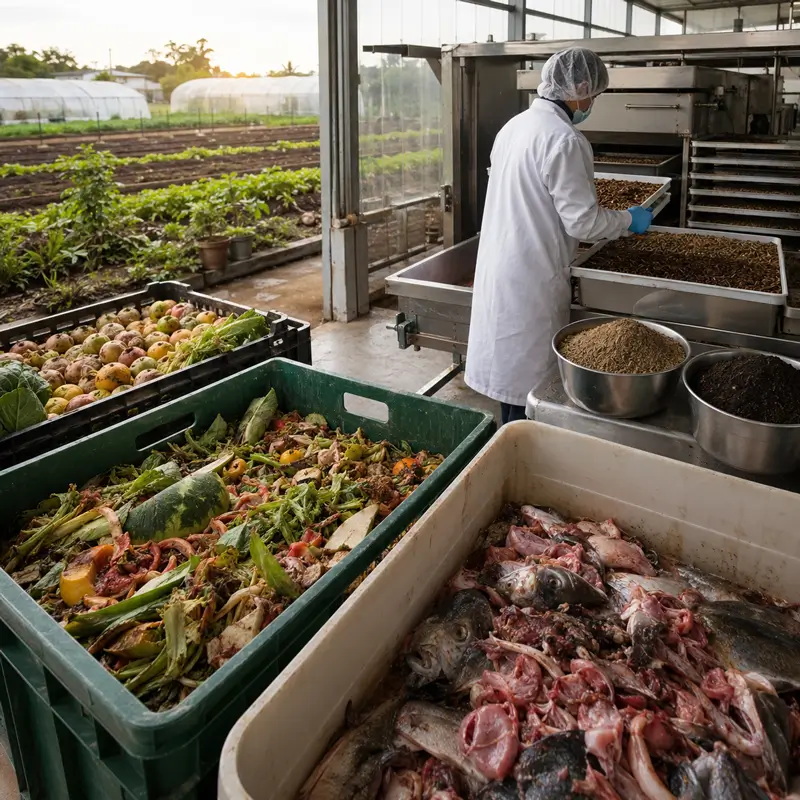
The economic logic of black soldier fly larvae is directly tied to the circular agricultural economy because it extracts value from the very point that is usually considered a cost center. Fruit and vegetable waste, waste from food-processing plants, and certain permitted food-grade streams can become rearing substrates if they are properly separated and quality-controlled. Fishery waste is also technically attractive, but its perishability, salinity, fat content, heavy metals, and regulatory classification mean that using this stream is defensible only with input testing and strict control. Therefore, the central issue is not simply rearing an insect; it is designing an industrial chain that simultaneously manages the source of waste, preprocessing, rearing, harvesting, processing, and final-product control.
For Iranian agriculture, the appeal of this issue is not limited to producing an alternative feed. On one side, the country faces diverse organic streams in wholesale produce markets, food industries, and fisheries; on the other, it needs measurable economic models for developing aquaculture, poultry, and biological soil inputs. A document presented in the FAO context for Iran’s fisheries reports 261,000 total fisheries workers, 144,000 direct fishers, 117,000 aquaculture workers, 15,488 vessels, and 350 fisheries cooperatives. These figures show institutional and logistical capacity, but turning that capacity into an industrial black soldier fly larvae project is defensible only when regional pilots realistically assess waste quality, safety risks, and product markets.
How Does Bioconversion of Produce Waste with Black Soldier Fly Larvae Create Value?
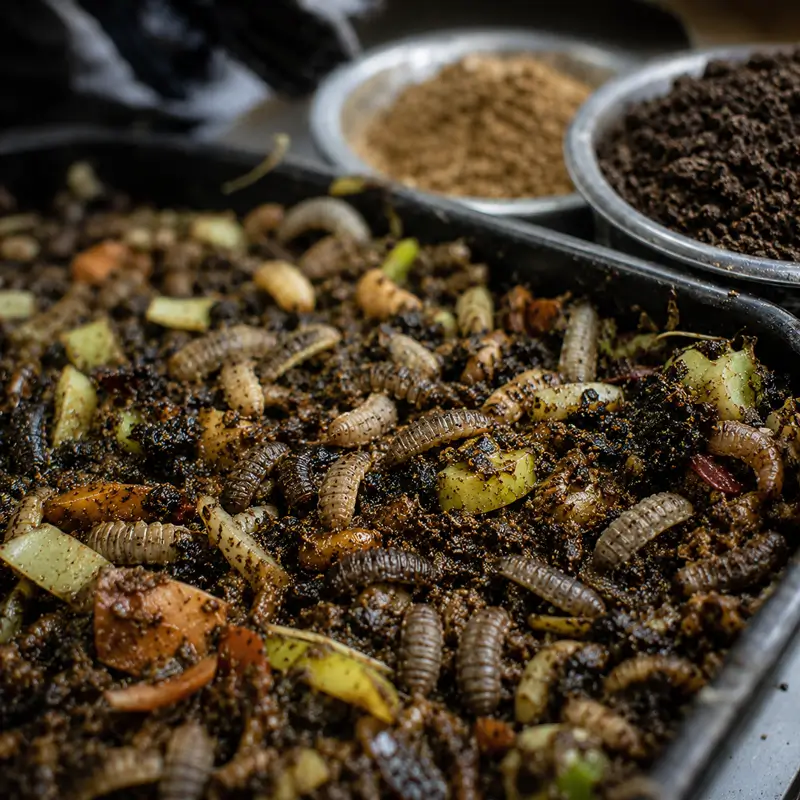
In operational terms, bioconversion with black soldier fly larvae means feeding separated organic biowaste to larvae, harvesting larval biomass, and then managing process residues for soil-amendment or organic-fertilizer pathways. Eawag technical resources describe this technology as a method for converting organic biowaste into larval biomass and frass, and they report a 50 to 80 percent reduction in waste material. Within the same framework, conversion of up to 20 percent of waste into larval biomass over roughly 14 days is presented as a guiding figure. These numbers should be treated as design indicators, not fixed universal promises, because temperature, humidity, particle size, larval density, and substrate composition all change the final outcome.
The main advantage of fruit and vegetable waste compared with higher-risk streams is its better fit with the logic of separation and preprocessing. This stream usually has high moisture content and, in daily operations, requires shredding, moisture adjustment, retention-time control, and prevention of rapid spoilage. If this input enters the rearing facility without classification and monitoring, the biological advantage can quickly turn into risks such as odor, mold growth, fluctuating efficiency, and declining product quality. For this reason, successful units are not merely insect-rearing facilities; they are small bioconversion plants that record input data, growth conditions, and output quality.
In this chain, larval biomass carries protein and fat value, while frass is a material that can, after proper processing, be directed toward soil amendment. European Union regulations define frass as a mixture of insect excrement, parts of dead insects, and unprocessed rearing substrate. This definition matters because it separates raw frass from ready-to-use fertilizer or fully mature compost and shows that the output of a rearing facility is not automatically a final agricultural product. Therefore, any credible economic model must define processing, testing, and target markets for both outputs: the feed product and the organic soil material.
Insect Feed Safety from Rearing-Substrate Control to Final-Product Testing
The safety file in black soldier fly larvae technology begins with the rearing substrate. EFSA has emphasized that the biological and chemical hazards of insect products depend on the production method, feed or rearing substrate, harvesting stage, insect species, and processing method. This statement carries a clear operational message for produce and fishery waste: the final product approaches the feed chain only when input source, rearing conditions, post-harvest processing, and final testing are managed as an integrated system. Any broad use of the phrase organic waste for larval feed, without separating risk and permitted uses, weakens the path toward standardization.
In the case of fishery waste, economic appeal and safety risk move together. Residues from fish and seafood processing can be interesting for bioconversion because of their protein and fat content, but rapid spoilage, salinity, high fat levels, and the possibility of chemical contamination distinguish them from simple fruit and vegetable waste. The European Union’s animal by-products framework shows that animal by-products in the feed and fertilizer chain require health classification and regulatory control. Therefore, designing a fishery-based pilot must, from the outset, include a sampling map, short transfer times, temperature control, and final-product testing.
– Heavy Metals and the Risk of Accumulation in Larval Biomass
The study by Diener and colleagues on Hermetia illucens showed that cadmium, lead, and zinc can become relevant in the larval cycle, with cadmium showing a higher accumulation factor at the prepupal stage. The same principle has direct importance for contaminated produce waste, waste streams located near industrial sources, and fishery streams. Testing for cadmium, lead, mercury, arsenic, zinc, and copper should not be postponed until the product sales stage; it should be part of input control and rearing-substrate acceptance design. A study on adding seaweed to larval feed also showed that concentrations of cadmium, lead, mercury, and arsenic increased as the share of seaweed rose, reinforcing the principle that risk depends on substrate composition.
– Pathogens and the Common Mistake of Assuming Automatic Sterilization
Microbial-load reduction in black soldier fly larvae technology should not be treated as a fixed and guaranteed property of the insect. Microbial evidence is not uniform. One study on animal manure showed that larvae accelerated the inactivation of E. coli O157:H7 in chicken manure, but did not have the same effect in cattle manure, while Salmonella survival increased in pig manure. This result sends a clear message for industrial design: control of Salmonella spp., E. coli, Enterobacteriaceae, mold, and yeast must be included in the safety program. Post-harvest processing, including thermal killing, drying, defatting, milling, and packaging, is an inseparable part of converting larvae into a stable feed product.
How Have European Regulations Shaped the Market for Insect Feed and Frass?
Industrial acceptance of insect protein does not emerge without a clear regulatory pathway. In Regulation 2017/893, the European Union authorized the use of processed animal protein derived from insects in aquaculture feed, marking a turning point in connecting black soldier fly larvae to the aquafeed market. Later, Regulation 2021/1372 amended the framework restricting the feeding of animal proteins to non-ruminant animals and opened a wider path for the use of insect protein in poultry and pig feed. This pathway shows that the insect-feed market grows first through the standardization of rearing substrates, processing, and permitted uses—not merely through the biological capacity of the insect.
On the organic-fertilizer side, Regulation 2021/1925 introduced the official definition of frass into the regulatory framework and linked its market placement requirements to Regulation No 142/2011. This move brings frass closer to becoming a classifiable material in the organic-input chain, rather than an ambiguous waste stream. From an investment perspective, such classification matters because selling frass or using it in soil without appropriate standards, testing, and processing cannot become a reliable revenue pillar. Therefore, the European model carries a policy message for Iran: the black soldier fly larvae chain must define feed, fertilizer, and safety at the same time.
The separation of rearing substrates is just as decisive. European insect-feed regulations distinguish permitted feed-grade substrates from high-risk waste streams, preventing every organic waste from being presented as acceptable feed for producing feed material. This approach is especially important for produce and fishery waste, because some streams may be suitable for waste management or compost production, but require a stricter safety pathway if the objective is to produce feed for livestock, poultry, or aquatic species. Real added value is created when the input type is aligned with the output market and its requirements.
Why Does the Economics of Larval Meal and Insect Oil Depend on Processing?
The economics of black soldier fly larvae cannot be explained only by the biological conversion rate. The Surabaya economic study showed that, for an integrated centralized site, the net present value was about USD 325,000, while decentralized units with processing generated about USD 55,000. In the same study, product price and biomass conversion rate were the most sensitive variables, while the effect of fuel transportation was assessed as smaller by comparison. This result matters for business design because it shows that the advantage of proximity to waste must be completed by the ability to produce a high-value product.
Selling fresh larvae alone was not found to be financially feasible at any scale in the Surabaya model. By contrast, processing into dried larvae, larval meal, and oil increased the possibility of financial viability at smaller capacities and moved the revenue model away from dependence on a highly perishable product. This distinction is also instructive for Iran, because a unit located near a wholesale produce market or aquaculture farm will face spoilage risk, a limited market, and weak pricing power if it only harvests fresh larvae on a daily basis. Industrial value emerges when drying, defatting, milling, packaging, and quality control are added to the model.
Revenue in this chain can come from several pathways: waste-management fees, sales of fresh larvae, sales of dried larvae, sales of larval meal, sales of oil, and sales or use of frass after proper processing. However, the real weight of each pathway depends on the target market and permitted use. If the goal is producing aquafeed or poultry feed, testing for chemical composition, microbial contamination, heavy metals, and product stability becomes more important than the speed of waste collection. If the primary goal is biowaste management, a decentralized unit close to the waste generator has an operational advantage, but standardized feed production may require centralized processing.
Global Case Studies from Vertical Insect Farming to Development Finance
The Innovafeed case study in France shows that industrializing black soldier fly larvae gains meaning through industrial co-location and connection to agri-food infrastructure. The company has announced an annual capacity of 15,000 tons of insect protein for its Nesle site and has reported raising €140 million in capital. These figures come from corporate disclosures and should be read as an example of industrial scalability, not as an industry average. The importance of such an example is that it moves the insect chain from the level of a small workshop to that of a continuous, capital-intensive processing plant.
The example of Entobel in Vietnam shows another angle of scalability. The company has announced an annual production capacity of 10,000 tons of insect protein for its Vung Tau site, along with 50 vertical rearing levels, and has referred to the use of robotics, sensors, and data analytics in its production structure. This information is also corporate disclosure, but it is useful for understanding the direction of the industry: large-scale insect-protein production depends on environmental control, rearing density, harvest timing, and operational data. At this level, competitive advantage is not merely access to waste, but the ability to standardize products across repeatable cycles.
In Europe, the Protix and European Investment Bank model shows how development finance can reduce scale-up risk. The European Investment Bank and Protix signed a loan of up to €37 million, backed by InvestEU, to build a new plant in Poland and develop sustainable protein. The EIB environmental and social document for the Protix project also estimated direct and energy-related emissions in a standard operating year at 36,000 tons of CO₂ equivalent per year, attributing them to the production unit, electricity, and natural gas. This data is a reminder that even sustainable-protein projects must be assessed through life-cycle evaluation and energy scenarios.
– Teresa Czerwińska, Vice-President of the European Investment Bank: “Supporting innovative solutions is a priority for the European Investment Bank, and we are pleased to work with Protix.”
The entry of a development bank into this chain carries an important message for agricultural investors. Technologies such as black soldier fly larvae require capital for processing equipment, quality control, energy, automation, and market development before they reach sustainable profitability. At the same time, the Surabaya study shows that reliance on a low-value product or weak conversion rate can make the financial model fragile. Therefore, tools such as guaranteed loans, strategic partnerships with feed industries, and growth capital, alongside technical pilots, are part of the economic architecture of this industry.
– Lynn De Proft, Chief Financial Officer of Protix: “This support shows that our industry is here to stay and is ready for significant growth.”
The Tyson Foods and Protix model in the United States also highlights the role of the industrial investor. In this model, Tyson takes a minority stake in Protix while also creating a joint venture to build and operate insect-ingredient facilities on U.S. soil. This structure matters for food chains because a major animal-protein player is not merely a buyer of the product; it participates in the production infrastructure for alternative inputs. For agriculture and aquaculture, this model shows that the insect-feed market grows faster when a strategic buyer, an investor, and a technology producer are brought together in a shared model.
The Path to Localizing Black Soldier Fly Larvae for Iran’s Produce and Fisheries Sectors
Localizing this technology in Iran should begin with small, monitorable pilots, not with claims of large national capacity. Logical starting points are beside a wholesale produce market, a food-processing plant, or an aquaculture farm, because organic waste is more concentrated at these points and there is greater potential to control inputs, transfer time, and stream separation. A decentralized model located near the waste generator can be attractive for reducing the transportation of raw waste, but if the goal is to produce standardized feed, centralized processing and a quality-control laboratory become more prominent. This trade-off must be included in pilot design from the beginning.
For produce waste, the first issue is understanding the seasonal composition and sanitary quality of the input. Fruit and vegetable streams may appear less risky than animal waste, but high moisture, rapid spoilage, and secondary contamination can change both efficiency and safety. A suitable pilot must record input and output weights on a wet-matter basis and, preferably, on a dry-matter basis; calculate the conversion rate into larval biomass with moisture correction; and measure the growth-cycle time in relation to temperature, humidity, and particle size. Without these operational data, decisions about capacity, dryer type, labor requirements, and product cost will not be reliable.
For fishery waste, stricter design is necessary. Iran’s fisheries network, described in FAO documents through its workers, vessels, and cooperatives, provides a potential institutional base for regional pilots, but fishery waste must be viewed from the outset through the logic of feed safety and animal by-product classification. Short transfer times, temperature control, spoilage prevention, heavy-metal testing, and pathogen monitoring are design requirements. Using this stream for feed production without precisely defining the type of waste, preprocessing method, and final-product standard increases the technical and regulatory risk of the project.
From Frass to Aquafeed, Why Should Investment Decisions Be Phased?
Investment decisions in black soldier fly larvae should be phased and based on pilot data. The first phase is proving stable bioconversion, meaning that the unit can convert a defined input into larval biomass and manageable process residue within a controlled time cycle. The second phase is proving product safety and quality, meaning that larval meal, oil, and frass align with the target market in terms of composition, contamination, and stability. The third phase is proving the revenue model, because the Surabaya data show that product price and biomass conversion rate are the sensitive pillars of project economics.
In industrial design, frass should not be treated as certain and immediate revenue. Under the European regulatory definition, frass is a mixture of insect excrement, insect residues, and unprocessed substrate, and market placement requires processing and control requirements. Eawag guidance also shows that post-harvest residue can enter composting or anaerobic digestion and biogas pathways. Therefore, any unit that includes frass in its financial model must clarify the pathway for turning it into a soil-usable material, its quality testing, and its end-use market.
For aquafeed and poultry feed as well, the investment program should begin with the final product. If the target market is larval meal, the plan requires stable drying, milling, possible defatting, packaging, quality testing, and purchase contracts. If the target market is larval oil, extraction equipment and fat-composition standards are added to the project. If the main goal is waste management, waste-management revenue and disposal-cost reduction can be part of the model, but converting that stream into standardized feed requires a higher level of control and permitting.
Environmental assessment must also be project-specific. Claims about emission reduction or replacement of high-carbon inputs have insufficient analytical value without life-cycle assessment, reference substitutes, and energy data from the production unit. The Protix example in EIB documents shows that even sustainable-protein projects have direct and energy-related emissions, and their net effect depends on comparison with substitute protein and fat sources. Therefore, for Iran, every serious project must assess the energy scenario, transportation, feed substitution, and frass management within a life-cycle assessment framework alongside technical design.
A Practical Conclusion for Iran’s Circular Agriculture and Food Security
Black soldier fly larvae become a real tool of the circular agricultural economy when they connect three chains at the same time: biowaste management, feed-input production, and the return of organic matter to soil. Eawag data show that the biological capacity of this technology for reducing waste material and producing larval biomass is significant, but EFSA data and studies on heavy metals and microbes show that the same capacity can become a feed risk without input control and final processing. The European regulatory experience also shows that market acceptance is shaped by separating permitted substrates, defining the product, and controlling safety. Therefore, the value of this technology lies in the combination of biology, process engineering, regulation, and market development.
For Iran, the logical path begins with limited pilots, precise data collection, and cooperation among the waste, animal-feed, fisheries, and soil-input sectors. Wholesale produce markets, food-processing plants, and aquaculture farms are three suitable points for operational testing, but each has a different safety and economic model. Before scaling up, investors must use real data from their own units to assess biomass conversion rate, meal and oil quality, frass status, processing costs, and the buyer market. If this phased pathway is followed, black soldier fly larvae can move from a biological idea to a measurable infrastructure for circular agriculture, alternative feed, and smart management of organic waste.