
Cybersecurity for digital-agri infra with standards and SOC

Cybersecurity in Digital Agriculture Infrastructure, Grounded in Standards, a SOC, and an Incident Response Plan
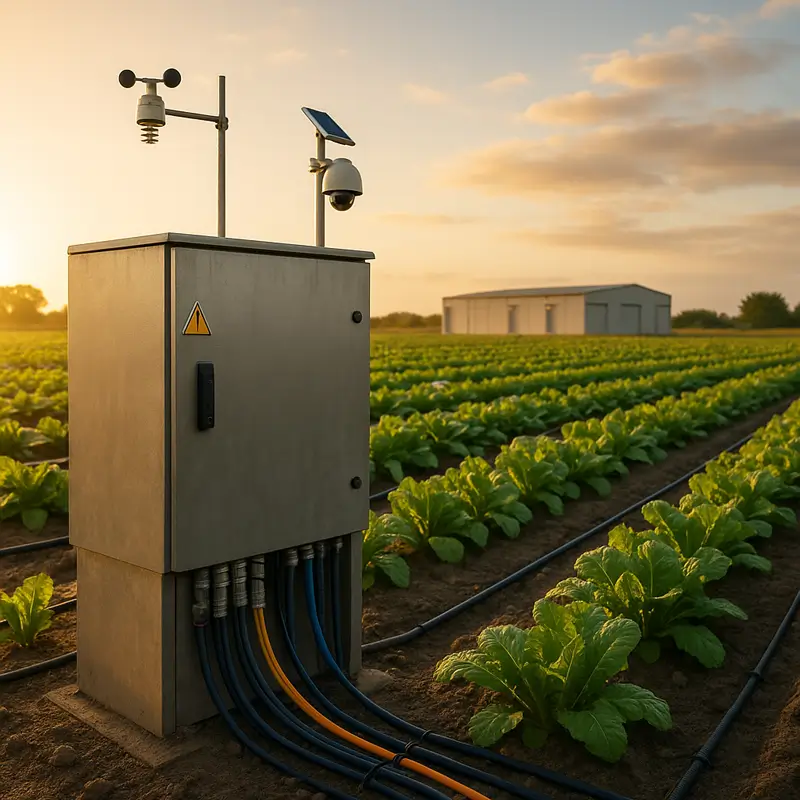
Digital agriculture takes shape when farm, greenhouse, livestock, and food-processing systems are connected to sensor networks and industrial control. Data and commands move beyond office IT and reach water pumps, fertigation solenoid valves, cold rooms, and sorting robots. This physical-digital link delivers major gains in productivity and quality, yet it also ties the attack surface to the field, the product, and the plate; a software error or an intruder can disable irrigation or spoil the cold chain.
In this context, a precise definition of operational technology is fundamental. In the industrial security canon, operational technology is the set of programmable systems that interact directly with the physical environment from PLCs and SCADA to drives and field sensors. This definition clarifies the scope: digital-agriculture assets are not merely “data”; they are the actuators that regulate water, nutrients, temperature, and ventilation. Any deliberate or accidental manipulation has tangible effects on the crop and on consumer health.
The threat landscape has shifted meaningfully in recent years. Reputable European reporting shows availability threats at the top, with ransomware close behind. For the food chain, this simply means that denial-of-service or data lockups first translate into halted planting, harvesting, transport, and storage stoppages that equate to quality loss, wasted inputs, and extra energy costs.
Real-world cases show the risk is not abstract. At one of North America’s largest meat processors, a ransomware attack halted part of production and the company paid several million dollars to eliminate customer risk. In the agricultural machinery sector, an attack coinciding with planting season disrupted ordering and delivery, and some sites faced days of slowdown or outage. These incidents underscore a key truth: in agriculture, attack timing matters as much as attack technique.
A professional response stands on the shoulders of standards and frameworks. The second version of the Cybersecurity Risk Management Framework aligns the Identify, Protect, Detect, Respond, and Recover functions with cyber governance, enabling organizations to build agriculture- and food-specific profiles. Industrial-control security guidance provides a common language of controls for operational environments and, alongside the 62443 family of standards, stitches together the enterprise security program and the technical requirements of components. Updated incident-response guidance also makes the readiness-to-review cycle more precise and actionable.
Governance and regulation are likewise decisive. In the European Union, the second Network and Information Security directive expands the scope of essential and important entities and sets requirements for risk management, reporting, and governance across the food chain. Several countries in the region have issued binding OT frameworks that prescribe controls for industrial environments and map them to international standards. While such rules impose compliance costs, in sensitive food industries they deliver clear advantages in resilience, market trust, and exports.
For farm and food-industry managers, the issue is not just technology; it is operational resilience. When drip irrigation runs on PID control or fertilizer is injected automatically at a fixed flow, unintended parameter changes can salinize soil, waste water, or under-feed plants. Cybersecurity here must be designed in lockstep with process safety: every security control, beyond its effect on confidentiality and integrity, should include procedures to prevent unsafe impacts on people and the environment.
At the execution layer, the Security Operations Center is pivotal. The visibility triad log management and event correlation, endpoint monitoring, and network threat detection should be implemented at each digital-ag site proportional to its scale. For small units, managed services and lightweight network sensors are cost-effective; for larger units and silo/cold-store clusters, network zoning, an industrial DMZ, and abnormal-behavior detection in industrial traffic meaningfully reduce time to detect and respond.
Cybersecurity investment may look like a cost at first glance, but international experience shows that the average breach cost considering downtime, response, and recovery is high, and organizations that use automation and AI in security operations both pay less and shorten mean time to contain. In the food chain, every hour of stoppage in peak season equals lost quality or product spoilage; prioritizing security budgets before planting and harvest seasons is therefore an economic decision.
– Key Takeaway for Agriculture
Cybersecurity in digital agriculture is not an IT project; it is a cross-disciplinary program that directly affects safety, quality, and product economics. Accordingly, selecting the right standards, designing a scalable SOC, and maintaining a well-rehearsed incident response plan must be part of farm and factory design not an afterthought at the end of the plan.
Frameworks, Technical Architecture, and the Role of the SOC/IRP
Walking the line between IT and OT security without a reference framework is a mistake. The Cybersecurity Risk Management Framework, version two, adds a governance domain that connects policy to operational controls and enables creation of sector “profiles” for agriculture and food. In this profile, assets are clustered into irrigation, greenhouses, cold storage, sorting, and water treatment, and for each cluster, security objectives, threat scenarios, and baseline controls are defined. When this common language is combined with industrial control system security guidance and the IEC 62443 family, it forms an end-to-end chain from policy to implementation.
At the technical level, industrial network zoning and segmentation are the first principles. Partitioning assets into logical areas and deploying firewalls between IT and OT, separating control zones from engineering workstations, and defining a data-exchange conduit in the industrial DMZ all constrain lateral movement and enable centralized monitoring. Every data flow between zones must have a clear identity and purpose, and only the necessary ports and protocols should remain open. Using allow-lists for industrial protocols like Modbus and OPC UA and logging every unusual connection is the foundation of violation detection.
The SOC’s visibility triad is the pillar of detection and response. Log management and event correlation should be fed by operating systems, network devices, and SCADA applications; endpoint monitoring must watch processes on engineering workstations and application servers; and network threat detection should analyze industrial flows down to command and tag level. Data overlap creates context for analysis and for automating response playbooks, materially reducing time to detect and time to restore service.
The incident response plan must be a living document that covers roles, processes, and scenarios specific to digital agriculture. In an irrigation-parameter tampering scenario, the action chain includes logical containment of the affected zone, restoration of a trusted controller configuration, water and soil sampling for safety assurance, and stakeholder notification. In a cold-store disruption scenario, beyond cyber actions, pre-rehearsed procedures for backup power, prioritized product dispatch, and rapid temperature/humidity checks must be ready. Regular exercises and lessons learned determine the quality of this plan.
Understanding the adversary requires a shared language. The industrial tactics and techniques knowledge base maps activity from initial access to impact and helps teams develop testable scenarios. For example, “changing controller operating mode” or “inhibiting emergency response” are techniques with direct effects on safety and quality. Mapping controls and alerts to these tactics turns defense coverage from slogans into measurable numbers.
National and regional standards complete the puzzle. In Europe, the second Network and Information Security directive sets risk-management, reporting, and oversight requirements for essential and important entities, covering the food chain. In Saudi Arabia, OT cybersecurity controls aligned with international standards provide detailed technical and managerial requirements for critical industries. In France, industrial-system security guides are available as operational references for operators. Their common essence is layered separation, least-privilege access control, and secure maintenance.
Supply-chain risk management for software and hardware is a decisive link. A software bill of materials for SCADA and drivers, authenticity checks for firmware updates, controlled change policies, and pre-deployment testing in non-production environments all reduce the risk of injecting unintended changes. For connected agricultural equipment such as tractors and soil sensors, key-management policies, strong authentication, and disabling unnecessary services must go hand in hand with event monitoring. Behavioral baselining for water flow, energy-use patterns, and refrigeration cycles is a powerful tool for detecting deviations.
The economics of security must be metric-driven. Industry evidence shows high global average breach costs, and organizations that use automation and AI in their SOCs achieve multi-million-dollar savings and cut nearly one hundred days from the detect-to-contain cycle. In agricultural terms, that means less spoilage, avoiding water and energy waste, and preventing harvest-chain stoppages. Internal metrics such as log-coverage percentage, false-alert ratio, target security level, and mean time to restore service should be reported monthly.
For countries that export agricultural products, alignment with destination-market requirements is a competitive advantage. Compliance with European obligations not only reduces legal risk but also builds buyer trust. At the enterprise level, synergy between energy-optimization programs, behind-the-meter power for greenhouses and cold stores, and cyber-resilience improves return on investment. If OT-security investment is designed alongside digitization and mechanization projects, it lowers total cost.
Localization Strategy for Iran: From Architecture to Execution
With diverse climates and a wide agricultural value chain, Iran stands on the verge of a leap that is achievable only through secure and sustainable digitalization. Pressurized irrigation, modern greenhouses, extensive cold storage, and processing centers are rapidly connecting to monitoring and control systems, increasing operational dependence on technology. If this dependence is not paced with security, the risks of seasonal stoppages, product quality degradation, and economic loss will rise. A localized strategy must blend global standards with the country’s legal, infrastructural, and human-capital realities, and it must be anchored to measurable metrics.
At the policy level, drafting a sector “profile” of the Cybersecurity Risk Management Framework for agriculture and food is a practical starting point. This profile co-developed by relevant ministries, regulators, the private sector, and universities sets objectives, scenarios, and baseline controls for sub-sectors such as crops, livestock, aquaculture, greenhouses, storage, and processing. In parallel, the incident response plan should be localized so that operational playbooks exist for Iranian scenarios like pump-network disruptions, tampering with fertigation systems, and cold-chain breaks, with periodic drills mandated.
At the technical level, the execution plan spans several tracks. First, site- and cluster-level network zoning: isolating the SCADA core, engineering workstations, sensor networks, and data-exchange gateways using industrial firewalls and communication allow-lists. Second, implementing the visibility triad with a priority on lightweight industrial-traffic sensors, centralized log management, and lightweight agents on engineering workstations. Third, deploying a data-exchange conduit in the industrial DMZ for secure integration with cloud platforms and production/logistics planning systems. Fourth, change and patch management with a test environment and a safe rollback procedure. Fifth, identity and access management based on least privilege and multi-factor authentication for critical stations.
Financing this transition requires a mix of instruments. For large-scale greenhouses and cold stores, public-private partnerships can fund backup-energy infrastructure and secure edge data centers and, together with long-term power purchase agreements (PPAs), improve electrical and digital resilience. For smaller units, venture funds and supply-chain finance tools can enable procurement of secure industrial gateways, monitoring sensors, and subscriptions to managed security services. The key principle is that security must be inseparable from the business model and the project’s economic case.
Human capital is the golden link. Building OT-security skills for electrical and mechanical specialists, forming incident-response teams at the provincial level, and creating an experience-sharing network among silos, cold stores, and greenhouses narrow the skills gap. Partnering with universities for joint courses in industrial control and security, plus internships on real projects, creates a sustainable pipeline of specialists. In parallel, a culture of safety and reporting must be strengthened so a farm operator knows that reporting an unusual sign in temperature or water flow is the first link in rapid response.
For exports, alignment with destination-market requirements creates a competitive edge. A producer who can demonstrate that digital processes are secured to industrial standards, incident reporting is rapid, and the cold chain is monitorable and resilient will have the upper hand in stringent European and regional markets. In supply contracts with international retailers, OT-cybersecurity clauses have become quality criteria; proactive compliance can improve pricing and contract stability.
The proposed execution roadmap spans three horizons. Three-month horizon: rapid asset and risk assessment, zone definition, deployment of lightweight network sensors, convergence of existing logs, and drafting baseline playbooks for irrigation and cold-store scenarios. One-year horizon: complete segmentation, establish an industrial-DMZ data conduit, integrate production-planning and logistics systems, run disruption exercises and recovery tests, and develop province-level response teams. Three-year horizon: mature a sector SOC, conduct periodic assessments under the Cybersecurity Risk Management Framework, achieve full integration with business continuity management, and measure effectiveness against agreed KPIs.
To ensure impact, key metrics must be defined and tracked from the outset. Examples include log-coverage percentage in critical zones, mean time to detect and contain, number of scenario-driven drills in pre-planting and pre-harvest seasons, target security level per zone, the false-alert ratio, and the percentage of assets with a software bill of materials (SBOM). Process metrics such as water loss versus baseline, percentage of cold-store temperature deviation from the allowed range, and product spoilage rate also show security’s effect on quality and productivity.
Alongside these measures, transparent communication with stakeholders and the media is vital. International experience shows that candor in incident disclosure, cooperation with law enforcement, and a clear recovery plan not only reduce legal and reputational costs but also lower the likelihood of ransom payment. Strengthening partnerships with specialist bodies and leveraging national and international guidance ensure that knowledge-based agriculture, anchored in security, follows a path of sustainable growth.