
Deforestation Compliance and Farm Export Risk
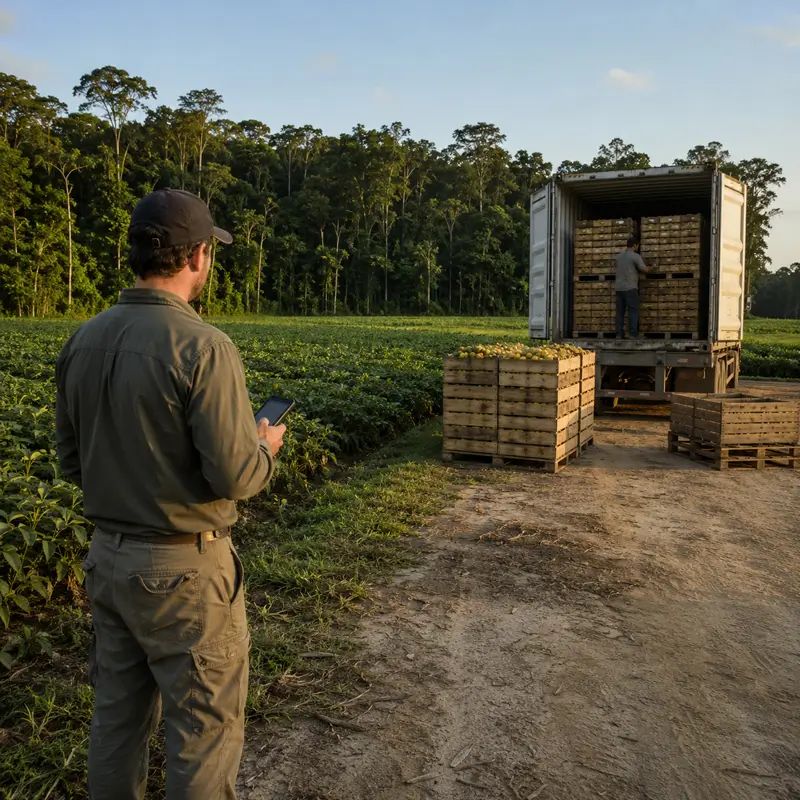
Compliance with Anti-Deforestation Regulations in Agricultural Exports
Agricultural markets are no longer assessed only by product quality, competitive pricing, and delivery capacity. In part of global trade, the buyer must know which land the product came from, what path it followed through the supply chain, and whether its origin is linked to deforestation after the reference date. The European Union Deforestation Regulation, known as the EUDR, has turned this logic into a market-access requirement. A commodity covered by these regulations may enter or be exported from the EU market only if it is deforestation-free, produced in accordance with the laws of the producing country, and accompanied by a due diligence statement.
The importance of this shift becomes clear when we consider that deforestation at the global scale remains closely connected to the production and trade of agricultural commodities. FAO estimates show that the annual rate of deforestation from 2015 to 2020 was 10 million hectares per year. Although this figure declined from 12 million hectares per year in the 2010 to 2015 period, it is still significant for food security, climate, and the sustainability of agricultural value chains. FAO’s remote-sensing survey also identifies agricultural expansion as the driver of nearly 90 percent of global deforestation, with cropland expansion accounting for close to 50 percent and livestock grazing accounting for 38.5 percent. For this reason, the new regulation is not merely an environmental issue; it has been translated into the language of trade, creditworthiness, insurance, and investment.
For exporters, the main change is the shift in the center of gravity of compliance. In the past, many supply chains operated with product certificates, purchase documents, invoices, health certificates, customs documents, and quality control records. The EUDR, however, elevates geographic origin to a higher level and requires the operator to record the country of production and the geolocation of all plots of land where production took place in the due diligence statement. For livestock products, the location of all establishments where the animals were kept must also be reported. Therefore, the key question is no longer only what the product is and what standard it meets, but where it came from and whether its origin can be defended under anti-deforestation criteria.
Why Do Anti-Deforestation Regulations Change Access to Export Markets?
The EUDR has a specific scope, and its impact should not be generalized to all agricultural trade. The covered commodities include cattle, cocoa, coffee, palm oil, natural rubber, soy, and wood, while certain derived products such as beef, chocolate, coffee, oils, tires, wood, and wooden furniture are also listed in Annex I. The practical result of this list is that every exporter must match its product to the scope of the regulation at the commodity-code level, rather than relying only on the broad label of an agricultural product. This distinction is especially important for countries such as Iran, because major traditional products such as pistachios, saffron, and dates are not inherently included among the seven EUDR commodities. However, any composite or derived product containing cocoa, coffee, soy, palm oil, wood, natural rubber, or cattle must be checked against Annex I.
The regulation also sets clear boundaries for implementation timing. Practical enforcement has been announced for large and medium-sized operators from 1405-10-09 and for micro and small operators from 1406-04-09. The EUDR deforestation reference date is 1399-10-11, and products produced before 1402-04-08 are considered outside the scope of the regulation. The 2026 Guidance also defines the time of production for most commodities as the time of harvest, while for cattle it is the date of birth of the animal. These details show that a compliance system must store both geographic and temporal data side by side, because land origin without production timing is not sufficient for an anti-deforestation assessment.
From a public-policy perspective, the European Union’s stated objective is to reduce the pressure that consumption and production of covered commodities place on forests. The European Commission has announced a target of reducing emissions linked to these commodities by at least 32 million tons of CO₂ per year. For exporters, this figure is not merely a distant environmental indicator, because it has been translated into market control. If a product falls within the scope of the regulation, the absence of reliable evidence about land origin, legality of production, or the absence of non-negligible risk can lead to a halted transaction, customs-clearance delays, increased documentation requests, or the supplier being removed from the purchasing chain.
How Does Plot Geolocation Become the Main Export Compliance Document?
Geographic traceability under the EUDR differs from ordinary warehouse and shipment tracking. A supply chain may know which warehouse the product was loaded from, which port it passed through, and which intermediary sold it, yet still be unable to provide the geolocation of the plot of land where it was produced. The regulation requires the operator to collect information on the country of production and the geolocation of all plots of land. If a product comes from multiple sources or multiple geolocations, the risk must be assessed separately for each source or geolocation. In this model, mixing origins without precise recording can make an apparently orderly supply chain vulnerable from a compliance perspective.
General traceability standards can solve part of this issue, but they are not a complete substitute for EUDR requirements. ISO 22005:2007 sets out the basic principles and requirements for designing and implementing a traceability system in the feed and food chain and can be applied to different organizations at various stages of the chain. GS1 EPCIS is also designed for recording and exchanging supply-chain event data and creates a common language for visibility among actors. However, the use of these standards for EUDR becomes more adequate when they are combined with a GIS layer, plot identifiers, coordinates, legal documents, remote-sensing controls, and risk assessment.
The issue of third-party certifications must also be understood precisely. The 2026 Guidance makes clear that certifications and verification schemes can provide complementary data for risk assessment, but they do not replace the operator’s due diligence responsibility and do not create a green lane. This point has practical importance for exporters and buyers, because reliance on voluntary certificates or self-declarations without linkage to geographic data and verifiable documents does not close the risk gap. As a result, certification should be part of the compliance file, not the entire compliance file.
How Is Supply-Chain Risk Assessed Under the EUDR?
Due diligence under the EUDR begins with information collection, but it does not stop there. The 2026 Guidance links risk criteria to factors such as the country of production, deforestation rate, forest-degradation rate, risk of illegal production, product risk, supply-chain complexity, history of non-compliance, data falsification, corruption, weak law enforcement, sanctions, and armed conflict. This list shows that the supply chain is not merely the physical route of goods, but a network of legal, data-related, and institutional risks. The greater the number of origins, the more numerous the intermediaries, and the less verifiable the documents, the higher the likelihood of non-negligible risk.
Legal verification is one of the sensitive layers of this process. The information, documents, and data demonstrating compliance with the laws of the country of production must be sufficient, convincing, and verifiable. This requirement is not limited to forest law and may also relate to land rights, environmental regulations, third-party rights, labor rights, human rights, tax, customs, and anti-corruption rules connected to production. From this perspective, an exporter that keeps an organized file on land origin, exploitation documents, and supply-chain events is not merely presenting documents in negotiations with a European buyer; it is reducing transaction risk for the counterparty.
Market risk in this framework, simply put, is the risk of losing access to the EU market or facing higher transaction costs and longer transaction times. This risk may appear as rejection of the due diligence statement, requests for additional data, customs-clearance delays, diversion of trade to less demanding markets, or removal of the supplier from the contract. For banks and insurers, these same variables can be converted into credit-risk and insurance-risk indicators. The absence of geolocation, multiple-origin commodities, high-risk regions, a history of non-compliance, the possibility of document falsification, weak law enforcement, or sanctions can, from a financial perspective, mean higher repayment risk, higher claims risk, or the risk of sales-flow disruption.
Global Lessons from Cocoa and Commodities Covered by Anti-Deforestation Regulations
The European Union itself is the most important regulatory case study in this area, because the EUDR has moved beyond sustainability recommendations and become a legal mechanism for market access. The main actors in this model are the European Commission, operators, traders, competent authorities of Member States, and producers in countries of origin. The text of the regulation does not define a direct financing model to compensate for compliance costs, and the practical burden of data collection, risk assessment, and evidence retention is distributed across the supply chain. This situation shows exporters that compliance cannot be postponed to the end of the chain and the moment of shipment. The data must begin at the level of the land and the supplier.
The cocoa chain in Côte d’Ivoire is a clear example of the difference between general traceability and the geolocation requirement. Trase reported that for the country’s 2024 cocoa exports, only 48 percent of export volume could be traced through public company data to the production department, while the European Union was the destination for 66 percent of Côte d’Ivoire’s cocoa exports. The remaining 52 percent falls into indirect or low-disclosure chains, making proof of origin and deforestation screening more difficult. Even so, a distinction must be made between traceability to the production-department level and geolocation of the plot of land, because the EUDR requirement is more precise than identifying an administrative or regional level.
The 2026 review of the commodity scope also shows that compliance is not a fixed and closed issue. In the 2026 Staff Working Document, 31 product codes were reviewed for addition or removal, including 10 codes proposed for removal and 21 codes proposed for addition. The annual import value of products proposed for removal from the scope was estimated at €2.5 billion, with a deforestation impact of 40.9 thousand hectares per year. By contrast, the annual import value of products proposed for addition was reported at €9.3 billion, with a deforestation impact of 7.4 thousand hectares per year. Because these figures relate to a proposed scope amendment, any operational decision must be checked against the final text of the delegated act.
Data Architecture for Tracking Land Origin and Managing Due Diligence Statements
An effective compliance system must go beyond product registration and establish links among commodity codes, land origin, owner or operator, coordinates, legal documents, and supply-chain events. In such an architecture, every shipment must be traceable to one or more specific plots of land, a production or harvest date, legal documents, and the transfer route. If the product is composite or enters the process from multiple suppliers, the system must clarify the share of each source as much as possible and make it possible to assess risk separately for each geolocation. This level of data turns traceability from a documentation tool into risk-management infrastructure.
The combination of ISO 22005 and GS1 EPCIS can serve as the data backbone of this architecture, because the former provides the design logic for traceability systems in the feed and food chain, while the latter standardizes the exchange of supply-chain events. However, for EUDR purposes, complementary layers must be added: GIS for geolocation, remote-sensing controls for land-use change, a legal-document file for the legality of production, and a risk-assessment engine for country, product, supplier, and supply-chain complexity. Such a system becomes more valuable when its output is not used only to fill out a form, but can also support commercial negotiations, export credit insurance, and bank credit assessment.
From a financial perspective, the point where the EUDR connects with capital markets and credit lies in non-compliance risk. Precise CAPEX and OPEX data for implementing EUDR systems at the exporter level, broken down by commodity and country, is not available for use in this file. However, the official risk logic shows that the absence of geographic data and weakness in the chain of custody can increase transaction costs. When a bank or insurer sees that an exporter has verifiable land origin, supply-chain events, and legal documents, it faces lower information risk. Under the regulation itself, the European Commission must assess the role of financial institutions in preventing financial flows linked to deforestation by 1409-04-09 and then at least every five years thereafter.
Iran’s Path Toward Aligning Agricultural Exports with Anti-Deforestation Requirements
For Iran, a precise analysis must begin with the commodity scope. The direct impact of the EUDR does not extend to all of Iran’s agricultural exports and only involves Annex I commodities or products made with covered commodities. Therefore, an Iranian exporter must first check the HS or CN code of the product, the composition of raw materials, and whether inputs such as cocoa, coffee, soy, palm oil, wood, natural rubber, or cattle are present. This approach prevents risk exaggeration and directs implementation resources toward the very products that genuinely require a compliance file.
The practical opportunity for Iran is to design a traceability module within export systems, a module capable of bringing together product code, land origin, coordinates, owner or operator, legal documents, and supply-chain events. This path means moving beyond the level of product certification to the level of a land-origin file, supply-chain events, and supplier risk assessment. For composite products, this module must be able to distinguish among different origins so that one high-risk raw material does not make the entire shipment ambiguous in the eyes of a European buyer. If designed properly, the same infrastructure can also support bank credit assessment, export credit insurance, and reduction of origin-claim risk.
The potential advantage for a transparent exporter is that in the new regulatory environment, European buyers do not look only at price. An exporter that has accurately documented geolocation and land origin, kept exploitation documents verifiable, and recorded the chain of custody in event-based form may appear more reliable to the buyer than a supplier with an opaque chain. This credibility is especially important for multiple-origin or composite products, because the 2026 Guidance considers risk assessment necessary for each source or geolocation. The main weakness is also clear: scattered data, certificates without geographic support, and the absence of an organized legal file reduce the ability to respond to the buyer’s due diligence requirements.
To implement this path, three practical decisions matter. First, covered and non-covered commodities must be separated at the level of product code and actual composition, not based on the general title of agricultural exports. Second, land and chain data must be designed from the beginning with open standards so that full dependence on a single software vendor is avoided and data exchange with buyers, banks, insurers, and control authorities becomes easier. Third, supplier risks such as multiple origins, insufficient documentation, possible document falsification, history of non-compliance, weak verification, or sanctions-related conditions must be recorded in an internal scoring model. Such a model turns compliance from a momentary response to a buyer’s request into a permanent risk-management process.
The Future of Agricultural Exports in Markets That Demand Land-Origin Evidence
The European Union’s anti-deforestation regulation signals a profound shift in agricultural trade, a shift that turns land origin into part of market value. A product with suitable physical quality faces serious risk in markets covered by the EUDR if its geographic origin and chain of custody cannot be proven. On the other hand, an exporter that has organized its land-origin file, supply-chain events, legal documents, and risk assessment is not merely responding to a regulatory requirement. It is building a data asset that can be used in commercial negotiations, bank credit assessment, and export insurance. This is precisely where sustainability, technology, and trade finance become connected.
For countries whose exports are partly involved with covered commodities or derived products, the right approach is neither a general fear of the regulation nor ignoring it. The precise path runs through matching commodity codes with Annex I, identifying covered raw materials, recording geolocation, documenting the legality of production, linking supply-chain events, and assessing the risk of each origin. Iran should apply the same differentiated logic: it should not generalize the effect of the EUDR to all agricultural exports, but for covered commodities or composite products it should build a defensible compliance file. The future of agricultural exports in strict markets depends more than ever on the ability to prove origin, ensure data transparency, and manage supply-chain risk.
