GenAI Feed Enzyme Design: Bioprocessing

Generative AI-Driven Design of Feed Enzymes and Proteins: From Structure to Bioreactors
Pressure on the food and feed chain no longer begins only with input shortages or price volatility; a major part of the issue now occurs at the molecular level. When feed for livestock, poultry, or aquaculture species is not properly digested, part of the phosphorus, nitrogen, and dietary energy leaves the production cycle, creating both economic costs and environmental burdens on farms and waterways. Feed enzymes, from phytase to xylanase and protease, enter precisely at this point because they can break specific chemical bonds and increase animals’ ability to utilize nutrients. Generative artificial intelligence, if combined with industrial bioprocessing and safety testing, can turn the design of these molecular tools from a long and costly search into a more targeted process.
The target market for such a technology is not small. Alltech’s 2025 industry data reported global compound feed production at approximately 1.440 billion metric tons and explained that the dataset was compiled using information from 142 countries and 38,837 feed mills. This scale shows that even small improvements in digestibility, enzyme stability, or retention of activity after pelleting can have practical effects across the feed chain, although any commercial analysis of AI-designed enzymes must avoid inventing unsupported figures about market share. In aquaculture, the FAO reported global production of 130.9 million tons in 2022, and the fact that farmed aquatic animal production has surpassed traditional capture fisheries has further highlighted the importance of more efficient feeds in the blue economy.
For companies active in food security, biotechnology, and technology investment, designing feed enzymes with generative AI is not merely a laboratory issue. If it reaches industrial maturity, this technology becomes a point of convergence for computational modeling, gene synthesis, microbial expression, fermentation, formulation, and regulatory approval. Its real value becomes clear when a proposed sequence can be expressed in an industrial host, retain sufficient activity after fermentation and separation, remain stable against the steam and pressure of pelleting, and demonstrate measurable efficacy in the target species. Therefore, the central issue is not creating a visually elegant protein on a computer screen; the central issue is creating an enzyme that can be produced, controlled, and accepted within safety and regulatory systems.
Why Is Generative AI-Based Feed Enzyme Design Linked to Food Security?
A feed enzyme gains economic value when it targets a specific nutritional barrier. Phytase hydrolyzes phytate and helps release phosphorus and minerals; xylanase breaks down xylan and arabinoxylans in wheat-, barley-, and cereal-based diets and can reduce gastrointestinal viscosity; protease targets the digestibility of protein sources and meals by breaking proteins into peptides and amino acids. However, the efficacy of none of these enzymes is independent of the conditions in which they are used. The pH of different sections of the gastrointestinal tract, the protein or carbohydrate source, the animal’s age, the presence of anti-nutritional inhibitors, processing temperature, and feed moisture all determine whether an enzyme remains successful only on paper or also performs on the farm.
At this level, generative AI does not fully replace experimental testing; its role is to reduce the search space and guide the laboratory toward more reasonable candidates. In the past, enzyme engineering relied mainly on random mutagenesis, directed evolution, rational design, and limited simulations. After major advances in structural models and then in sequence and structure design models, the ability to computationally screen mutations, select more stable scaffolds, and design sequences compatible with a target backbone increased. However, even if a model suggests that a protein sequence is structurally desirable, it must still be determined whether that same sequence can be expressed in an industrial host, secreted, show sufficient catalytic activity, and remain stable after feed formulation.
– John Jumper and colleagues, DeepMind researchers at the time of the Nature paper: “The AlphaFold network directly predicts the three-dimensional coordinates of all heavy atoms in a protein.”
The importance of AlphaFold in feed enzyme design begins with this capacity for structural prediction. In CASP14, AlphaFold achieved a median GDT score of 92.4, and DeepMind reported that for many targets this corresponded to an approximate error of 1.6 angstroms. The AlphaFold Protein Structure Database now also provides predicted structures for more than 200 million known proteins in UniProt. This infrastructure is valuable for selecting initial enzymes, examining active sites, evaluating the effects of stabilizing mutations, and conducting structural screening, but it is not sufficient to prove activity, thermal stability, safety, or efficacy in industrial feed.
From AlphaFold to ProteinMPNN and RFdiffusion in Protein Sequence and Structure Design
The computational design chain usually begins with a simple question: in what environment should the desired enzyme function, and which of its properties needs to be changed? If the goal is to increase thermal stability, structural modeling can identify unstable regions or likely mutations; if the goal is compatibility with intestinal pH or improved expression in an industrial host, sequence design and computational screening must be combined with biological and process-related metrics. Inverse sequence design, or inverse folding, becomes important here because instead of predicting structure from sequence, it proposes sequences that are compatible with a target structure. In the feed industry, this capability becomes valuable only when computer-based design is connected to activity and stability testing under conditions close to real production.
– Justas Dauparas and colleagues, protein design researchers at the Institute for Protein Design and collaborating institutions: “ProteinMPNN achieves 52.4% sequence recovery, compared with 32.9% for Rosetta.”
This figure should not be interpreted as direct evidence of efficacy in feed phytase or xylanase; its value lies in showing the capacity of deep learning methods to design sequences compatible with protein backbones. In an industrial program, ProteinMPNN can be used alongside structural models to suggest mutations or alternative sequences, but its output must enter a cycle of gene synthesis, expression, activity measurement, and stability testing. At this stage, metrics such as FTU for phytase or U/g and IU/g for many enzymes are comparable only when the substrate, pH, temperature, and assay duration are precisely defined. Without this level of precision, an activity number can become more of a source of technical misunderstanding than a guide for investment.
RFdiffusion is another step in this direction because it moves the discussion from redesigning sequences on existing structures toward generating new backbones and scaffolds. In its Nature paper, this model was reported for the design and experimental testing of hundreds of symmetric assemblies, metal-binding proteins, and binders, and it is recognized as an important example of generative structural design. Nevertheless, its direct application to the design of feed phytase or industrial xylanase should not be assumed without experimental testing and bioprocess scalability. For the feed chain, computational innovation is meaningful only when it aligns with the requirements of pelleting, microbial expression, stability in the final product, and safety standards.
– Joseph L. Watson and colleagues, researchers from the Baker Lab at the University of Washington and collaborating institutions: “The authors demonstrate the power and generality of a method called RoseTTAFold diffusion, or RFdiffusion.”
Thermal Stability and Residual Activity in the Path from Protein Model to Feed Additive
The main difference between feed enzymes and many laboratory proteins lies in process stress. An enzyme may be stable and active in a controlled buffer, but during feed production it faces steam, pressure, moisture, and pelleting temperatures, and may lose a significant portion of its activity. For this reason, thermal stability cannot be described by a single simple number; Tm, activity half-life at a specific temperature, and the percentage of residual activity after heat treatment each show part of the picture. In enzyme design with generative AI, the true metric is valid only when structural stability is connected to post-process activity and performance in the final feed.
For phytase, the issue goes beyond phosphorus release. EFSA dossiers on 6-phytase show that the safety of the production strain and efficacy in target species are assessed separately. This distinction is very important for industrial design because an enzyme may be chemically suitable in terms of activity but still require independent evidence regarding its production source, impurities, or efficacy in the target species. In aquaculture, a 2024 study reported increased phosphorus digestibility and reduced fecal phosphorus excretion with phytase, showing the environmental importance of feed enzymes alongside their economic significance.
Xylanase and protease must be analyzed with the same logic. Xylanase is valuable when it can reduce the anti-nutritional effects of arabinoxylans in cereal-based diets while also retaining activity during feed production. Protease can help improve the utilization of meals and reduce nitrogen waste, but its efficacy depends on the type of protein, gastrointestinal pH, the animal’s age, and the presence of anti-nutritional inhibitors. Therefore, generative enzyme design, if not connected to nutritional metrics, target-species trials, and formulation quality control, does not move beyond the boundaries of protein design and does not become a reliable feed additive.
Industrial Production of Feed Enzymes in Bioreactors and the Bottlenecks of Microbial Fermentation
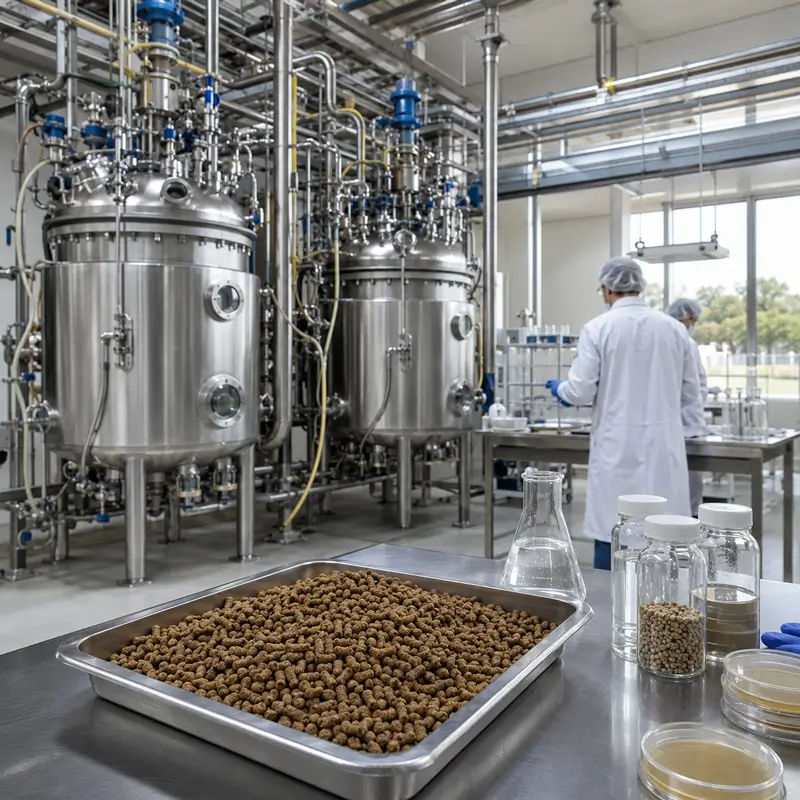
After a sequence is selected or designed, the industrial path enters the bioprocess stage. The selected sequence must be converted into a synthesizable gene, cloned into a suitable host, evaluated for expression and secretion, and then moved into fermentation, separation, concentration, drying, granulation, or coating. Hosts such as Bacillus for the secretion of extracellular enzymes, Aspergillus and Trichoderma for fungal hydrolases, and Komagataella or Pichia for recombinant protein expression have been introduced in the research literature as common options. Choosing a host is not merely choosing a production cell; this choice affects glycosylation, secretion, downstream costs, final product quality, and safety risk.
– Qais Ali Al-Maqtari and colleagues, researchers from Jiangnan University and Sana’a University at the time of the paper: “Submerged fermentation involves enzyme production by microorganisms in a liquid nutrient medium.”
Submerged fermentation and solid-state fermentation have been introduced as the two main routes for producing microbial enzymes. In submerged fermentation, production takes place in a liquid medium, a feature that makes it compatible with process control in bioreactors; in solid-state fermentation, the microorganism grows on a solid substrate, and this route is useful for certain enzymes and substrates. For an AI-designed feed enzyme, the industrial question is not only which sequence is better, but which sequence can be produced in the selected host, at scalable levels, with reproducible quality and competitive cost. This is the point at which protein design connects to process engineering and production economics.
In recombinant production, the origin of the strain and the status of the final product must be carefully distinguished. Using genetically modified strains to produce an enzyme does not necessarily mean that the genetically modified organism itself is present in the final product, but the safety dossier must demonstrate the absence of live cells, recombinant DNA of concern, toxins, and process-related impurities. This makes quality control part of commercial design, not a secondary step after production. An enzyme offered for livestock or aquaculture feed must be defensible in its final form in terms of activity, stability, safety, and production uniformity.
EFSA Regulations and the Path to Proving Safety and Efficacy for Feed Enzymes
In the European Union, Regulation (EC) No 1831/2003 establishes the legal framework for feed additives and makes authorization dependent on safety, quality, and intended use. For food enzymes, Regulation (EC) No 1332/2008 has created a harmonized framework, and according to EFSA, all food enzymes must undergo safety assessment and then be approved by the European Commission. The important distinction for feed is that EFSA assesses not only safety but also efficacy for enzymes used in animal feed. This principle sends a clear message for every AI-designed product: the computational model is the starting point, but authorization relies on experimental evidence, production safety, and efficacy in the target species.
EFSA’s 2024 guidance on the assessment of efficacy of feed additives is directly important for designing efficacy trials in target species. Such a framework reminds producers that claims about improved digestion or increased phosphorus availability must be supported by an appropriate trial design, a control group, dosage, activity metrics, and real conditions of use. For a product such as phytase, efficacy is related to phosphorus release and nutritional outcomes; for xylanase, reducing the effect of arabinoxylan and its gastrointestinal consequences is important; for protease, protein digestibility and its dependence on diet type and animal age must be clarified. In such a pathway, a technology claim without targeted testing cannot replace a scientific dossier.
From an investment perspective, these regulatory requirements must be built into the financial model from the beginning. Developing a feed enzyme does not include only the cost of computational design or gene synthesis; the costs of activity testing, stability testing, safety evaluation, scale-up, pilot production, formulation, and dossier preparation are also part of the path. Fermentation industry reports have also emphasized that the capital gap in scale-up cannot be closed with a single tool, and that a combination of patient capital, strategic partnerships, equipment leasing, government support, and blended finance may be relevant. For technologies dependent on industrial production and authorization, staged investment conditional on passing technical control points is more logical than unified and rushed financing.
– The Good Food Institute, a research and industry organization focused on alternative proteins: “There is no single magic bullet for filling the fermentation sector’s financing gaps.”
Iran’s Path to Localizing Feed Enzymes with a Focus on Redesign and Industrial Testing
For Iran, the more realistic initial path is not complete de novo design; the more logical starting point is redesigning known enzymes for thermal stability, target pH, and expression in an industrial host. This approach is more compatible with the global maturity level of current models and with domestic data limitations, because it distributes scientific and industrial risk across several testable stages rather than a few large leaps. First, the target enzyme, species of use, dominant diet, activity metric, and feed processing conditions must be defined. Then structural modeling, sequence design, gene synthesis, microbial expression, and stability testing must be organized into a systematic chain, not into separate projects with no industrial pathway.
Iran’s institutional infrastructure for this path should be strengthened from two directions. On one side, the Iran Veterinary Organization, in its executive guideline dated 1402/11/16, equivalent to February 5, 2024, explained the physical, microbial, and chemical characteristics of raw materials and prepared feed for livestock, poultry, and aquaculture under national veterinary regulations. On the other side, the knowledge-based ecosystem and innovation financing instruments can play a supporting role in developing feed additives, provided that financial support is accompanied by independent testing of quality and efficacy. Support without credible evaluation exposes the market to low-quality products and erodes the trust of industrial consumers.
Iran’s technical risk begins with the same risks seen globally, but it becomes more severe at the scale-up stage. The output of a generative model may appear stable on a computer, but it may fail to express in an industrial host, show poor secretion, develop undesirable glycosylation, or lack sufficient catalytic activity. If the product is produced using a recombinant host, the safety dossier must cover origin, strain, removal of live cells, impurities, and safety for the consumer, user, and environment. Therefore, domestic development should focus not on slogans about import substitution, but on production reproducibility, formulation quality, technical services, and proof of effect in real feed.
For an Iranian investor, the appeal of this field lies in the connection between biotechnology, industrial feed, and food security, but decisions must be based on verifiable stages. The first stage is selecting the enzyme and defining the industrial problem; the second stage is computational design and screening with AlphaFold, ProteinMPNN, or generative structure models; the third stage is testing expression and activity in selected hosts; the fourth stage is pilot production, formulation, and stability testing; and the fifth stage is preparing the safety and efficacy dossier for the authorization pathway. Such a structure allows the investor to assess risk at each stage and prevents a biotechnology project from turning into a high-risk fixed cost.
Practical Conclusion for Investment in Feed Enzymes and Industrial Bioprocessing
The design of feed enzymes and proteins with generative AI has strategic value only when it is connected to a specific problem in feed. AlphaFold, ProteinMPNN, and RFdiffusion each solve part of the problem: one predicts structure, another proposes sequences compatible with structure, and the third moves closer to generative backbone and scaffold design. But a feed product is not defined only by a three-dimensional structure or an elegant sequence. Activity at the target pH, thermal stability, residual activity after pelleting, expression in an industrial host, impurity control, and efficacy in the target species are the criteria that turn a model output into a usable product.
The industrial path of this technology is interdisciplinary and staged. Structural biology, deep learning, industrial microbiology, fermentation engineering, feed formulation, safety assessment, and production economics must be considered simultaneously. At the global level, the high volume of feed production and the growth of aquaculture strengthen demand for more efficient enzymes; at the regulatory level, EFSA shows that safety and efficacy must be built into product design from the start. For Iran, the lower-risk starting point is redesigning known enzymes and building a testing chain through pilot production, not moving directly into fully novel design without industrial testing infrastructure.
The right decision in this field is neither limitless optimism about generative models nor complete skepticism toward them. Real value is created through the combination of precise computation, rigorous experimental testing, reproducible production, and transparent dossier preparation. If these four layers are placed together, an AI-designed feed enzyme can move from a laboratory idea to an industrial tool for reducing nutrient loss, increasing diet efficiency, and developing knowledge-based bioprocessing. Otherwise, model outputs remain merely a list of promising sequences and do not turn into a real advantage in the feed chain or food security.