
Greenhouse CO2: chemical absorption & scrubber design

Greenhouse CO2 Management via Chemical Capture–Release: CO2 Scrubber Design and Safety
Enriching a greenhouse atmosphere with carbon dioxide is one of the lowest-cost levers for boosting photosynthetic productivity in protected cultivation. The strategic question today is: where will this CO₂ come from, and how can it be supplied safely, reliably, and economically? Chemical capture and release with amine solvents or solid sorbents is inspiring a new generation of “CO₂ scrubbers” for greenhouses that can produce relatively pure CO₂ from local flue gas—or even ambient air—and deliver it to the target range during daylight hours.
This pathway only makes sense when process design details, gas quality, safety requirements, and investment logic are assessed realistically—and when the experience of countries such as the Netherlands, France, and Canada is translated into engineering terms. In today’s industrial farms, the operational target for many C3 crops is typically 800–1,000 ppm, and injection must be balanced with ventilation so that energy losses and gas leakage are minimized. Academic and practical guides treat this band as the zone where photosynthetic response to CO₂ is often significant—but co-contaminants such as ethylene, NOx, and CO must not reach the crop space.
WUR report WPR-1189 on securing future CO₂ supply without fossil fuels focuses precisely on four pillars: quantity, concentration/enrichment, purity, and distribution. In practice, Dutch experience shows that diversifying the supply mix (pipeline networks, industrial recovery, and localized capture solutions) reduces the risk of CO₂ shortages and lowers dependence on on-site combustion.
The human factor is safety. CO₂ is colorless and odorless and, being denser than air, accumulates near the floor; this necessitates multi-level alarms, low-level ventilation, and safety interlocks on injection valves in enclosed greenhouse spaces and gas rooms. International guidance sets the low alarm around 5,000 ppm and the high alarm around 30,000 ppm, and the 8-hour occupational exposure limit at 5,000 ppm; these values directly inform detector selection and calibration, operator training, and day-to-day procedures.
– U.S. Occupational Safety and Health Administration (OSHA): “The 8-hour permissible exposure limit (PEL) for CO₂ is 5,000 ppm.”
– U.S. National Institute for Occupational Safety and Health (NIOSH): “The IDLH level for carbon dioxide is 40,000 ppm.”
– International Code Council (ICC): “CO₂ gas detection activates with a low threshold at 5,000 ppm and a high threshold at 30,000 ppm.”
On the demand side, Europe provides strong precedents. In France, according to CTIFL data, 89% of heated tomato and cucumber surfaces use CO₂ enrichment, with flue-gas recovery or liquid CO₂ as the dominant routes. In the Netherlands, the OCAP network delivers “hundreds of thousands of tons” of CO₂ per year to more than 600 greenhouses, sourced from bio-industry and refineries; a key puzzle piece is “green” CO₂ recovered from Swiss-Dutch ethanol, reported to have a nameplate capacity of about 400,000 t/y (H-Gas).
– CTIFL (France): “CO₂ enrichment is used on 89% of heated greenhouse areas for tomatoes and cucumbers.”
This article presents CO₂ scrubber design for greenhouses in a practitioner’s language, anchored in up-to-date evidence: from choosing the capture route (post-combustion with MEA/MDEA or solid sorbents), to heat integration and compressor selection, to gas-quality control and secondary risk management such as nitrosamine formation in amine systems. Each section is backed by documented sources and official links, so deployment or investment can proceed with minimal knowledge risk.
– U.S. Department of Energy (DOE): “The theoretical minimum for separation and compression is about 113 kWh per ton of CO₂.”
For the professional reader, one key point stands out: while MEA has long been the post-combustion standard, the technical literature over the past five years shows that advanced amine systems and novel regeneration configurations (e.g., flash strippers) have reduced reboiler duty to roughly 2.5–3.0 GJ per ton of CO₂—figures that, together with better heat recovery from a boiler or CHP, can materially lower OPEX even at greenhouse scales.
Next, we lay out a roadmap for designing and operating a greenhouse CO₂ scrubber: a scan of global practice and supply infrastructure, then capture/regeneration engineering principles, quality control and safety, and finally project economics and contract models. The core aim is a decision frame for growers or investors when flue-gas capture makes sense, when a small local DAC unit does, and when purchasing liquid CO₂ is the better option.
– Dutch Greenhouse Growers’ Association: “Total sector emissions in 2022 remained below the 5.6-Mt ceiling.”
With this framework, two classic pitfalls can be avoided: first, injecting CO₂ without adequate purification and ethylene monitoring which can damage flowers and buds even at ppb levels; and second, overlooking regeneration energy costs, which, if not optimized, can undermine the project’s economics. Practical remedies for both are provided in the text.
– Ohio State University (Extension): “In some greenhouses, 25 to 200 ppb ethylene over weeks can disrupt growth.”
Finally, a lab-to-demo experience from Austria also confirms the outlook for higher separation efficiency: the “ViennaGreenCO₂” report notes that TU Wien pilot tests achieved over 90% CO₂ separation an indication that novel capture routes with fluidized-bed designs and heat integration can be viable even for low-concentration sources.
– Energy Innovation Austria: “More than 90% carbon-dioxide separation was confirmed in the pilot unit.”
What follows is an execution pathway grounded in credible data and industrial practice not merely a wish list. From solvent selection to nitrosamine monitoring, from PID tuning of injection valves to supply contracts with regional networks, every decision must be backed by numbers, standards, and documented citations.
– Scottish Environment Protection Agency: “Health guidance values for airborne nitrosamines have been reported in the 0.07–10 ng/m³ range.”
Global Landscape and CO₂ Supply Models for Greenhouses
Over the past decade, Europe has been a living lab for non-traditional CO₂ supply to greenhouses. The OCAP network in the western Netherlands collects industrial and biogenic CO₂ and distributes it via pipelines, reducing growers’ dependence on on-site combustion. Corporate and industry reports indicate that “hundreds of thousands of tons” of CO₂ are delivered annually to more than 600 users, with part of the feedstock recovered from bioethanol. This model carries two messages: first, it cuts combustion-borne co-contaminants (NOx, CO, ethylene) inside the greenhouse; second, it stabilizes supply on days when heating is off but the crop still needs CO₂.
France, alongside liquid supply networks, has made CO₂ enrichment standard practice in heated tomato and cucumber production. CTIFL reports that 89% of such areas use CO₂, with supply split between flue-gas recovery (alone or supplemented with liquid CO₂) and dedicated liquid CO₂. This split shows that “purity” and “security of supply” are practical priorities for producers—worthy of long-term contracts.
– CTIFL (France): “Flue-gas recovery and liquid CO₂ are the dominant supply routes in heated crops.”
At the policy level, the Netherlands has applied a sectoral emissions cap for greenhouse horticulture. According to Glastuinbouw Nederland, 2022 emissions were 4.466 Mt—below the 5.6-Mt ceiling; a signal to market actors that fuel saving and cleaner CO₂ sourcing are competitive advantages, not just obligations. At the same time, the Dutch government has warned of short- and long-term shortages of “sustainable CO₂” and recommends diversifying sources.
– Glastuinbouw Nederland: “2022 emissions remained below the 5.6-Mt ceiling.”
Canada—and Ontario in particular—has issued practical guidance on CO₂ dosing for years, recommending 800–1,000 ppm targets for many crops. These guides stress injecting only during light hours and ensuring gas quality with respect to combustion contaminants. North American academic and extension documents also emphasize removing ethylene and CO, since even very small amounts of ethylene can damage buds and flowers.
– Ontario Ministry of Agriculture (OMAFRA): “At 1,000 ppm, photosynthesis increases in many crops.”
On separation technology, the literature shows that post-combustion capture can achieve >90% at typical flue-gas concentrations (≈4–12 vol% CO₂), albeit with regeneration heat demand. Reviews from 2020–2024 report 3–4 GJ per ton for MEA, with advanced amines documented as low as ≈2.5–3.0 GJ per ton. Pilot programs such as TU Wien’s ViennaGreenCO₂ have likewise confirmed >90% separation.
– Energy Innovation Austria: “Using a fluidized bed can reduce the cost per ton of separation.”
Europe’s safety pillar is backed by clear standards. IFC 2018 requires detectors in spaces with beverage-CO₂ systems to have a low alarm at 5,000 ppm and a high alarm at 30,000 ppm; OSHA and NIOSH publish, respectively, PEL = 5,000 ppm (8-hour) and IDLH = 40,000 ppm. Germany’s TRGS 900 lists AGW = 5,000 ppm, and France’s INRS lists VLEP-8h = 5,000 ppm. This numerical convergence simplifies engineering: design three alarm levels (low, mid, high), provide low-level exhaust, and use valve interlocks.
– ICC (IFC 2018): “A low threshold of 0.5% and a high threshold of 3% CO₂ by volume are set.”
– Operational Lessons from European Practice
First, where a regional network exists, a long-term supply contract with gas-quality clauses and a safety annex is the best starting point. Second, if the greenhouse has a boiler or CHP, a small post-combustion scrubber with online quality monitoring and oxidation filters (for CO and VOCs) can be a path to self-reliance. Third, in the absence of a centralized source, a small local DAC unit that concentrates only to 800–1,000 ppm—rather than producing ultra-pure CO₂—can be attractive on energy and CAPEX grounds for greenhouse use.
– WUR (Research report): “Greenhouses need only 0.08–0.1% concentration.”
Engineering a CO₂ Scrubber for Greenhouses: Process, Quality, and Control
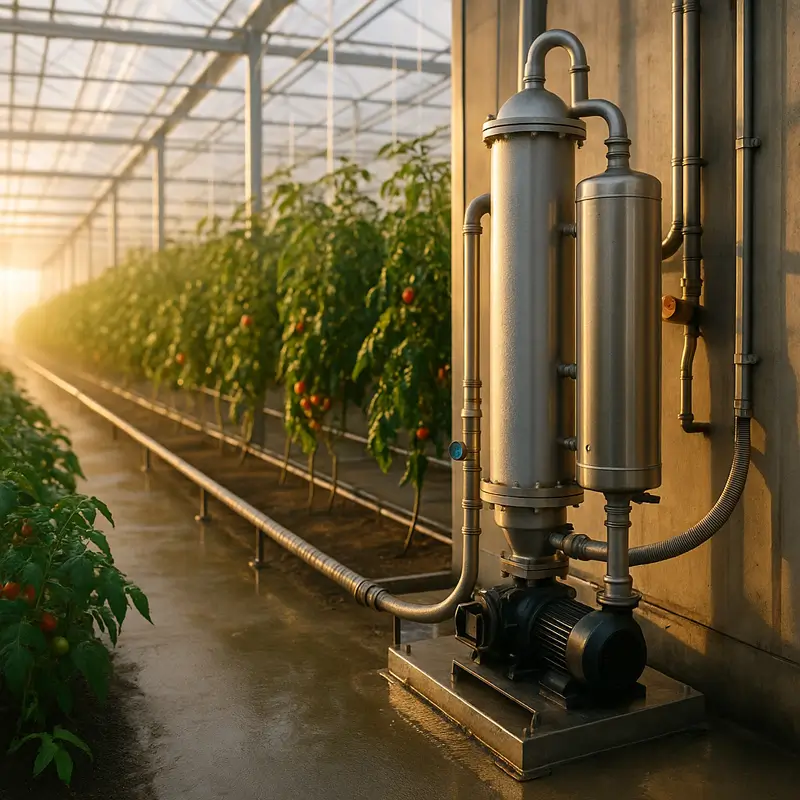
The reference model for post-combustion capture is the “absorber column + interstage heat exchanger + flash/reboiler + regenerator column” configuration with aqueous amine solvents. In typical operation, absorption runs at 40–60 °C, solvent strength at 20–40 wt%, and regeneration at 100–125 °C. Reboiler duty for classic MEA is reported around 3–4 GJ per ton of CO₂, trending toward ≈2.5–3.0 GJ/t with advanced solvents. For a greenhouse, this means each ton of CO₂ produced from flue gas requires substantial heat, making integration with boiler or process hot-water heat recovery doubly valuable.
After separation, a compression line to a few bar usually suffices for in-greenhouse distribution. The DOE literature estimates a thermodynamic minimum of about 113 kWh per ton for separation plus compression (to roughly 150 bar), but greenhouse applications typically require far lower pressures; therefore, actual electricity use can be significantly below pipeline-injection scenarios.
– Gas Quality Control: From Contaminant Removal to Continuous Monitoring
CO₂ quality for dosing is the differentiator between a safe, high-performance system and a risky one. WUR and Ontario guidance stress that CO, NOx, SOx, particulates, organics—and especially ethylene—must be kept below very stringent limits. Ethylene in the ppb range can damage flowers and buds and may originate from faulty heaters or CO₂ burners. An industrial solution combines catalytic oxidation (for CO/VOCs), polishing adsorption, a mist eliminator to control solvent aerosol, and fixed multi-gas sensors in the greenhouse space.
– Ohio State University (Extension): “Chronic ethylene at 25 to 200 ppb can disrupt growth.”
In amine systems, managing secondary emissions matters. TCM/NILU studies show that in the presence of NOx and under certain conditions, nitrosamines/nitramines can form; some regulators propose very stringent ng/m³ guidance for the sum of these compounds, with reviews citing ranges from 0.07 to 10 ng/m³. Practical controls include optimizing solvent chemistry, upgraded demisters, aerosol filtration, and periodic surveillance using validated analytical methods.
– NILU (Norway): “The potential ambient-air impact is estimated to be below a few percent of guidance limits.”
For non-amine alternatives, solid-sorbent capture with thermal/humidity swing cycles (TSA/TVSA) or rotating beds—especially for local DAC—can be attractive, because the goal is merely to concentrate to ≈0.08–0.1% rather than produce ultra-pure CO₂. This choice reduces chemical complexity and secondary-emission risks, though fan/vacuum power and bed maintenance costs must be calculated carefully.
– WUR (Research report): “In a fossil-free future, local DAC is one of three practical options for greenhouses.”
Safety, Operations, and Training: From Sensors to Response Protocols
CO₂ safety rests on three pillars: properly selected and calibrated sensors, targeted near-floor ventilation, and clear response procedures. The harmonization of standards has made this easier: IFC 2018 defines a low alarm at 5,000 ppm and a high alarm at 30,000 ppm for spaces with CO₂ systems, while OSHA and NIOSH publish, respectively, PEL = 5,000 ppm and IDLH = 40,000 ppm. In Europe, Germany’s TRGS 900 and France’s INRS record similar limits. The practical takeaway: configure three alarm levels (low, mid, high); at the mid alarm, stop injection and increase ventilation; at the high alarm, evacuate rapidly and re-monitor until returning to a safe level.
– OSHA: “CO₂ is a colorless gas, heavier than air; it accumulates at low elevations.”
Beyond CO₂ itself, combustion byproducts such as CO and ethylene have caused many damaging events. The engineering remedy is to install fixed CO and ethylene sensors in sensitive houses (cut flowers, nurseries) and add an oxidation-polishing stage at the scrubber outlet. Fugitive amine emissions must also be monitored in amine systems to prevent formation of secondary products; TCM/NILU experience shows that with proper design, ambient concentrations can be kept far below guidance limits.
– SEPA (Scotland): “Aerosol-control strategies and solvent selection are key to risk reduction.”
– Day-to-Day Operations and Process Control
Effective operation depends on the injection profile: inject only during light hours, set the target according to growth stage, and coordinate with ventilation so that CO₂ is retained within the active leaf layer. A simple control loop—using multi-point CO₂ sensors and ambient dynamic-pressure feedback—can drive the injection valves with a soft PID. The mapping from “dosing per square meter” to “kg CO₂ per hour” is best calibrated to air exchange and leakage, not merely area. Online quality analyzers for CO, NOx, and ethylene at the scrubber outlet enable automatic cut-off and activation of the polishing train whenever a contaminant rises.
For small amine scrubbers, maintenance includes periodic testing of total alkalinity, electrical conductivity, analysis of solvent degradation, and addition of corrosion inhibitor. Lowering heat duty with higher-effectiveness heat exchangers and condenser heat recovery can make a noticeable difference in the energy bill at greenhouse scale. If the heat source is constrained, selecting lower-energy amines (e.g., MDEA/PZ blends) can shift the OPEX optimum.
– DOE (CCUS report): “Separation efficiencies above 90% are achievable with process optimization.”
Economics, Contracts, and a Localization Pathway for Iran
The business logic of a greenhouse CO₂ scrubber rests on three pans of the scale: the heat for regeneration and power for compression, the cost of quality assurance (polishing and monitoring), and the crop’s performance value-add. Where a gas-fired boiler or CHP is available, installing a small point-source scrubber and integrating it with exhaust-heat recovery can drive the cost per ton of CO₂ to a highly competitive level. Technical reviews report 2.5–4.0 GJ per ton for regeneration heat; the better the heat integration and solvent choice, the lower the fuel bill. Conversely, if connection to a regional CO₂ network (the OCAP model) or local liquid CO₂ supply is feasible, a supply contract with gas-quality clauses and delivery SLAs reduces operational risk.
For Iran, several practical pathways are plausible. First, leverage existing stacks (greenhouse hot-water boilers, cluster greenhouses, or small CHPs) with low-energy post-combustion scrubbers and gas polishing—provided safety is observed. Second, organize regional supply from food/beverage, fertilizer, and biogas industries that produce recoverable CO₂ and can meet the seasonal needs of greenhouses under long-term contracts. Third, deploy small DAC units that concentrate only to ~0.08–0.1%—well suited to greenhouses lacking a nearby centralized source. In all scenarios, safety training, standardized alarm settings, and contaminant monitoring must be prerequisites.
– INRS (France): “VLEP-8h at 5,000 ppm is a reliable reference for alarm design.”
On financing, PPP or BOOT models can be attractive for regional pipelines and conditioning stations; at small-unit scale, corporate financing or partnership with the local energy provider is more practical. Key contract clauses include: gas-quality specifications (max NOx/CO/ethylene), response to supply interruptions, an independent quality-monitoring program, and safety KPIs (periodic testing of alarms and ventilation). Dutch experience shows that emissions-cap policies create economic incentives to reduce on-site combustion and purchase cleaner CO₂.
– Glastuinbouw Nederland: “An emissions-cap instrument facilitates delivery of measurable results.”
At execution level, a localization roadmap can start here: (1) define CO₂ dosing quality specs (drawing on WUR/OMAFRA) with stringent limits for ethylene and CO; (2) mandate fixed CO₂/CO sensors and a three-tier alarm response aligned with IFC/OSHA; (3) standardize annual gas-quality assessment and reporting; (4) introduce incentives to connect clustered greenhouses to nearby industrial sources or to install shared scrubbers in greenhouse parks; (5) offer an energy credit line to integrate scrubber heat with existing boilers.
– DOE (CCUS report): “Reaching ~200 kWh per ton for compression work is a realistic benchmark.”
This program reaches break-even when the crop’s performance value-add (e.g., percent yield increase for the target crop) is weighed against the cost per kilogram of CO₂ produced and then optimized. Management tactics such as staged dosing, synchronization with irradiance, and ventilation timing can reduce CO₂ consumption without sacrificing performance. Final practical advice: start small, lock in quality and safety, then scale up.