IMTA for a Sustainable Blue Economy

Integrated Multi-Trophic Aquaculture on the Coast: Co-Cultivating Fish, Shellfish, and Seaweed to Reduce Waste and Create Revenue
The growth of aquaculture is no longer merely a response to fish shortages in the market; it is now tied to food security, pressure on natural resources, and the quality of governance in the blue economy. According to FAO’s SOFIA 2024 report, global aquaculture production reached 130.9 million tonnes in 2022, of which 94.4 million tonnes consisted of aquatic animals. In the same year, for the first time, 51 percent of the world’s aquatic animal production came from aquaculture rather than capture fisheries. This shift shows that the future supply of aquatic protein depends more than ever on farm design, waste management, and the ability of production systems to adapt to the ecosystem.
– Manuel Barange, FAO Assistant Director-General and Director of the Fisheries and Aquaculture Division: “These figures show the capacity of aquaculture to feed the world’s growing population.”
For Iran, the importance of this issue emerges through two separate but related paths. On the one hand, according to the FAO/WAPI fact sheet, the country’s aquaculture production increased from 412,887 tonnes in 2017 to 478,737 tonnes in 2021. On the other hand, Iran’s share of global marine aquaculture has been reported at only 0.09 percent, while the country’s production mix still relies mainly on carp, trout, and marine shrimp. This picture does not, by itself, prove commercial readiness for integrated multi-trophic aquaculture, but it does show that if marine-oriented development proceeds without environmental and economic design, a growth opportunity may turn into an ecological risk.
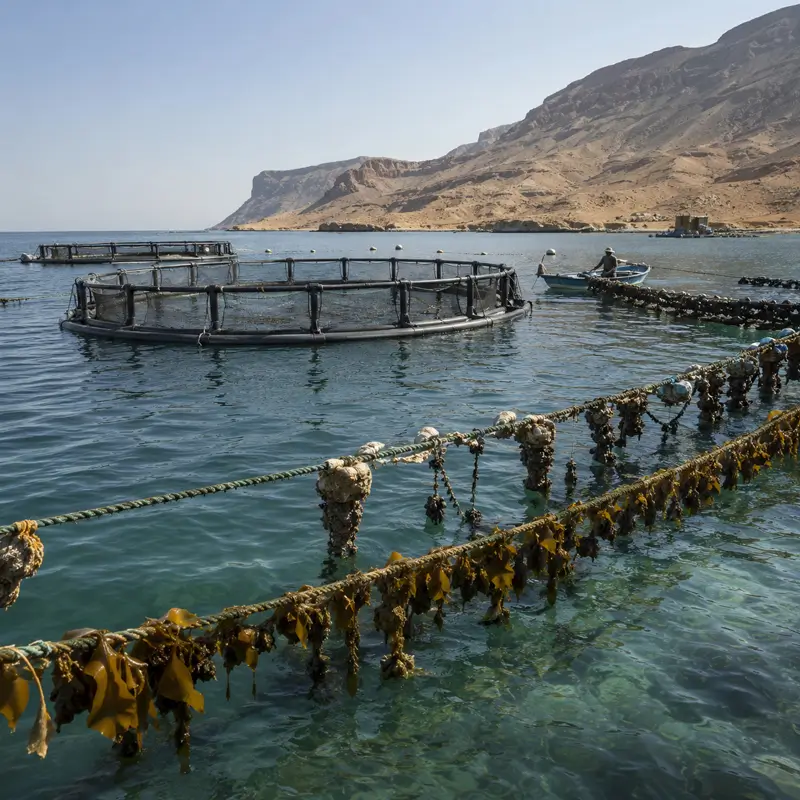
Integrated multi-trophic aquaculture, or IMTA, becomes important precisely at this point. In FAO’s definition, this system is not simply about placing several aquatic species next to one another; it is the combination of fed species such as fish or shrimp with organic extractive species such as shellfish and inorganic extractive species such as seaweed. Its main difference from simple polyculture is that each component has a defined role in the flow of matter and energy. Fish receive feed, shellfish filter part of the organic particles, and seaweed converts part of the dissolved inorganic nutrients into harvestable biomass.
Why Is Integrated Multi-Trophic Aquaculture Important for Iran’s Blue Economy?
In offshore fish cages, the issue is not simply producing more fish; every unit of feed transfers a portion of nitrogen, phosphorus, and organic matter into the surrounding environment. An article in Marine Pollution Bulletin on Iranian cages in the Persian Gulf warned that, with a target of 200,000 tonnes of annual production, nutrient discharge could become a major issue. The significance of this warning is linked to the characteristics of the Persian Gulf, because coral ecosystems and the semi-enclosed nature of the water body make its capacity to tolerate cumulative pressures more sensitive. Therefore, cage farming development in southern Iran cannot be defined merely by increasing the number of farms; it requires carrying-capacity design, environmental monitoring, and a lower-waste production model.
IMTA seeks to reduce part of this risk through biological design. In this context, bioremediation is not an environmental slogan; it means converting part of the farm’s output into harvestable biomass. Shellfish, as an organic extractive component, can process part of the suspended particles and organic matter in the water column and store them in their bodies. Seaweed, as an inorganic extractive component, absorbs dissolved nitrogen and phosphorus and, through this pathway, helps reduce eutrophication pressure.
– Doris Soto, Senior Fisheries Officer at FAO, in the integrated mariculture document: “Bioremediation of the impacts of feed-based aquaculture is the main advantage of integrated systems in mariculture.”
The economic point here is just as important as the environmental one. If shellfish or seaweed serve only as cleaning agents and no independent market develops for them, the model will not be sufficiently attractive at a commercial scale. FAO emphasizes this same logic: the extractive component must have independent economic value, because IMTA must ultimately reduce environmental pressure while also moving the farm away from full dependence on fish revenue. For Iran’s coasts, this means that pilot design should not be aimed only at demonstrating waste reduction; it must also clarify the pathway for sales, processing, and industrial use of the by-product.
The Technical Mechanism of Fish, Shellfish, and Seaweed Co-Cultivation in Reducing Cage Waste
The technical design of IMTA begins with understanding the physical form of the waste. The waste released from fish cages is not a single type of material; part of it consists of organic particles from uneaten feed and excreta, while another part consists of dissolved inorganic nutrients such as forms of nitrogen and phosphorus. For this reason, the placement of shellfish and seaweed must be aligned with current patterns, distance from the cage, and the type of target material. If these components are merely placed beside the cage without being coordinated with the hydrodynamics of the area and the feed load, waste reduction will not become a reliable outcome.
The official framework of Fisheries and Oceans Canada explains this logic clearly. Shellfish should be positioned where they can receive organic particles closer to the cage, because these particles are heavier and usually settle or disperse along the current sooner than dissolved substances. By contrast, the seaweed component can be placed farther from the cage, because dissolved inorganic nutrients are lighter and travel longer distances with the current. Therefore, IMTA design is less a fixed layout than a dynamic siting problem based on current, depth, feed load, and growing season.
– Fisheries and Oceans Canada, an official Government of Canada institution: “Kelp and other seaweeds absorb dissolved inorganic nutrients such as nitrogen and phosphorus.”
Bioextraction metrics show that differences in species and harvested biomass are decisive in calculating environmental impact. In the study by Wu and colleagues, each kilogram of dry-weight Saccharina latissima was reported to reduce nitrogen-driven eutrophication by the equivalent of 0.023 kilograms of nitrogen, while each kilogram of dry-weight Gracilaria tikvahiae was reported to reduce it by the equivalent of 0.035 kilograms of nitrogen. The SUBMARINER technical report also presents mussel harvesting as extracting, on average, about 10 kilograms of nitrogen and 1 kilogram of phosphorus per tonne of shellfish harvested from the sea. These figures do not represent guaranteed performance for Iran, but they do define the calculation framework.
Feed type also plays a direct role in the cage’s output load. The article by Qi and colleagues reported that in cages using trash fish, around 142 kilograms of nitrogen and 26 kilograms of phosphorus enter the environment per tonne of fish produced, while formulated feed results in about 72 kilograms of nitrogen and 17.3 kilograms of phosphorus. This comparison shows that IMTA is not a substitute for feed management and should not be expected to compensate on its own for the weakest production decisions. An integrated system becomes meaningful when feed improvement, carrying capacity, shellfish placement, and seaweed cultivation area are all considered within a single model.
Global IMTA Case Studies from China to Europe and Their Message for Iran
The experience of Sanggou Bay in China shows that the bioextractive effect of seaweed becomes significant when the system is designed at an appropriate scale. According to FAO, producing 1,500 tonnes of seaweed per square kilometer can remove about 40 tonnes of nitrogen, 5 tonnes of phosphorus, and 500 tonnes of carbon. For Iran, this case study is less a ready-to-transfer number and more a demonstration of the importance of scale. The climate, depth, species, consumer market, and hydrodynamics of southern Iran are not the same as those of this bay, but the principle of converting nutrients into harvestable biomass carries a clear message for the design of coastal pilots.
The European IDREEM project is important from another angle. This project was implemented with 15 partners in 8 European countries and a budget of 5.7 million euros, with the aim of increasing resource efficiency, reducing waste, and increasing production through the development of IMTA. The final CORDIS report stated that in some cases, reductions in certain waste streams exceeded 80 percent, and across the partners as a whole, aquaculture production increased by 5 percent. However, the same experience also showed that for some producers, the scale required to demonstrate a meaningful environmental benefit was beyond the scope of the project.
– European Commission CORDIS, final report of the IDREEM project: “In some cases, significant reductions in waste streams of more than eighty percent were observed.”
Scale limitation is one of the most important policy lessons for Iran. An economic study from Scotland on seaweed reported that to absorb 10 percent of the nitrogen from a 1,000-tonne salmon farm, about 10 to 13 hectares of seaweed cultivation would be required. This figure relates to salmon and a cold-climate setting and should not be applied directly to southern Iran, but it shows that real nutrient reduction cannot be achieved with a few symbolic seaweed lines beside a cage. If the goal is to reduce environmental impact, cultivation area, growing season, biomass productivity, and feed load must be calculated from the very beginning of pilot design.
Portugal provides a smaller but useful example of a pilot pathway. The ALGADEPUR project, with a total budget of 208,836 euros and European Union support of 177,511 euros, equivalent to 85 percent of the budget, was designed to test four local seaweed species alongside a semi-intensive fish farm. The value of this example lies in the fact that the capacity of local species to improve water quality is tested first, and only then is a decision made about the economics of the by-product. For Iran, too, such sequencing is more logical than moving directly into large-scale investment, because a pilot must clarify both biological performance and market logic.
The Economic Model and Financing of Fish, Shellfish, and Seaweed Pilots
The economics of IMTA begins with a simple contradiction: extractive components create costs, but their revenue is not certain at the outset. In a seaweed farm, capital costs include boats, equipment, hatchery infrastructure, cultivation structures, nets, ropes, and harvesting equipment. Operating costs also include hatchery work, seeding, cultivation, harvesting, and maintenance. Therefore, adding seaweed and shellfish to fish cages is not merely an environmental decision; it changes the capital balance, liquidity risk, and sales plan for the by-product.
The economic review by Knowler and colleagues shows that integrating shellfish or seaweed with salmon monoculture has been assessed as financially positive in many studies. However, the same review emphasizes that outcomes depend on assumptions about price, scale, market, risk, and licensing costs. This point is critical for Iran, because the domestic financial model should not be copied from foreign figures. If the market for shellfish and seaweed, hatchery costs, harvesting costs, and processing capacity are not clearly defined, the pilot’s net present value will remain only a conditional scenario.
– Damon Knowler and colleagues, authors of the article published in Reviews in Aquaculture: “Integrating shellfish or seaweed with salmon monoculture can increase farm profits.”
Blue carbon revenue must also be treated cautiously. Verra’s file on the methodology for carbon removal through seaweed is listed as archived, and this status alone shows that relying on guaranteed carbon-credit sales for an Iranian pilot is not logical. The issue is not merely carbon uptake in biomass; measurement, reporting, verification, permanence of removal, and carbon ownership must also be clarified. Therefore, in Iran’s financial model, blue carbon should be treated as a conditional long-term option, not as the main pillar of cash flow.
Pilot financing must be aligned with both technology risk and environmental risk. The fish component, because of existing cage-farming experience, can be closer to private capital, but the seaweed and shellfish components in the first stage require research support, joint monitoring, and risk reduction. The experience of European projects shows that connecting universities, industry, and public support can reduce the cost of learning and produce reliable data for investor decision-making. In Iran, too, a successful pilot must generate financial statements, environmental data, and a market pathway at the same time, because none of these alone is sufficient for a development decision.
Siting Requirements, Carrying Capacity, and Market Standards for Iran’s Coasts
Siting in IMTA is an engineering and ecological decision, not simply the selection of an empty marine area. In its guidance on site selection and carrying capacity, FAO emphasizes that decision-making must be proactive, because the impacts of aquaculture are often regional and cumulative. This principle is especially important for cages in southern Iran, because nutrient load, prevailing current, depth, sediment, water clarity, and habitat sensitivity must be assessed before production density is increased. If carrying capacity is examined only after environmental pressure appears, the cost of correction will usually be higher than the cost of proper design at the outset.
– Jorge Bermudez, author of the legal and policy section of the FAO workshop on siting and carrying capacity: “Planning decisions must be proactive, not reactive, because aquaculture impacts become cumulative.”
Iran’s regulations for cage fish farming cover siting criteria for marine cages and supporting coastal lands, and in cage-related considerations they address waste materials, organic matter, nitrogen, phosphorus, and sedimentation risk. These points of connection can form the basis for the gradual integration of IMTA into cage design. However, designing a fish, shellfish, and seaweed system requires additional layers such as bioextraction metrics, the ratio of extractive biomass to feed, and seasonal monitoring of nutrient flows. Any pilot that establishes this link will move from the level of a technological idea toward the level of a management tool.
Market standards already affect investment decisions today. ASC Farm Standard v1.0.1 began accepting audits on 2025-08-01 and will become mandatory for all audits on 2027-05-01. The scope of this standard includes farm management, environmental impact, human rights, and animal welfare, and for export markets it can become a serious indicator of sustainability. The GLOBALG.A.P. IMTA Standard also covers the chain from the entry of fingerlings, shellfish seed, and seaweed seed to harvesting, site selection, feed, chemicals, and worker health.
For Iran, compliance with these standards is not important only at the export stage. Even in a domestic pilot, the data structure should be compatible with the language of credible standards from the beginning so that the cost of redesigning the system does not increase later. If water-quality monitoring, feed records, current maps, shellfish and seaweed harvest data, and sediment indicators are collected in an auditable format, the pilot becomes a knowledge asset. This asset can play a decisive role in negotiations with investors, banks, regulators, and industrial buyers.
Iran’s Implementation Pathway for Coastal Pilots and Investment Decision-Making
Iran’s implementation pathway should begin with scientific caution and economic clarity. Integrated multi-trophic aquaculture on the southern coasts should not be presented as an established operational reality; it should be defined as a localization pathway based on pilots, monitoring, and phased learning. The first step is to select sites where prevailing current, depth, habitat sensitivity, feed load, distance from shore, and the feasibility of installing shellfish and seaweed structures can be evaluated. Then, water-quality and sediment metrics must be recorded seasonally so that the relationship between fish production and the absorption capacity of the extractive components gradually becomes clear.
The second step is to design the pilot so that its output is not limited to an environmental report. The pilot must show how much seaweed or shellfish biomass can be harvested under real conditions, how much seeding and maintenance costs affect operations, and what possible processing or sales pathway exists for the by-product. This information matters to banks and private investors, because without it, no defensible relationship can be built between reduced environmental risk and financial return. In such a model, the government or a research institution can cover the costs of data collection and early risk reduction, while private capital focuses on the productive and market-oriented component.
The third step is to define stop criteria and scale-up criteria. If the ratio of seaweed and shellfish to feed load is so small that it does not create a meaningful reduction in nitrogen and phosphorus, farm development will merely have the appearance of integration. If the by-product is harvested but has no market or industrial use, maintenance costs will be imposed on the farm and the economic logic will weaken. Scale-up criteria must combine measurable nutrient reduction, sediment health, harvestable biomass, operating cost, market acceptance, and the ability to comply with ASC and GLOBALG.A.P. standards.
The practical conclusion for Iran’s coasts is clear: IMTA is neither a guaranteed promise to reduce all waste nor a ready-made formula for rapid revenue generation. Its value lies in moving marine cage development away from a single-product, high-risk pathway toward a multi-component, monitorable system that is closer to the logic of a sustainable blue economy. If design is based on carrying capacity, data collection, proper species selection, and a cautious financial model, co-cultivating fish, shellfish, and seaweed can become a tool for reducing environmental pressure and creating complementary revenue. The right decision for Iran is to begin with small but precise pilots—pilots that measure the environment while also revealing the real economics of the by-product.