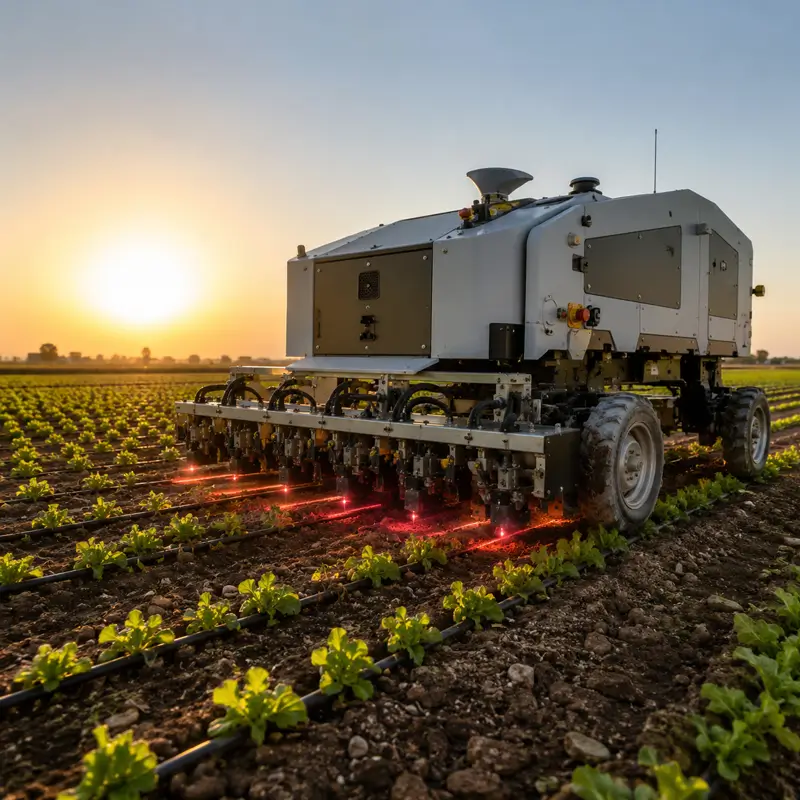
Laser Weeding Robots for Low-Input Farming

Laser and Electric Weeding Robots: A Pathway to Eliminating Herbicides in Precision Agriculture
Weeds in a field are not just a biological nuisance; they impose part of the production cost, input consumption, labor pressure, and chemical residue risk on the food chain. Chemical control, because of its speed and broad coverage, has been the main pillar of weed management for years. Precision agriculture, however, points to a different path: seeing each plant, distinguishing it from the main crop, and eliminating that exact point with targeted action. In this logic, the field is no longer a uniform surface for spraying; it becomes a network of small, continuous decisions, each of which must be supported by data, energy, and safety.
Laser, electrical discharge, and precision mechanical tools are three different responses to the same problem. A laser system concentrates optical energy on the meristem or target tissue; an electrical system sends high-voltage current through the plant and soil to destroy cells and roots through internal heating; and precision mechanical tools use cameras and image processing to guide a blade or cultivator to the right location. The main difference among these three technologies is not simply that they are all non-chemical, but how they consume energy, how quickly they cover the field, their level of operational risk, their cost of ownership, and how well they fit crops with higher added value.
The importance of this transition is not only technical. Under the Farm to Fork framework, the European Union has announced two nonbinding targets: a 50 percent reduction in the use and risk of chemical pesticides and a 50 percent reduction in the use of more hazardous pesticides by 2030. Even when such policies do not create direct obligations, they shift the direction of industrial investment and give more weight to non-chemical technologies. For Iran as well, the issue is not merely the import of an expensive machine; it is about designing a measured pathway toward low-input, safe, and scalable agriculture in high-value chains.
The Technical Logic of Weed Removal Without Herbicides
A laser weeding robot uses a combination of machine vision, deep learning models, and precise targeting. The commercial Carbon Robotics LaserWeeder has been introduced with 42 cameras, more than 100 crop-specific deep learning models, and 30 lasers rated at 150 watts. The manufacturer claims sub-millimeter accuracy, more than 5,000 weed strikes per minute, and up to 99 percent weed elimination. The smaller LaserWeeder G2 200 has also been introduced with 8 diode lasers rated at 240 watts, 12 cameras, and a rate of 3,333 strikes per minute, showing that the industrial path is moving toward multiple machine sizes suited to farm scale and tractor capacity. In this technology, the decision point is exactly where the system determines that the meristem or sensitive tissue of the unwanted plant should receive energy.
The electrical system operates according to a different physical logic. In this method, current enters the plant through an applicator, passes through plant tissue and soil, and the circuit is closed through a second applicator. For the F601, RootWave reports a frequency of 18,000 hertz, power of up to 60 kilowatts, speed of up to 5 kilometers per hour, row width of 2 to 6 meters, treatment width of 30 to 65 centimeters, and a weight of 1,500 kilograms. Zasso XPS has also been introduced for orchards and vineyards with 24 kilowatts of power, a weight of 1,200 kilograms, a width of 1.52 to 4.84 meters, speed of up to 4 kilometers per hour, and a requirement for a 75-horsepower tractor.
— The Role of Precision Mechanics in a Gradual Transition
Precision mechanical tools form the intermediate link between traditional cultivators and high-energy laser or electric robots. In the collaboration between RootWave and Garford announced on June 11, 2024, the Robocrop system was described as using a camera and an image-analysis computer to locate crops and guide blades quickly and precisely. This model matters because it does not define non-chemical technology as necessarily eliminating mechanical components altogether. Instead, it first increases guidance accuracy and then creates the possibility of adding an electrical module or more targeted systems. For chains where accepting heavy upfront investment is difficult, this gradual combination can reduce both technical and financial risk.
Energy and Operating Speed in Real Fields
The key metric in comparing these technologies is not only the nominal power of the machine; energy consumption per unit area and weed density matter more. In the WeLASER research project, a 1,714-kilogram laser weeding robot with a 2-meter working width, a speed of about 2 kilometers per hour, positioning accuracy of ±3 millimeters, and weeding efficiency of 65 to 90 percent was examined. The same study reported total thermal energy consumption at weed densities of 5, 60, and 120 weeds per square meter as 248.8, 553.63, and 890.94 megajoules per hectare, respectively. These figures show that laser technology has two very different operational profiles in a clean field versus a heavily infested one.
The amount of energy required to eliminate each target is also decisive. In the WeLASER experiments, 5 to 20 joules of optical energy per meristem was reported as a potentially effective range, while the review by Coleman et al., cited in the same article, mentions a range of 21 to 350 joules per weed for complete pyrolysis using a CO2 laser. The difference between these two ranges is practically important because targeting the meristem with lower energy can reduce consumption, but full destruction of plant tissue requires more energy. Therefore, the advantage of laser technology becomes clearer when detection, aiming, and firing time are sufficiently precise.
Field coverage speed is the next pressure point. Carbon Robotics reports operational capacity of 0.20 to 0.61 hectares per hour for the LaserWeeder and 0.16 to 0.28 hectares per hour for the G2 200. This speed is worth evaluating in crops with high value per unit area, but for farms where the only decision criterion is operating cost per hectare, it does not by itself create a decisive advantage. RootWave F601 has a linear speed of up to 5 kilometers per hour, but the absence of a hectares-per-hour metric in the product data limits direct comparison with laser systems and makes decision-making dependent on field trials.
Comparison with traditional methods in the WeLASER life-cycle study provides an important warning. In the review by Coleman et al. cited in the same analysis, the traction energy of some cultivators and tools such as harrows, sweep cultivators, and rotary hoes is reported in the range of 4.2 to 50 megajoules per hectare, while chemical boom spraying, based on 1.0 to 3.9 liters of diesel per hectare, is reported as equivalent to 37 to 145 megajoules per hectare. Compared with these values, consumption of 553.63 megajoules per hectare in the WeLASER scenario with 60 weeds per square meter shows that eliminating herbicides does not always mean reducing energy use. The correct benchmark is the combination of energy, precision, control quality, the need for repeated operations, and crop value.
Ownership Economics and Operating Costs
The economics of a laser weeding robot depend above all on capital cost and annual utilization. The Western Growers case study on Braga Fresh reported the purchase price of one LaserWeeder at $1.2 million and calculated depreciation over a five-year period and 2,350 acres per year at $102.13 per acre. The unit conversion in the same case puts this depreciation at about $252.37 per hectare. Total operating cost, including two operators, hardware, OTA service, tractor, fuel, and logistics, was reported at $267.72 per acre, or about $661.57 per hectare.
These figures should be interpreted cautiously when generalized, because the Western Growers study is an industrial case study, not a peer-reviewed multi-crop trial. Even so, it is valuable for understanding the LaserWeeder business model because it shows that the economic logic of the machine is based on replacing part of the cost of hand weeding in dense organic crops, not merely on reducing herbicide costs. With two LaserWeeders, Braga Fresh covered about 4,700 acres, equal to roughly 1,902 hectares, of dense organic crops. The calculation for each machine was based on 2,350 acres, equal to about 951 hectares. This level of utilization plays a decisive role in lowering unit cost.
For electric technology, the economic picture in available sources is closer to operating cost than purchase price. In the RootWave and Garford collaboration, the estimated cost of using eWeeding across several systems was announced at £55 to £120 per hectare. Because of the corporate nature of the source, this figure should be read as an industry estimate, but from a market-model perspective, it highlights the contract-service pathway. Systems installed on precisely guided toolbars can create more flexible options for growers between full machine ownership and receiving field services.
Cost of ownership is not only the price of the machine. The commercial LaserWeeder requires a tractor with at least 175 horsepower and a PTO of at least 90 horsepower, while the G2 200 requires a tractor with at least 110 horsepower and a 40-horsepower PTO. Zasso XPS, with a 75-horsepower requirement, and RootWave F601, with an 80-horsepower requirement, sit at a lower tractor-power level, but they still depend on operators, maintenance, parts, safety, and training. Carbon Robotics also mentions a one-year warranty, 24/7 software support, and service and support programs after the second year, showing that software and after-sales service are part of the real economics of the machine.
Safety and Life-Cycle Impact
From a safety perspective, an agricultural laser is not a simple farming tool. Carbon Robotics identifies the LaserWeeder as a Class 4 Laser Product and warns against eye or skin exposure to direct or scattered radiation. The UK Health Security Agency also highlights eye and skin hazards associated with high-power lasers. As a result, any field deployment must be designed from the beginning with shielding, interlocks, access control, operator training, safe zones, emergency shutoff, and insurance liability in mind, rather than treating safety as an implementation appendix added after purchase.
Electric weeding also requires another level of safety. High-voltage current makes human and animal contact, soil moisture, insulation, mechanical geometry, safe distance, and emergency shutoff central design issues. Zasso refers to CE certification for XPS and emphasizes insulating materials and mechanical geometry, but such references do not replace independent field assessment and a localized safety protocol. Non-chemical technology becomes an advantage only when it does not replace chemical risk with uncontrolled optical or electrical risk.
Environmental impact must also be viewed across the life cycle. In the WeLASER project LCA, the baseline scenario for sugar beet showed that WeLASER’s impact was calculated to be about 20 percent higher than chemical spraying in the human toxicity indicator and about 147 percent higher in the human health indicator related to climate change. The main cause was identified as energy consumption and the production or use of electrical and electronic components. This result does not negate the value of eliminating herbicides; it only expands the boundary of analysis from “not using a chemical substance” to “total energy, parts, electronics, useful life, and end-of-life management of the machine.”
Electronic waste and metallic materials also matter within the same framework. The WeLASER study highlighted impacts related to copper and gold in electrical and electronic components and considered end-of-life management an important factor in assessing total impact. For this reason, a farm that adopts laser or electric technology is not only reducing herbicide use; it is also connecting itself to a new chain of parts, sensors, lasers, electrodes, software, and recycling. Precision agriculture becomes more sustainable when technical design, repair planning, useful life, and recycling are built into the investment model from the start.
Application Pathways in High-Value Crops and Iran
The natural entry point for these technologies is crops with high hand-weeding costs, sensitivity to chemical residues, or high value per unit area. The Braga Fresh data show that LaserWeeder was evaluated in dense organic crops with high annual utilization, mainly from the perspective of replacing part of the cost of hand weeding. RootWave F601 has been introduced for trees, vines, and bush fruits, and Zasso XPS also targets orchards and vineyards. This pattern shows that the initial market for non-chemical technologies is more likely to form in chains where product quality, market standards, and labor costs carry greater economic weight.
For Iran, localization must begin with the field problem, not with the appeal of the machine itself. Iran’s institutional history with IPM creates a conceptual point of support; the FAO has reported that Iran’s IPM group was formed in 2009, had about 500 members including FFS/IPM farmers, facilitators, consumers, and NGO actors, and that IPM became part of Iran’s research and extension program. This background does not mean the country is ready for robotics, but it shows that the logic of reducing dependence on chemical intervention is not unfamiliar to Iran’s extension and research system. The next step is to turn this logic into precise, safe, and measurable pilots in selected value chains.
The lower-risk model for Iran is to start with precision mechanical tools equipped with machine vision and then move toward integrating electric or laser modules. This path aligns with the RootWave and Garford experience because precise toolbar guidance is an infrastructure that creates operational value even before adding higher-risk energy systems. The full import of a high-power laser robot with a $1.2 million price tag in the Braga Fresh study, because of capital cost, tractor-power requirements, specialized services, parts, and safety requirements, should be considered only in chains where utilization level and crop value can absorb such investment. Smaller pilots, with clear metrics for energy, speed, control quality, safety, and unit cost, shift the decision from the appeal of technology to the economics of the farm.
Conclusion for Investment Decisions
Laser weeding robots, electric weeding, and precision mechanical tools are three levels of a shared transition: moving from uniform spraying to point-specific intervention. Laser offers the highest level of targeting and optical complexity, but it turns energy use, field coverage speed, hazard classification, and capital cost into central issues. Electric technology advances non-chemical control with linear speed and applications in orchards and vineyards, but it makes high-voltage management and safety standards more serious. Precision mechanics may be less spectacular, but as an entry platform into precision agriculture, it carries lower cost and lower risk.
The right decision is not to choose one technology as the absolute winner. In dense organic crops, laser may be justified by replacing hand weeding; in orchards and vineyards, electric systems can be evaluated for herbicide-free control in defined rows; in farms with more limited capital, precision mechanical tools with machine vision can be the first stage. Each scenario must be assessed against five metrics: energy per hectare, operational capacity, control quality, ownership cost, and safety-risk level. Only when these five metrics are considered together does herbicide elimination move from a technological slogan to an economic and operational decision.
For Iran, the strategic value of this field lies in connecting low-input agriculture, high-value crops, technology services, and staged investment. The practical path does not begin with scattered purchases of expensive machines; it begins with defining the target crop, pilot plot, safety protocol, energy measurement, ownership or service model, and support contract. If this framework is followed, laser and electric technologies, alongside precision mechanical tools, can become part of the precision-agriculture toolbox. In this pathway, eliminating herbicides is the result of accumulated data, safety, economies of scale, and the right crop selection, not the automatic consequence of bringing an advanced machine into the field.