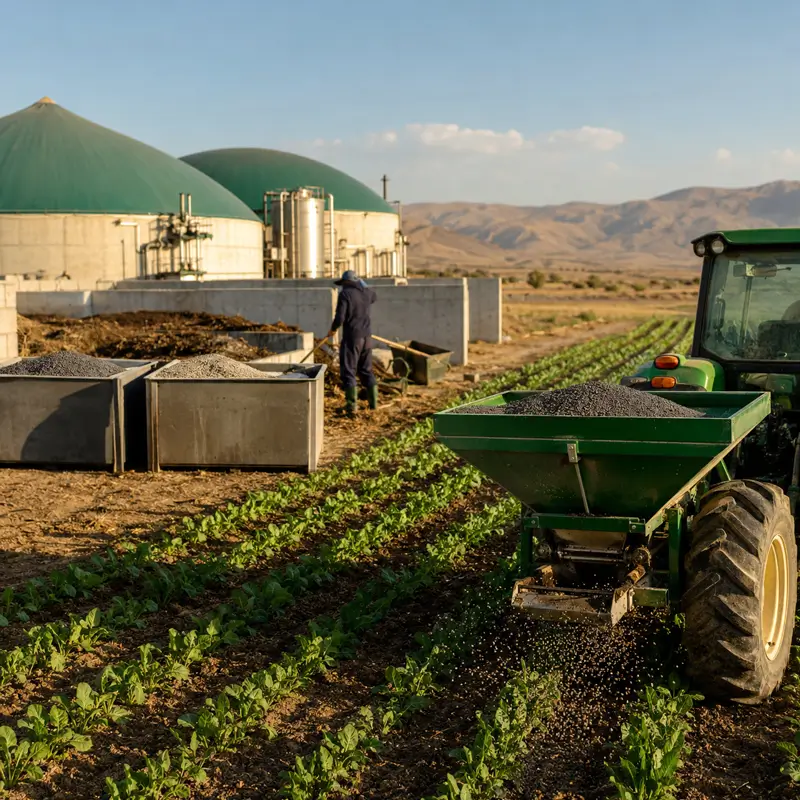
Recycled Fertilizer: Partial P Replacement, Iran

Recycled Fertilizers from Ash, Digestate, and Biowaste: An Alternative Path to Partially Replacing Mineral Phosphate in Agriculture
For a farm, phosphorus is not merely a nutrient; it is part of food production security, soil sustainability, and the real cost of agriculture. Whenever the supply of phosphate fertilizer depends on limited mineral resources, imports, price volatility, or uncertain quality, farmers face a risk that begins in the soil and extends throughout the food chain. Recycled fertilizers from ash, digestate, and biowaste become important at precisely this point, because instead of treating waste as something to be disposed of, they reintroduce nutrients into the production chain as controllable secondary resources. This pathway is not a complete replacement for mineral phosphate. Rather, it is the design of a complementary, standardized, and traceable layer that can reduce part of the pressure on phosphorus supply.
The main difference between recycled fertilizer and raw waste is not a matter of naming or origin; it lies in feedstock control, the conversion process, and quality testing of the final product. Digestate, sludge ash, separately collected biowaste, and precipitated phosphate salts become defensible for agricultural use only when their P₂O₅ content, phosphorus bioavailability, heavy metals, pathogens, and physical impurities are documented. This technical boundary separates the path of recycled fertilizers from the unsafe use of waste. For Iran as well, the reliable starting point is the definition of a standardized product, not the addition of a new label to the fertilizer market.
In Iran’s agricultural economy, the discussion of recycled fertilizer must be understood alongside three concerns: soil protection, reduced risk in input supply, and increased value from waste streams. Agricultural soil does not have unlimited capacity to absorb contaminants, and the entry of heavy metals or pathogens into farmland can turn the advantage of recycling into a long-term threat. On the other hand, biological waste and phosphorus-bearing streams lose their nutrient value if they are disposed of without technological design. Therefore, the main question is not whether any waste can become fertilizer. The real question is which stream, with which technology, and under which standard can assume part of the role of mineral phosphate.
Why Should Recycled Fertilizer Be a Standardized Product Rather Than Unprocessed Waste?
Regulation (EU) 2019/1009 accepts recycled fertilizers under the category of EU fertilizing products, but it divides them into specific component material categories. These categories include compost, fresh crop digestate, digestate other than fresh crop digestate, precipitated phosphate salts, thermal oxidation materials, pyrolysis or gasification materials, and high-purity recovered materials. The value of this classification is that it moves the market beyond the generic phrase “organic fertilizer” and classifies each product based on origin, process, and function. Such a model is particularly important for Iran, because standardizing recycled fertilizer without technological classification increases the risk of mixing controlled products with low-quality waste.
Under this logic, the final product must both fall within a product function category and be made from an authorized component material. The PFC indicates the product’s function, while the CMC clarifies the origin and process of the component material. Before placing the product on the market, the producer must also prepare technical documentation, carry out conformity assessment, issue a declaration of conformity, and affix the CE marking. This administrative chain may appear regulatory on the surface, but in practice it has an economic role, because it increases the confidence of farmers, distributors, and importers in product quality.
For recycled phosphate fertilizers, the standard is not limited to the percentage of nutrients. The product must also be controlled for heavy metals, microbial contamination, coarse impurities, and cross-contact between input feedstock and output product. If a phosphorus-bearing material is obtained from sludge, wastewater, or biowaste but lacks these controls, it remains far from a standardized fertilizing product in agricultural terms. This is the critical point for Iran as well: any policy aimed at partially replacing mineral phosphate must begin with a testing and traceability system, not with the announcement of raw waste capacity.
Technical Criteria for Precipitated Phosphate Salts in Partially Replacing Mineral Phosphate
–P₂O₅ and Organic Carbon Criteria in Recycled Phosphate Products
Precipitated phosphate salts, such as struvite, are one of the clearest technical pathways for recovering phosphorus from biological and wastewater streams. Under CMC 12, these products must contain at least 16% P₂O₅ on a dry matter basis, and their organic carbon content must not exceed 3% of dry matter. These two figures show that precipitated phosphate products differ from classic organic fertilizers, because their main purpose is to return phosphorus in a concentrated and measurable form. Reporting on a dry matter basis is also important, because moisture can create a misleading impression of the actual nutrient concentration.
Low organic carbon in precipitated phosphate salts does not mean that the material has no value. Rather, it shows that this product category is designed for a phosphate function. By contrast, solid organic fertilizer and liquid organic fertilizer are defined separately in European regulations with minimum organic carbon requirements, and their function is more closely linked to improving soil organic matter. This distinction is important for policymaking in Iran, because compost, digestate, and struvite should not be assessed under a single label. Each must be evaluated in its own place, with its own appropriate indicators, and for its specific use objective.
–Control of Physical Impurities and Contact Between Feedstock and Output Product
In precipitated phosphate salts, coarse impurities larger than 2 millimeters must not exceed 3 grams per kilogram of dry matter for each category of organic matter, glass, stones, metal, and plastic, and their combined total must not exceed 5 grams per kilogram of dry matter. These figures have direct significance for the fertilizer market, because farmers accept a product when its appearance, uniformity, and physical quality are reliable. The presence of plastic, glass, or metal in recycled fertilizer is not only a technical risk; it is also a reputational risk for the entire market for these products. For this reason, physical control, alongside chemical and microbial control, is part of the definition of a technological product.
The production process for precipitated phosphate salts must also take place in a reactor under controlled conditions. European regulations do not allow physical contact between input and output after precipitation, even during storage. This requirement establishes a simple but essential principle: a recycled product is clean only when its production pathway is protected from recontamination. For Iran, phosphorus recovery pilots should follow the same logic and incorporate the separation of contaminated feedstock, output product, storage, transportation, and sampling into the unit’s architecture from the outset.
The Role of Ash and Thermal Oxidation Materials in Safe Phosphorus Recovery
Ash gains agricultural value in the discussion of recycled fertilizers only when its origin and production process are clear. Under CMC 13, thermal oxidation materials are defined as materials produced through thermochemical conversion under non-oxygen-limiting conditions. This category can cover certain ashes derived from separately collected biowaste, municipal sewage sludge, and authorized food industry streams. However, mixed municipal waste and hazardous waste are excluded from key parts of this pathway, because their contamination risk for agricultural products is higher.
The importance of sewage sludge ash lies in its capacity to concentrate phosphorus, but this same concentration can also come with concentrated contaminants. Therefore, recovery technology from ash should not be reduced to incineration and direct use of the residue. The defensible pathway is controlled processing of ash, separation or reduction of contaminants, and conversion into a product that can be tested through specific indicators. Experiences with technologies such as Ash2Phos are useful for policy discussion only when corporate claims are attributed accurately and not generalized directly to Iranian conditions.
According to EasyMining, the Ash2Phos process for sewage sludge ash achieves a phosphorus recovery rate of more than 90% and an ash recycling rate of more than 95%. These figures may indicate the technological potential of phosphorus recovery from ash, but the source is corporate and should not be treated as independent performance evidence or an economic guarantee for Iran. The main value of this example for Iran is that it demonstrates the logic of the chain: ash should be the feedstock for a recovery technology, not a material that reaches farmland without purification and quality control. This distinction marks the boundary between a circular economy and the transfer of contamination to soil.
How Do Digestate and Biowaste Become a Loop for Nutrient Return?
Digestate is the solid or liquid output of anaerobic digestion, and European regulations distinguish between digestate derived from fresh crops and digestate other than fresh crop digestate. This distinction shows that feedstock origin determines product quality. Digestate from cleaner feedstock is not the same as digestate from diverse waste streams, and each must be assessed separately in terms of contamination, pathogens, salinity, nutrients, and suitability for agricultural use. Therefore, digestate should not remain an unnamed byproduct of biogas production. It should be designed as a product with manageable quality.
Separately collected biowaste also creates a lower-risk pathway for producing compost, digestate, or precipitated phosphate salts compared with mixed municipal waste. The reason for this advantage is not merely collection discipline; it is the reduced likelihood of plastic, metal, glass, hazardous materials, and unwanted contaminants entering the fertilizer production stream. When feedstock is cleaner from the beginning, quality-control costs and the likelihood of product rejection in final testing decrease. For Iran, prioritizing closer and more controllable streams such as food industries, large livestock farms, slaughterhouses, and biogas units is more logical than beginning with mixed municipal waste.
Compost has a separate position in this chain and should not be simply equated with recycled phosphate fertilizer. Iran’s national compost standard, No. 10716, was first developed in 2007, and its revision was approved in 2025 by the National Committee on Fertilizers and Pesticides. This process shows that compost quality and its physical and chemical characteristics remain an active subject of standardization. However, compost alone is not a direct answer to replacing mineral phosphate and should be viewed alongside products such as precipitated phosphate salts, processed ash, and standardized digestate within a recycled fertilizer basket.
Cadmium and Pathogen Control as Conditions for Recycled Fertilizer Use on Farms
Cadmium is one of the most sensitive indicators in the discussion of phosphate fertilizers, because repeated fertilizer use can introduce it into soil and create food-related concerns. Regulation (EU) 2019/1009 sets the cadmium limit for mineral or organo-mineral phosphate fertilizers with P₂O₅ equal to or greater than 5% at 60 milligrams per kilogram of P₂O₅. This figure is not legally binding for Iran, but it can serve as a reference benchmark in designing a national standard or quality-control guideline. Its importance lies in the fact that partially replacing mineral phosphate should not mean accepting a higher contaminant risk.
Heavy metal control is not limited to cadmium. For organo-mineral fertilizers, limits are defined for hexavalent chromium, mercury, nickel, lead, and inorganic arsenic, and specific limits are also provided for copper and zinc unless these elements have been intentionally added and declared to correct micronutrient deficiencies. This logic makes the fertilizer market dependent on transparent labeling and testing. Farmers accept recycled products when they know that useful nutrients have been separated from harmful contamination.
Microbial safety is also a core condition for agricultural use in products produced from wastewater, sludge, biowaste, or biological streams. Under CMC 12, Salmonella must be absent in 25 grams or 25 milliliters of product, and E. coli or enterococci must not exceed 1,000 CFU per gram or milliliter. For some biological inputs, risk elimination can be documented through pressure sterilization at above 133°C for at least 20 minutes at an absolute pressure of at least 3 bar, or through pasteurization at 70°C for at least 1 hour. These figures show that recycled fertilizer, without a sanitization step and microbial testing, cannot be considered a reliable agricultural product.
Persistent organic pollutants must also be considered alongside metals and pathogens. For precipitated phosphate salts derived from certain biological inputs, the PAH16 limit is set at 6 milligrams per kilogram of dry matter. In addition, the combined total of aluminum and iron in precipitated phosphate salts must not exceed 10% of dry matter, because this indicator may be related to product quality and phosphorus availability. Such criteria show that a recycled phosphate product cannot be marketed merely by declaring its phosphorus content; its full chemical composition must be managed.
Germany’s Experience in Phosphorus Recovery from Sludge and Sewage Sludge Ash
Germany is one of the important examples of linking regulation, waste streams, and phosphorus recovery. Estimates by the German Environment Agency have shown that the phosphorus potential in municipal sewage sludge is about 54,000 tons of phosphorus per year. The amendment of the Sewage Sludge Ordinance in 2017 was also intended to advance phosphorus recovery, demonstrating that the recycled fertilizer market does not emerge through technology alone. It also requires recovery obligations, quality control, and defined pathways for use. This experience is important for Iran as a policy model, not as a basis for directly copying capacity or technology.
The technical message of Germany’s experience is that sludge and sewage sludge ash can serve as secondary phosphorus sources, but phosphorus recovery does not eliminate the issue of contaminants. Pharmaceuticals, organic pollutants, metals, and risks associated with sludge must be considered in process design and product testing. For this reason, recovery from ash or sludge must take place within a controlled and traceable system. For Iran, the value of this case study lies in showing the policy pathway: first, the feedstock stream is identified; then recovery obligations and product standards are defined; and finally, an agricultural consumption market is built on technical trust.
Iran’s Regulatory Capacity for Standardizing Recycled Phosphate Fertilizers
In Iran, the Soil Protection Law provides important legal capacity for controlling pollution caused by agricultural inputs. Article 18 of this law requires large production, industrial, construction, service, infrastructure, and mining units to monitor soil pollution. Note 1 of the same article also subjects natural and legal persons active in the production, import, and formulation of all types of fertilizers and pesticides to this provision. This capacity is important for recycled fertilizers, because a product produced from a waste stream must be placed from the outset within a framework of pollution monitoring and producer responsibility.
Article 16 of the executive bylaw of the Waste Management Law also requires the standards institute to develop standards for organic fertilizers, especially compost obtained from the processing of ordinary and agricultural waste. This basis shows that the relationship between waste, processing, and fertilizer quality is not without precedent in Iranian law. However, the development of recycled phosphate fertilizers requires standards beyond general compost. Precipitated phosphate salts, processed ash, and digestate must be classified based on their own specific indicators, including P₂O₅, cadmium, pathogens, physical impurities, and feedstock origin.
The revision of Iran’s national compost standard in 2025 can be an opportunity to expand the standards-based approach to other categories of recycled fertilizer. If this path stops at the general characteristics of compost, recycled phosphate products will not have a clear position in the market. The European experience shows that the final product and the component material must be defined simultaneously, so it is clear which feedstock each product comes from, through which process it is produced, and for what function it is intended. Such an approach can help Iran prevent market disorder and farmer distrust.
Iran’s domestic pathway should use existing legal capacities and connect them to more precise product standards. The Soil Protection Law can serve as the basis for pollution monitoring, the compost standard can provide initial experience in quality control for organic materials, and technological classification can separate new recycled fertilizer categories from one another. In this framework, the goal should not be to announce a large market without measurable criteria. The goal should be to create a registration, testing, and labeling system that makes recycled products assessable for both farmers and regulators.
Iran’s Implementation Path for Building Trust in the Recycled Fertilizer Market
Farmers’ trust in recycled fertilizer develops when the product behaves predictably. Nutrient labeling, release rate, salinity, phosphorus bioavailability, heavy metals, pathogens, and field performance must all be included in the product evaluation system. Without this information, farmers will see recycled fertilizer not as a reliable input, but as a high-risk material. Therefore, market development for these products does not depend on promotion; it depends on test data, honest labeling, and producer accountability.
Iranian pilot projects should begin with cleaner feedstocks located near the point of production. Large livestock farms, slaughterhouses, food industries, wastewater treatment plants, and biogas units can be more suitable starting points, because their feedstock streams are more traceable than mixed municipal waste. Locating fertilizer production units close to feedstock sources also makes transportation, moisture, perishability, and processing costs more manageable, although no cost or yield figure should be announced for Iran without project-level data. This cautious pathway allows technical learning and standard correction before broader expansion.
To reduce market risk, contract systems and quality control must be designed at the same time. Long-term feedstock contracts with waste producers, commitments to periodic product testing, product liability insurance, soil monitoring on farms using the product, and standard certification are tools that can increase trust. These tools should not be presented as already implemented experience in Iran, but they are logically consistent with the nature of recycled products. A product that comes from a waste stream needs a higher level of transparency before entering farmland.
A Practical Conclusion for Partially Replacing Mineral Phosphate in Iran
Recycled fertilizers from ash, digestate, and biowaste gain strategic value for Iranian agriculture when they are treated as standardized products, not as a simple route for waste disposal. Recycled phosphorus can reduce part of the pressure on mineral phosphate supply, but this capacity is defensible only if P₂O₅, cadmium, heavy metals, pathogens, PAH16, physical impurities, and feedstock origin are controlled. The experience of Europe and Germany shows that phosphorus recovery requires a combination of technology, regulation, and market trust. For Iran as well, the point of reliance should be product standards, limited pilots, traceable feedstock, and a precise labeling system.
The realistic path is a phased movement from cleaner streams toward more complex products. Standardized compost, controlled digestate, precipitated phosphate salts, and processed ash should each have a separate position and should not be assessed by one general criterion. The Soil Protection Law and the national compost standard have created initial capacity, but partially replacing mineral phosphate requires dedicated standards for recycled phosphate categories. The right decision for Iran is not rapid development without control. It is the creation of a market in which nutrient recycling, soil protection, and farmer trust move forward together.