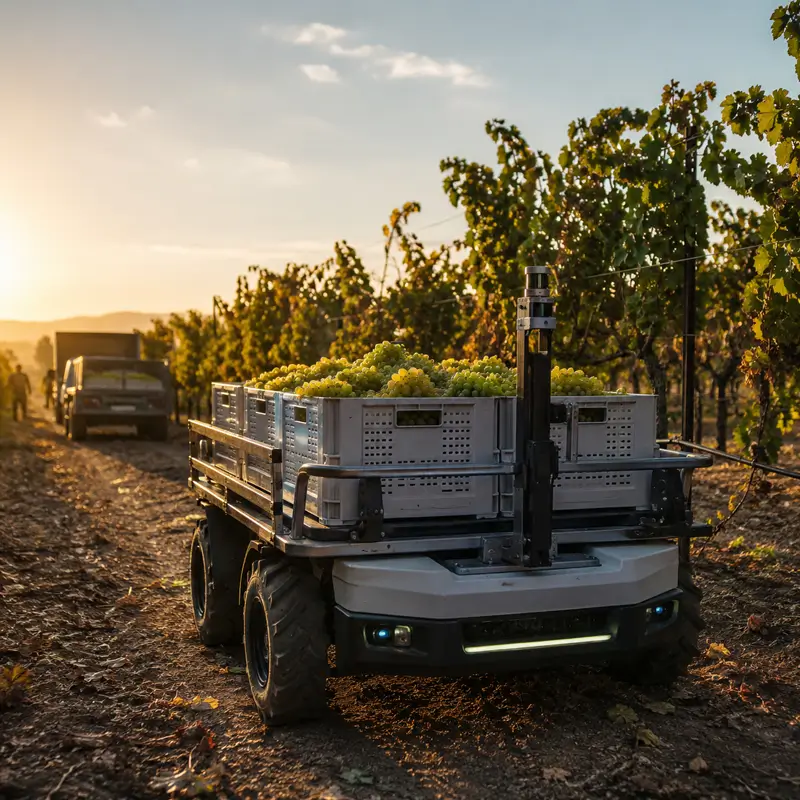
Postharvest Robotics for Quality Tracking

Robotic Postharvest Logistics: Autonomous Produce Handling, Waste Reduction, and Quality Traceability
On the farm, produce quality does not always stop changing at the moment of harvest; in many cases, that is exactly when deterioration begins. A crate that is shaken too much, a container that reaches shade or cold storage too late, pallets moved without precise identification, and produce compressed before initial grading are all part of the postharvest problem. FAO estimates show that 13.2 percent of the world’s food is lost after harvest and before retail; in other words, a significant share of food loss occurs precisely in the interval where transport, quality recording, pre-cooling, and logistics decisions must be handled with precision. From this point, robotic postharvest logistics shifts from a showcase technology into an infrastructure for preserving produce value, reducing losses, and managing data.
The importance of this issue is not limited to farm economics or reducing worker fatigue. FAO and UNEP have identified food loss and waste as responsible for roughly 8 to 10 percent of global greenhouse gas emissions. Therefore, every crate that reaches packing or cold storage faster, in better condition, and through a more stable cold chain touches a much larger issue: food security and climate. Autonomous transport robots, cold-storage AGVs, sorting-hall AMRs, and machine-vision systems operate exactly at this boundary between the farm and the supply chain. They do not merely move loads; they turn time, location, produce condition, and quality events into a traceable record.
From an investment perspective, the value of this technology becomes clear when fresh produce is no longer treated as an anonymous commodity, but as traceable units at the level of crates, tubs, pallets, and batches. Fragile produce such as strawberries or grapes faces three simultaneous risks in the short interval between harvest and cooling: mechanical damage, increased respiration, and a break in quality data. If robotic transport can reduce unnecessary worker back-and-forth movement, shorten routes, control impact, and at the same time connect each crate ID to temperature, time, and initial grading data, postharvest logistics becomes part of food security technology. This is where intelligent mechanization becomes inseparable from cold-chain management and digital traceability.
What Problem Does Robotic Postharvest Logistics Solve?
Robotic postharvest logistics should be understood as a set of automated or semi-automated systems that operate from the moment produce is separated from the plant until it enters cold storage, sorting, initial packing, or refrigerated transport. This scope includes autonomous movement of crates and tubs, quality recording, event traceability, reduction of unnecessary contact with produce, and management of transport routes. ISO 3691-4, which applies to driverless industrial trucks, includes examples such as AGVs, AMRs, bots, and automated guided carts within its scope, but this framework is more compatible with warehouses, packing facilities, and cold storage. For movement in the field and close collaboration with humans, ISO 18497-1 is more relevant to semi-automated, semi-autonomous, and autonomous agricultural machinery, and shows that a field robot does not carry the same risk profile as an AGV operating inside a packing hall.
In practice, a postharvest transport robot moves between two worlds: the irregular world of the farm and the more controllable world of cold storage or the sorting hall. In the field, routes may be unpaved, sloped, wet, or busy, and seasonal workers, harvest crates, existing machinery, and even orchard shade structures may all be present in the same environment. In cold storage or packing halls, the operating zone is easier to design, making it possible to define AGV routes, stopping points, pallet handoff areas, human-robot boundaries, and emergency stops with greater precision. This difference explains why successful implementation begins with the design of the operating zone, not merely with the purchase of a mobile robot.
The first practical function of this technology is reducing dead time in transport. In the FRAIL-bots project at UC Davis, the core issue was that harvest workers spend part of their time carrying filled containers to the end of the field and then returning. The research design proposed small courier-like robots to reduce exactly this type of back-and-forth movement, and for a suggested crew of 50 workers, it considered a fleet of 5 or 6 robots. This figure does not imply definitive commercial readiness, but it does clarify the relationship among labor, transport routes, and fleet size as an operational design problem.
– Stavros G. Vougioukas, Associate Professor of Biological and Agricultural Engineering at the University of California, Davis: “My proposal will establish the scientific and technical foundation needed for human-robot collaboration.”
Human-robot collaboration in postharvest operations does not simply mean replacing workers. It means redesigning the division of labor. Humans can still perform the nuanced judgment involved in harvesting, spotting defects, hand-picking fragile produce, and managing unexpected situations, while robots can take over repetitive transport, back-and-forth movement, location logging, and linking each container to a digital ID. This division becomes valuable when the produce is fragile and each additional handling step increases the risk of bruising, point pressure, or delayed cooling. In this model, the robot is not an absolute substitute for human labor, but an interface between harvesting skill and the logistics discipline of the cold chain.
The Cold Chain, Produce Respiration, and the Logic of Time
Fresh produce remains alive after harvest, and this characteristic separates its logistics from the transport of industrial goods. Grapes have a respiration rate of roughly 1 to 2 milliliters of CO2 per kilogram per hour at 0 degrees Celsius, but at 20 degrees Celsius this rate rises to 12 to 15 milliliters. Strawberries show even greater temperature sensitivity; their respiration rate has been reported at 6 to 10 milliliters of CO2 per kilogram per hour at 0 degrees Celsius, 25 to 50 at 10 degrees Celsius, and 50 to 100 at 20 degrees Celsius. These differences show that delays in transport and cold-chain disruptions are not merely operational errors; they change the physiological deterioration rate of the produce.
For grapes, UC Davis recommends a storage temperature of -1 to 0 degrees Celsius and relative humidity of 90 to 95 percent, while also indicating airflow in the approximate range of 20 to 40 feet per minute. For strawberries, optimal storage conditions are stated as 0 degrees Celsius within a half-degree range and 90 to 95 percent relative humidity. These data give meaning to the transport robot, because the robot’s main mission is not simply delivering a container to its destination, but delivering it to a temperature-control point at the right time. If the autonomous route, harvest time, delivery time, crate ID, and temperature status are connected, pre-cooling becomes a logical continuation of harvesting rather than a separate operation.
In sensitive produce, bruising and delay often work together. A container that has been stacked under improper pressure, shaken along an uneven route, and delivered late to cold storage will have a different final quality profile from one that has been carried gently and moved into temperature control more quickly. For this reason, a robotic system must address three control layers at the same time: the physical design of crate stacking, the route and speed of movement, and data capture for integration with cold storage. Even if a robot has higher hardware speed, safety and produce-quality constraints may justify a lower operating speed, because the goal is not to maximize movement speed, but to minimize damage along the cold-chain route.
Machine Vision and Turning Each Crate into a Quality Record
The distinguishing feature of the new generation of robotic postharvest logistics is the connection between transport and perception. In Europe’s CANOPIES project, the technical scope was not limited to transporting table grapes; harvesting, pruning, transport, visual perception, joint planning, and human-intention prediction were all defined within a multi-robot framework. The project’s visual perception system was designed to detect ripe grape clusters, identify the cutting point on the stem, and recognize suitable branches for pruning. The same logic can be connected to initial grading and postharvest quality recording, because a robot or vision station can record signs of ripeness, damage, visual defects, or crate condition before the produce enters heavy sorting.
– Alberto Sanfeliu, IRI researcher affiliated with UPC and CSIC and project lead at UPC: “This type of collaboration is becoming more common in factories, but it is still very unusual in agriculture.”
This maturity gap between factories and agriculture has strategic significance. In factories, floor surfaces, lighting, movement routes, human behavior, and equipment layouts are generally more predictable. Orchards and greenhouses, however, face natural variation in produce, changing light, dust, humidity, branches, leaves, and the presence of seasonal labor. Therefore, machine vision in postharvest operations is not just a camera mounted on a robot. It is part of a decision system that must know at what stage the produce was observed, which crate the data represents, and how that data will be transferred to the next event in the cold chain. Without this connection, machine vision produces image-based reports, but it does not create a usable quality record for supply-chain management.
A quality record is created when each crate or pallet has an ID, time, location, event, and condition. The FDA Food Traceability Rule connects critical tracking events such as harvesting, cooling, initial packing, shipping, receiving, and transformation with key data elements. The GS1 EPCIS standard is also suitable for exchanging event data in a shared language among supply-chain partners, translating the five questions of “what, where, when, why, and how or in what condition” into a data logic. In this structure, transport robots and cold-storage AGVs become mobile sensors in the supply chain, because they combine produce movement with the generation of exchangeable data.
Operational Safety and the Boundary Between Field and Cold Storage
Safety in robotic postharvest logistics is not limited to an emergency stop button on the robot’s body. ISO 3691-4 emphasizes that the conditions of the operating zone have a meaningful effect on the safety of driverless industrial trucks and that preparing this zone is necessary to eliminate related hazards. This principle is especially important in packing halls and cold-storage facilities, because in these environments AGV routes, human crossing points, loading areas, turning zones, flooring, and operational signs can be designed with greater accuracy. If the operating zone is not properly defined, even a mechanically sound robot can become a source of risk when interacting with humans, forklifts, pallets, or cold-storage doors.
In the field, the issue becomes more complex, and ISO 18497-1 provides a more relevant framework for autonomous agricultural machinery. This standard addresses significant hazards in intended use and reasonably foreseeable misuse, showing that agricultural environments require a different safety logic because they are open, uneven, and exposed to humans, animals, dust, and non-uniform routes. Research examples such as Grapebot have also shown that transport between rows requires more than mobility; the system must know the position of the robot, the harvest cart, and the collection station, and it must manage service routes for multiple pickers. This logic transforms the transport robot from a simple load-moving device into a system for operational coordination.
At the industrial level, the broader robotics infrastructure has reached a notable stage of maturity. The IFR report for 2023 recorded 4,281,585 industrial robots operating in factories worldwide and 541,302 annual installations, but these figures belong to general industry and do not, by themselves, prove adoption of postharvest robots. The professional service robots report also shows sales of more than 205,000 units in 2023 and nearly 20,000 agricultural robots sold, with the limitation that the data cover the broader service and agricultural robotics market and are not specific to postharvest transport robots. This distinction matters because technological maturity in factories can create a learning pathway, but agricultural environments still require precise pilots, field safety validation, and adaptation to the cold chain.
– Marina Bill, President of the International Federation of Robotics: “Annual installations of 541,302 robots in 2023 mark the second-highest figure in the history of the industry.”
Research Case Studies and Economic Lessons
The FRAIL-bots project at UC Davis is one of the important examples for understanding the pre-commercial economic logic of this field. The project was defined through a USDA grant of $1,123,463 to develop mobile robots that assist in harvesting fragile produce, with the goal of reducing dead time caused by transporting filled containers. The significance of this project is not in sales figures or return on investment, but in the way it frames the operational problem: harvest workers spend time on transport that could instead be spent on more precise harvesting. For this reason, the initial value of the robot in such a system comes from reducing back-and-forth movement, organizing container delivery, and creating a data foundation for the next decision.
Grapebot, as a technical research example, also shows that a grape transport robot must manage load carrying, precise navigation, safe speed, emergency stopping, and service planning at the same time. Available data report a design payload of four 25-pound tubs, equivalent to roughly 45.4 kilograms, a 48-volt, 50-amp-hour LiFePO4 battery, centimeter-level RTK-GPS accuracy, and a software speed limit of 1 meter per second for safety. However, this example should be used cautiously, because there is no evidence of broad commercialization or quantified waste reduction. Its design value lies in showing the simultaneous combination of navigation, safety, load transport, and coordination with harvest workers.
CANOPIES in Europe adds another layer to this picture. The project, funded with 6.9 million euros through H2020 and involving European universities and research centers, was designed around human and multi-robot collaboration in harvesting, pruning, and transporting table grapes. Its key point is the connection between transport, machine vision, and joint planning, because the produce is not merely moved; it enters a flow of perception, decision, and action. This case study shows that the future of postharvest robotics is closer to coordinated fleets than to isolated machines operating separately from workers, cold storage, and data systems.
From a financial perspective, the available evidence points more to the research and development stage than to operational purchasing by farmers. The UC Davis project relied on a research grant, and CANOPIES relied on European public research funding; therefore, directly translating them into farm-level CAPEX, OPEX, or ROI is not defensible. The robot-as-a-service model has been discussed in the service robotics market, and IFR has reported RaaS fleets in transportation and logistics, but these data are not specific to postharvest agriculture. The practical conclusion for investors is that the financial model should begin with a joint pilot involving a cold-storage facility, sorting hall, or well-organized orchard, and then be tested through metrics such as harvest-to-cooling time, visual damage rate, transport productivity, and crate-level traceability.
A Localization Pathway for Iran
For Iran, the most cautious and defensible path begins in semi-controlled environments. Cold-storage facilities, sorting halls, greenhouses, and well-structured trellised orchards carry lower risk than uneven open fields in terms of operating-zone design, route control, ID installation, and connection to quality data. This choice aligns with the logic of ISO 3691-4 regarding the importance of the operating zone and with the difficulty of modeling agricultural environments seen in the UC Davis experience. Starting in these environments allows investors to introduce robots at a point where logistics value exists and where safety, workforce training, and cold-chain integration are more manageable.
Products such as grapes, strawberries, cherries, kiwifruit, citrus, and apples have potential for autonomous transport and quality recording because of their sensitivity to time, temperature, pressure, and crate-stacking discipline. However, implementation decisions should not be based on a generic claim of waste reduction. Instead, the specific failure point must be identified for each crop and each chain. In one orchard, the main problem may be the back-and-forth movement of harvest labor. In a greenhouse, the core issue may be crate identification and integration with cold storage. In a sorting center, the bottleneck may emerge in pallet movement among receiving, grading, and pre-cooling. Postharvest robotics becomes economically meaningful when it responds to the real bottleneck of that specific chain.
For implementation, system design should begin with the crate, not the robot. Container dimensions, maximum stacking height, produce contact surface, ID placement, code-reading method, cold-storage handoff point, and sorting entry sequence must be defined before selecting a mobility platform. If these components are not standardized, the risk is that damage simply shifts from manual handling to poor system design, while the produce still faces pressure, delay, or incomplete data. By contrast, when the crate, route, emergency stop, speed, ID, and target temperature are designed as an integrated system, the robot can become a link between harvesting, pre-cooling, and traceability.
In Iran’s implementation model, the pilot must be both technical and data-driven. Baseline metrics can include the time from harvest to entry into the cooling point, the percentage of crates with complete IDs, the number of recorded events per batch, delivery error rate, emergency stops, observed visual damage, and route compliance with the operating zone. These metrics do not require artificial early-stage numbers; they must be measured in each pilot so that scaling decisions are based on the data from that specific environment. For holding companies and technology investors, such a pilot makes it possible to distinguish scalable technology from a mere technology demonstration.
A Practical Conclusion for the Food Value Chain
Robotic postharvest logistics creates real value when it turns transport, cooling, safety, and data into a single architecture. If an autonomous transport robot only moves crates from one point to another, it has solved part of the problem. But if that same movement is connected to crate ID, harvest time, quality status, a safe route, and the event of entering cold storage, fresh produce becomes part of a manageable chain. In this structure, cold-storage AGVs, sorting-hall AMRs, and field robots each become a link in the chain, and their value is defined by how well they are connected to one another. This view is consistent with the goals of reducing postharvest loss, controlling quality, and enabling data-based accountability in the food supply chain.
The future path for knowledge-based agriculture is a move away from isolated mechanization and toward connected robotic systems. Fresh produce, especially fragile produce, requires a chain in which time, temperature, movement, mechanical contact, and quality data are considered simultaneously. Research experiences from UC Davis and CANOPIES show that human-robot collaboration, machine vision, and autonomous transport still require field design, operational safety, and precise financial modeling, but the technological direction is clear. The practical starting point is to run pilots in more controllable environments, connect them to the cold chain, and demonstrate value through measurable indicators in quality, traceability, and reduced operating time.