
Smart Scheduling of Irrigation and Pumping Based on Real-Time Electricity Prices
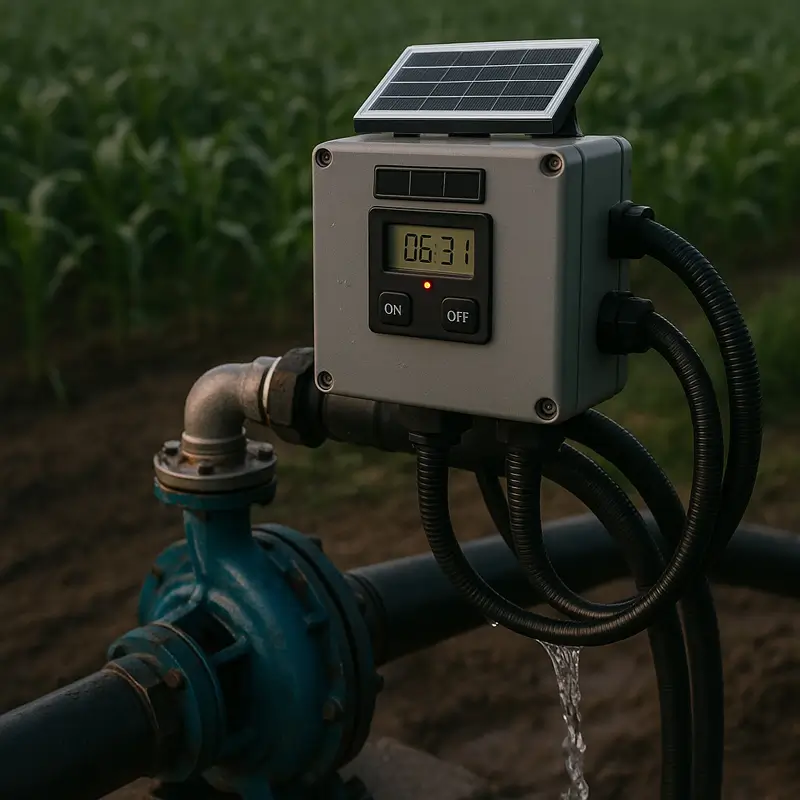
Smart Scheduling of Pumping and Irrigation Based on Real-Time Electricity Pricing
Pumping and irrigation are the beating heart of a farm, and every kilowatt-hour that enters this heart is directly converted into water, soil moisture, and ultimately crop performance. When electricity prices vary over the day, the time a pump is ON becomes as important as how long it is ON. This is exactly where smart scheduling begins: aligning irrigation programs and pump operation with price signals and grid conditions so that energy costs fall and stress on the grid during peak hours eases. In practice, this alignment happens in two ways: first through time-of-use tariff structures such as off-peak and peak periods, and second through demand response, which lets the farm automatically react to grid events or dynamic prices.
For the farmer, applying this idea means shifting part of the pumping from congested evening hours to off-peak nights or early mornings—without harming irrigation uniformity or the crop’s water needs. For the power system, it means smoother load peaks and better integration of renewables. What makes the difference is the quality of design and execution: correctly measuring the specific energy for pumping, understanding the system’s total dynamic head, and deploying controllers that respond to prices, event signals, and irrigation constraints. Every farm has its own pattern of soil, crop, water, and climate; therefore, the success of smart scheduling depends on local settings, real off-peak windows, and the availability of standard tools for controllable pumps.
Time-varying electricity tariffs have been implemented for years in many countries, and alongside them, industry standards for automated demand response have paved the way for safely connecting farms to price and event signals. International experience shows that when the price message is clear and the metering and control infrastructure is ready, a substantial share of agricultural pumping can be shifted from peak to off-peak hours. Those same experiences also warn that irrigation quality, distribution uniformity, and crop growth windows are red lines that any scheduling program must respect. Put simply, the cheaper hour is not always the best hour—unless it is carefully aligned with the plant’s water demand.
Concept, Rationale, and Mechanism
Smart pump scheduling relies on time-varying and dynamic pricing. In the simple case, off-peak, mid-peak, peak, and sometimes critical-peak periods are defined, with different energy prices—and even demand charges—in each period. In more advanced models, hourly or even 15-minute prices are sent to the consumer, and the controller can adjust the pumping plan according to reservoir level, soil-moisture status, and grid pressure. This mechanism is most effective when the system connects to price and event signals via open, proven protocols, and when the specific energy for pumping and irrigation uniformity are continuously monitored. Key outcome indicators include kilowatt-hours per cubic meter, the share of load shifted from peak to off-peak, and kilowatts reduced from the load peak. These same indicators form the basis for calculating economic and technical savings.
From a hydraulics perspective, the specific energy for pumping is a function of total dynamic head, overall efficiency, and flow rate. If overall efficiency is low, shifting pumping to off-peak merely changes the bill timing and delivers little real energy gain. Therefore, a successful program starts with pump testing and calibration, setting operating pressure for sprinkler and drip systems, and selecting the optimal speed using a variable-frequency drive. Such a foundation allows scheduling to be implemented on an efficient system—one whose real-time consumption is minimized to meet water needs in every hour. Once this groundwork exists, the price signal becomes a lever for cost optimization, not a cover for mechanical inefficiency.
The human and operational dimension is vital, too. Irrigation is not a purely technical decision; it is tied to the cropping calendar, water availability, withdrawal constraints, and even field terrain issues. Successful programs let the farmer encode farm priorities into the algorithm: upper and lower pressure limits, minimum reservoir level, night-time restrictions, and each crop’s sensitivity to cycling. These preferences are combined with prices, load forecasts, and even renewable generation forecasts to produce daily or weekly schedules. In this model, the human role shifts from manual operator to supervisor with the authority to intervene—emphasizing irrigation quality when needed, even if that means pumping during some higher-price hours.
Geography of Deployment and Measurable Outcomes
Up-to-date reports have reached consensus in several core areas: agriculture’s meaningful share of electricity use in some states and countries, the real capacity to shift pumping load to off-peak hours, and the impact of open standards on lowering implementation costs. Successful examples from North America to Europe, Africa, and East Asia each with different regulatory and pricing details converge on one conclusion: if the price signal is sufficient and irrigation quality is preserved, both the farm and the grid benefit. The differences lie mostly in how this balance is achieved from seasonal tariffs and opt-out peak exemptions to dynamic rates and advance-notice critical-peak events.
– Samuel Sandoval-Solis, Professor, University of California, Davis: “Time-based electricity rates often reduce demand charges during off-peak hours.”
– Daniele Zaccaria, Faculty, University of California, Davis: “Many farmers cannot limit pumping only to off-peak hours.”
– Bruce Nordman, Researcher, Lawrence Berkeley National Laboratory: “Time-varying rates exist; CPP, TOU, and more dynamic pricing.”
In North America, agricultural time-varying programs with defined peak and off-peak periods and in some cases critical-peak days are well established. Official data show that agricultural electricity use makes up a significant share of the load in some states, and pilots have recovered meaningful flexibility from agricultural pumping. In markets and networks with hourly or seasonal pricing, that flexibility is monetized for farmers as capacity value or direct energy cost reductions. In Europe, the right to dynamic contracts and diverse tariff patterns from France’s color-coded days to debates among Spanish irrigation communities about dual contracts and dual demand charges illustrate how to tune the balance among cost, flexibility, and water-delivery quality.
In China, recent reforms have raised peak-to-valley price ratios in systems with large load swings, creating a stronger signal for load shifting. At the same time, some provinces define explicit proportions for peak, off-peak, and critical-peak that help set favorable pumping windows. In South Africa, time-varying structures such as Ruraflex have been available to agriculture for years, and national studies emphasize that sound system design and scheduling of irrigation hours are the keys to lowering energy costs. The common thread across these examples is that price alone is not enough; hydraulic efficiency and standard control tools are the second pillar of success.
But it is not all economics. Irrigation quality is driven by pressure, flow, and distribution uniformity, and any cycling of pumps or shift in operating hours can affect these variables. Technical standards for the design, installation, and testing of irrigation systems and pumps have been developed precisely to mitigate such risks. When scheduling aligns with these standards, energy costs fall and the farm’s carbon footprint drops as well, because kilowatt-hours per cubic meter decline while off-peak network capacity is better utilized. This alignment of water, energy, and carbon is now one of the primary metrics for investors and financiers backing smart-agriculture projects.
– M. Venter, Researcher, South Africa Water Research Commission: “There are substantial opportunities to cut energy costs through proper design and operation.”
– B. Grove, WRC Research Associate: “The variable cost of electricity depends on pumping hours, kW demand, and the tariff structure.”
Mathematics of Water and Power on the Farm: From Total Dynamic Head to Price Signals
A numerical grasp of the specific energy for pumping is essential for any scheduling decision. The energy required to lift a unit volume of water depends on the total dynamic head and efficiency. If the system head is high or efficiency is low, each cubic meter demands more electricity and the benefit of shifting hours may shrink. Pump monitoring and testing let farmers and consultants compare real performance curves with nameplate data and select optimal operating points. When these data feed the controller, it can, for each price interval, choose an optimal combination of flow and pressure to preserve irrigation uniformity while lowering specific energy. In systems equipped with a variable-frequency drive, this optimization occurs smoothly and controllably by tuning motor speed and the pump’s operating point.
The economics are not simple either. A farm’s electricity bill is not just the sum of kilowatt-hours; demand components and sometimes critical-peak penalties also matter. In leading markets, agricultural tariffs typically include peak, mid-peak, and off-peak periods with different rates, and may activate event days with much higher prices. Therefore, scheduling software must account not only for energy, but also constraints on maximum demand during peaks and requirements on event days. Success is measured by reducing the average electricity cost per cubic meter pumped, cutting maximum demand during peak windows, and maintaining distribution uniformity at levels that protect yield. Balancing these aims calls for multi-objective algorithms that let the farmer weight preferences.
At the system level, industry standards for pump testing, micro-irrigation design, and device demand-response capability are the technical pillars of safe deployment. These standards ensure that any load-reduction or load-shifting command does not impose unauthorized pressures on pipes and emitters, and that pump start frequency does not rise to wear-inducing levels. Open communication protocols carry price and event signals and interoperate with a broader ecosystem of meters, gateways, and controllers. When these pieces fit together, scheduling becomes a stable, repeatable capability not a pilot that collapses with the first tariff change.
– Automated Demand Response: From Events to Prices
Demand response in agriculture becomes transformative when it moves beyond manual reactions to phone calls or texts and into structured signal exchange. Systems based on open protocols can receive load-reduction events, critical-peak notices, and even price messages, then adjust pumping automatically without human intervention. This shift is not just about convenience; it improves auditability, reporting, and operational safety, and it is essential for participation in load aggregation and capacity markets. In practice, the gateway or smart meter acts as a trusted intermediary between the grid operator and the pump controller recording events, authenticating them, and translating commands into the equipment’s native language.
Scheduling intelligence is complete when the algorithm can observe real-time price, load forecasts, wind and solar forecasts, and soil-moisture status simultaneously, refreshing the irrigation calendar without frequent user tweaks. If a reservoir is available, storage strategy enters the picture pumping some water in cheap hours and using it in expensive hours. Without a reservoir, flexibility is lower, but one can still shift part of the load by adjusting target pressure and flow. In both cases, data logging and learning from past periods help the algorithm decide better next season.
– Mary Ann Piette, Research Director, Lawrence Berkeley National Laboratory: “Without a price-based coordination mechanism, you must reject more load-addition requests or raise capacity costs.”
– I. van der Stoep, WRC Research Associate: “Irrigation scheduling directly shapes electricity cost; peak times are not always the best choice.”
Policy and Market Linkages: From the Right to Dynamic Contracts to Safe Off-Peak Windows
Leading regulatory frameworks have guaranteed consumers’ right to access dynamic-price contracts and, alongside that, imposed requirements to disclose risks and benefits. When this right is combined with widespread deployment of smart meters, it creates the infrastructure for farms to access hourly prices or event signals with minimal friction. In countries where peak-to-valley price differentials have risen meaningfully, the incentive to shift load is stronger, and system planners can count more confidently on agricultural participation. Experience across provinces also shows that defining short critical-peak periods with higher prices is an effective tool for rapid load alignment on stressed grid days.
Beyond contractual rights, evolving technical standards and demand-side planning guides play a complementary role. When connection to price and event signals is built on open protocols, farmers avoid lock-in to proprietary solutions and can benefit from competition among equipment and service vendors. Such an ecosystem also helps with project finance, since banks and funds are attentive to open standards and auditable reporting. Ultimately, local success hinges on tariff nuances: Is there a demand component during peaks? Are peak-exempt days defined for irrigation-critical periods? Do seasonal rates make the irrigation calendar more flexible? Clear answers to these questions turn scheduling from a slogan into a durable economic advantage.
– A member of an EU energy policy team: “Consumers must have real access to electricity contracts with dynamic pricing.”
– A demand-response standards researcher: “Open protocols enable safe, testable device connectivity.”
Iran-Focused: Tariff Realities, Infrastructure, and the Path to Localization
Tariff structures in Iran define off-peak, mid-peak, peak, and critical-peak periods, and for some agricultural uses provide incentives such as applying off-peak rates when consumption is avoided during peak hours. These nuances enable the design of scheduling programs—especially when farms have access to smart meters and programmable controllers. The key to load shifting is aligning the grid’s off-peak windows with the irrigation calendar and water constraints. Where storage reservoirs are available, a larger share of pumping can move to off-peak, easing stress on local networks during summer evenings. For greenhouses and constant-pressure systems, tuning target pressure and using variable-frequency drives can provide a controlled way to reduce peak demand.
Localization rests on two pillars: technical standardization and tariff incentives. Technically, relying on pump-testing and micro-irrigation design standards ensures irrigation quality and uniformity are not sacrificed for lower costs. On the communications side, using open protocols to receive event or price signals enables secure, scalable connectivity. On the incentive side, well-designed demand-response rewards, peak-exempt days, and smart refinement of demand charges can strengthen the economic signal. This mix is especially important in regions where subsidies weaken the peak-to-off-peak price differential. In such contexts, performance-based incentives tied to peak reduction are an effective motivator.
From an investment perspective, the equipment bundle includes smart metering and instrumentation, controllers compatible with open protocols, variable-frequency drives, pressure and moisture sensors, and scheduling software. Enablement programs can, through field trials, pump upgrades, and pressure calibration, materially reduce the specific energy for pumping—so that time-shifting savings sit on a more efficient base. For financing, savings-based contracts and pay-for-performance models (indexed to peak and energy reductions) can be developed with distribution companies and aggregators, provided that outcome metrics are independently verifiable.
– Practical Scenarios and Risks
A low-change scenario relies on awareness and use of existing off-peak periods; the impact on system peak is limited, but informed farmers can cut part of their costs. A mid-range scenario adds performance incentives and technical guidelines, creating a more visible reduction in local peaks while managing the risk to uniformity through standard-based requirements. An advanced scenario—featuring automated demand response, alignment with price signals, and pressure/flow optimization—delivers the greatest gains but requires upfront investment and close cooperation among farmers, utilities, and technology providers. Common risks include narrow irrigation windows for sensitive crops, wear from frequent cycling without proper protective equipment, and insufficient price signals. Insurance coverage and transparent technical service contracts can mitigate part of these risks.
Good governance for this transition includes national guidelines for agricultural demand response, defined performance indicators, pre-commissioning test procedures, and periodic reporting requirements. Alignment with international standards opens pathways for technology exports and foreign capital, and prevents lock-in to proprietary solutions. With this approach, the Iranian farm becomes not only a smart electricity consumer but also part of a broader flexibility system that improves renewable integration and strengthens the resilience of rural grids.
– A distribution planning expert: “Short critical-peak days are a rapid tool for balancing the grid during summer.”
– A pressurized-irrigation consultant: “Optimizing target pressure with a variable-frequency drive enables load shifting without harming uniformity.”
– An infrastructure finance specialist: “Pay-for-peak-reduction creates a tangible incentive to invest in controllers.”
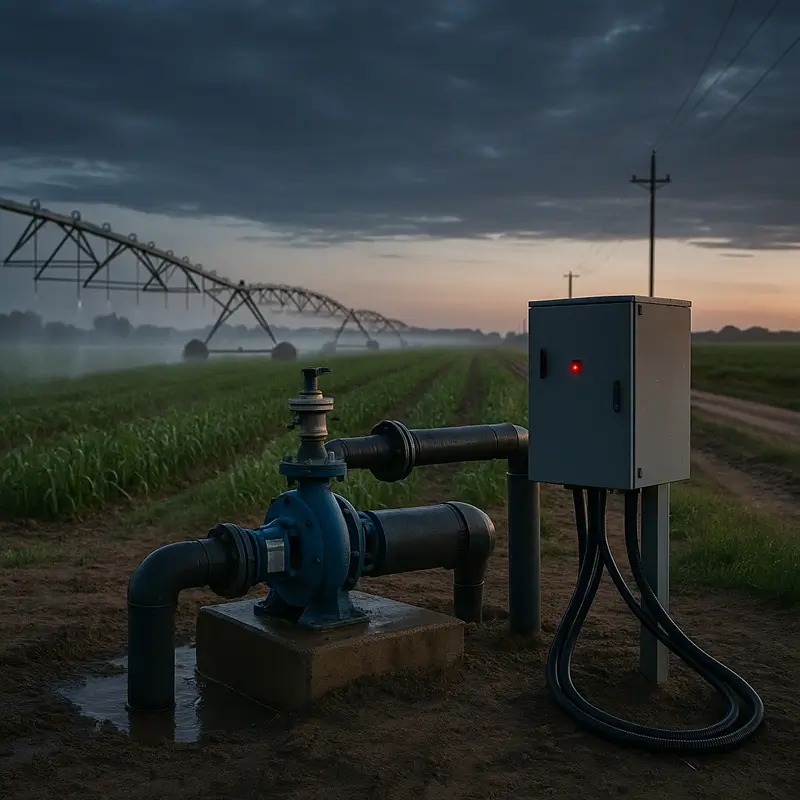
Practical Takeaways for Iranian Farms: From Pilot to Scale
A successful smart scheduling program starts with measurement. Continuous logging of specific energy for pumping, pressure, and flow across the season provides a clear picture of energy productivity. A standards-based pump acceptance test clarifies the roadmap for upgrades and maintenance and shows where changing pipe diameter or resetting the target pressure is cost-effective. Next comes alignment with price: set simple rules—such as prohibiting pumping during defined peak windows except under emergency—or define targets like the percentage of load shifted to off-peak. The scheduling software should translate these rules into daily plans and hold ready-to-run scenarios for critical events.
Economically, sensitivity analysis shows that even modest reductions in the specific energy for pumping materially amplify the savings from time shifting. This effect roughly doubles when demand charges exist during peak periods. A practical recommendation for farms without control gear is to start by installing accurate metering and a variable-frequency drive on large pumps; then connect to price/event feeds and run limited pilots for part of the season. In parallel, develop field procedures to protect irrigation uniformity and cap start frequency, thereby containing risks. After one season of data collection, decisions on scale-up and further investment are made on evidence.
For the value chain, this transition creates technological and financial opportunities: scheduling platforms, agricultural demand-response aggregators, pump testing and calibration services, and pay-for-performance models. Tying these components to open standards fosters a more competitive market for equipment and services and lowers total cost of ownership. The same linkage enables export of localized solutions to regional markets with similar tariff structures and network-flexibility needs. Ultimately, success at scale means turning time-smartness into an everyday farm routine—simple to grasp for the farmer, yet grounded in rigorous technical standards and the best global practices under the hood.
– Field Implementation Checklist
One: Measurement and testing. Record specific energy for pumping, pressure, and flow, and validate the pump’s performance curve. Two: Tariff alignment. Extract off-peak windows and critical-peak days and define farm rules. Three: Control tools. Acquire a variable-frequency drive and a controller compatible with open protocols, and connect them to the smart meter. Four: Irrigation quality. Check pressure and distribution uniformity under different scheduling scenarios and document allowable limits. Five: Pilot and review. Run the program for part of the season and generalize after data analysis. Six: Financing. Convert energy savings and peak reductions into pay-for-performance contracts. This path starts small, but with technical rigor and stakeholder alignment it can reach true scalability.